
Humid subtropical climate (Cfa and Cwa)
A warm-temperate climate with hot, humid summers and mild to cool winters; classified as Cfa or Cwa in the Köppen system and found in parts of East Asia, the Americas, Africa and Australia.
Overview
A humid subtropical climate describes regions with long, hot, and humid summers and winters that are generally mild to cool. In broad terms it is a warm-temperate climate with sufficient moisture for vegetation year-round or with a winter dry period. For a general introduction to climate categories see climate classification.
Image gallery
3 Images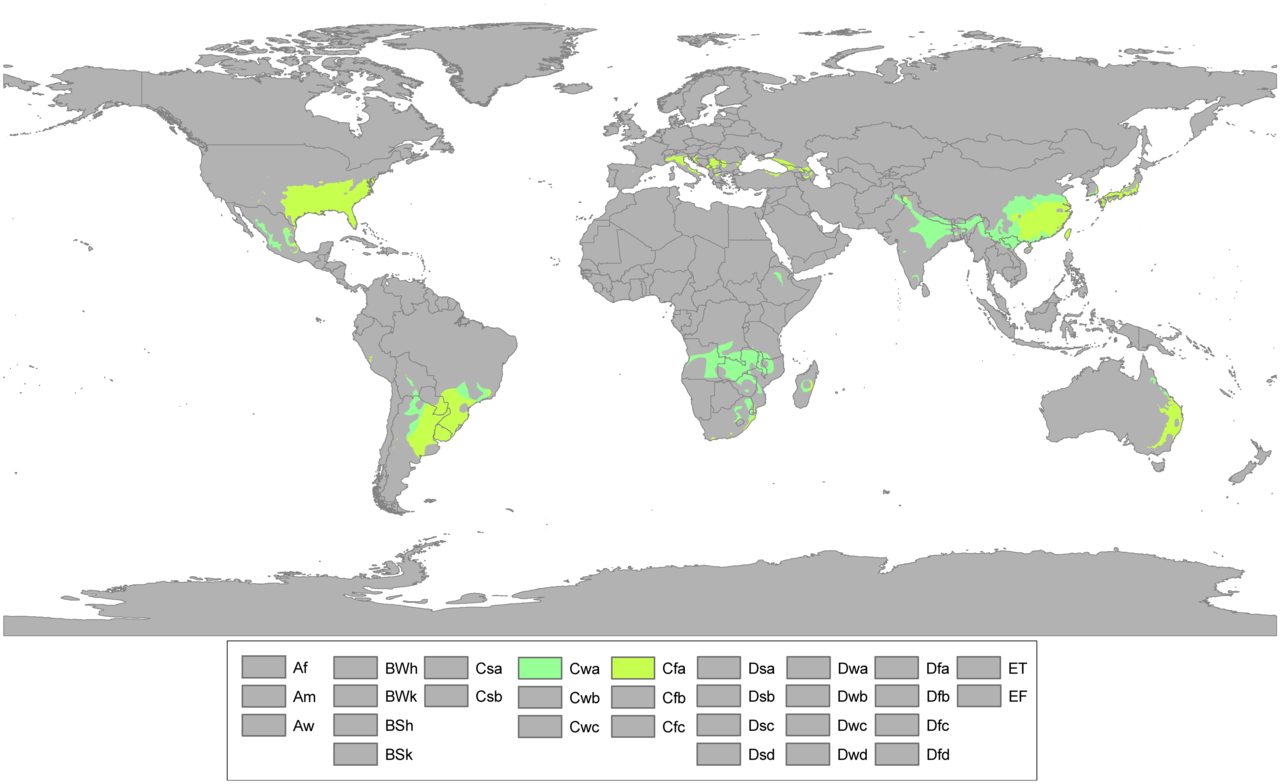


Classification and origin
Climatologists place humid subtropical zones in the warm temperate group of the Köppen classification. That system separates two main subtypes: Cfa, where precipitation is fairly evenly distributed through the year, and Cwa, where winters are relatively dry. These labels help differentiate regions with similar temperature regimes but different seasonal rainfall patterns.
Key characteristics
- Temperatures: Summers are typically hot and humid; winters range from mild to cool, seldom extremely cold.
- Precipitation: Many areas receive year-round rainfall, while some experience marked dry winters.
- Seasonality: Pronounced summer warmth and humidity, often with convective thunderstorms or monsoon influences.
Distribution and examples
Humid subtropical climates appear on several continents, usually on the eastern side of continents between about 20° and 40° latitude. Notable urban examples include Atlanta, Brisbane, Buenos Aires, Durban, Milan, Shanghai, and Tokyo, illustrating local variation in rainfall timing and intensity.
Historical and practical significance
This climate supports broadleaf forests, diverse agriculture (rice, cotton, citrus in various locales) and dense human settlement because of generally favorable growing seasons and year-round water availability. Urban planning, stormwater management and building design in these zones must account for heat, humidity and sometimes intense summer storms or tropical cyclones.
Distinctive facts and distinctions
Although humid subtropical areas share warm summers, they can differ markedly in winter precipitation and in the influence of monsoon or maritime systems. The Cfa/Cwa split highlights whether winters are dry; local topography, ocean currents and prevailing winds further modulate temperature and rainfall patterns.
Related articles
Author
AlegsaOnline.com Humid subtropical climate (Cfa and Cwa) Leandro Alegsa
URL: https://en.alegsaonline.com/art/45705