
Holy Name Cathedral (Chicago): history, role, and architectural overview
Holy Name Cathedral is the seat of the Roman Catholic Archdiocese of Chicago. Built after the Great Chicago Fire, it serves as the archbishop's parish and a focal point for major liturgies and civic ceremonies.
Overview
Holy Name Cathedral, formally the Cathedral of the Holy Name, is the central church and episcopal seat of the Roman Catholic Archdiocese of Chicago. As the archdiocese's cathedral and as the parish of the archbishop, it is a primary location for major liturgical celebrations, ordinations, funerals, and civic memorial services. The cathedral occupies a prominent place in Chicago's religious and civic life and is often referenced in discussions of the city's Catholic history. For official information see the Archdiocese of Chicago resources.
Image gallery
9 Images




History and origins
The current cathedral was built to replace earlier Catholic churches lost in the Great Chicago Fire of October 1871. The fire destroyed both the former cathedral and other parish buildings, prompting the archdiocese to plan and construct a new cathedral on a different site. The completed structure was dedicated on November 21, 1875, marking a rapid recovery and a reestablishment of the archdiocese's central house of worship. Historical context and diocesan records are summarized in archival materials and local histories; for broader diocesan context see diocese overviews and regional studies.
Architecture and interior
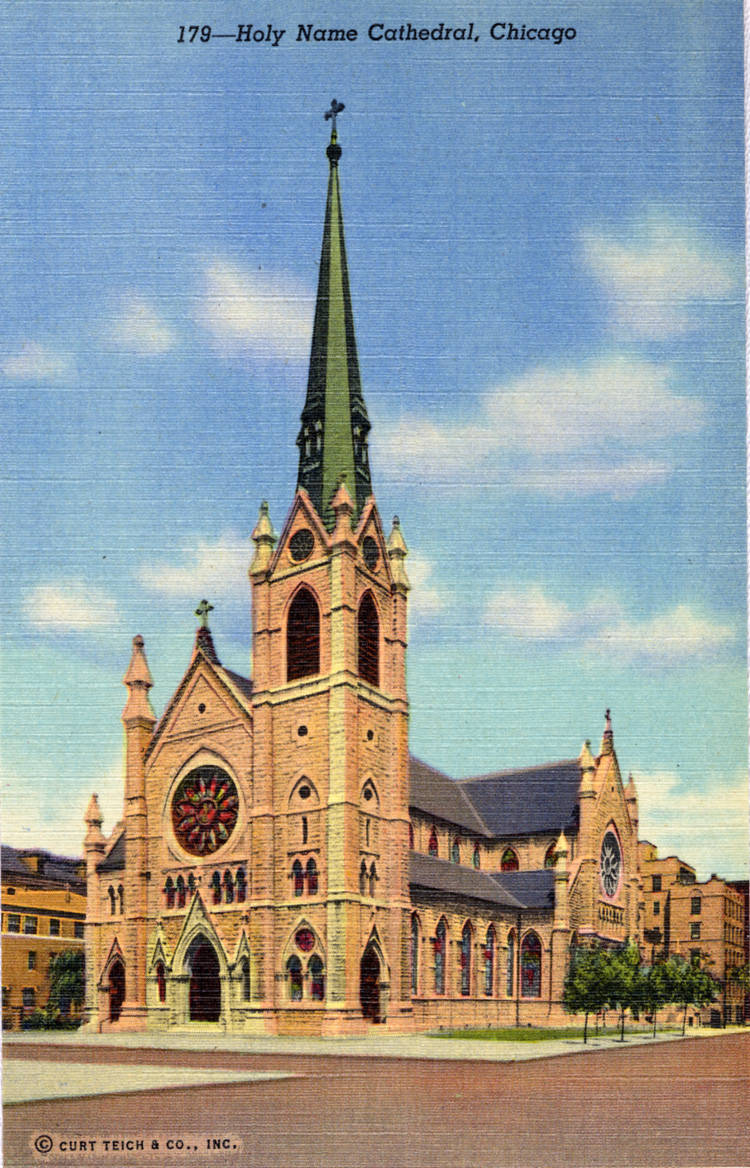
Holy Name Cathedral was built in a style reflective of late 19th-century ecclesiastical architecture, with features common to large urban cathedrals: a long nave, side aisles, a defined sanctuary, and traditional liturgical furnishings. The interior contains devotional areas, stained glass, and a high altar oriented for the cathedral's role in public worship. Over time the building has undergone maintenance and restorative work to preserve its fabric and adapt to liturgical developments. Visitors and researchers often consult published guides and photographic records for visual details; see parish and cultural guides at related resources.
Role, uses, and community importance
The cathedral functions on several levels:
- As the liturgical center of the archdiocese, hosting ordinations, chrism Masses, and archbishop-led celebrations.
- As a parish church serving a local congregation with regular Masses, sacraments, and pastoral ministry.
- As a civic and cultural venue for memorials, interfaith gatherings, and musical events that reflect the city's public life.
Its dual identity — both diocesan seat and neighborhood parish — gives Holy Name Cathedral a sustained role in Chicago's religious landscape. For accounts of particular events and civic connections consult archival summaries and local reporting, including sources linked at archival references.
Notable facts and distinctions
Because it replaced earlier churches destroyed in one of the city's defining disasters, the cathedral is often associated with Chicago's post-fire rebuilding and the resilience of its Catholic institutions. It remains a focal point for ceremonial life in the archdiocese and a regularly visited landmark for those studying the city's religious architecture and community history.
Related articles
Author
AlegsaOnline.com Holy Name Cathedral (Chicago): history, role, and architectural overview Leandro Alegsa
URL: https://en.alegsaonline.com/art/44826
Sources
- nrhp.focus.nps.gov : "National Register Information System"