
Grieskirchen District (Upper Austria)
Administrative district in Upper Austria's Hausruckviertel centered on the town of Grieskirchen. Rural and small‑industry economy, composed of 34 municipalities with agricultural plains and rolling hills.
Grieskirchen District is an administrative district in the state Upper Austria (Oberösterreich) in Austria. Its administrative centre is the town of Grieskirchen. The district combines small urban centres with predominantly rural territory and is part of the traditional Hausruckviertel region of Upper Austria.
Image gallery
1 Image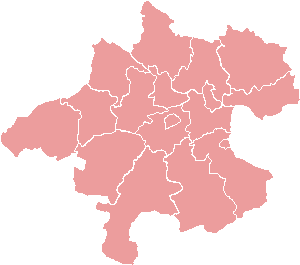
Geography and landscape
The district covers a mix of low hills, agricultural plains and scattered woodlands. The landscape is shaped by gently rolling terrain typical of the Hausruck hills and by a network of small streams and drainage valleys. Soils and local climate favour mixed farming, meadows and pastures, and many villages are set among fields and orchards.
History and administration
Modern district structures in the region date to administrative reforms of the 19th century that organized Austria into clearer subnational units. Today the district authority in the town of Grieskirchen oversees local services, coordination between municipalities and ties to the state government in Linz. Municipalities in the district have elected councils and mayors responsible for local planning and community services.
Economy and transport
The local economy is a blend of agriculture, food and wood processing, and a variety of small and medium enterprises. Many residents commute to larger nearby cities for work, supported by regional road links and rail connections that provide access to hubs such as Wels and Linz. Local businesses often focus on family‑run operations, regional supply chains and craft trades.
Municipalities and community life
Grieskirchen District comprises 34 municipalities, ranging from the central market town of Grieskirchen to small rural villages. Communities maintain a lively calendar of local fairs, cultural events and religious festivals; local churches, historic farmhouses and small museums reflect the district's rural heritage. Public services, schools and sports clubs are concentrated in the larger towns while village life remains oriented around agriculture and local associations.
As part of Upper Austria's Hausruckviertel, the district is often noted for its accessible countryside, a balanced mix of economic activity and traditional rural character. Visitors and residents alike find a landscape shaped by farming, small industry and community traditions rather than large metropolitan development.
Related articles
Author
AlegsaOnline.com Grieskirchen District (Upper Austria) Leandro Alegsa
URL: https://en.alegsaonline.com/art/40913