
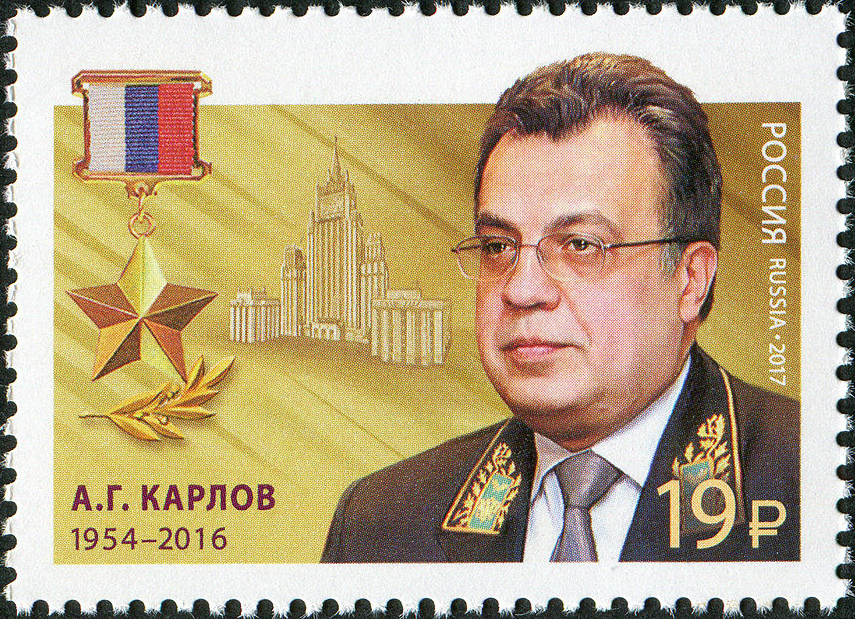
Andrei Karlov — Russian Ambassador to Turkey (1954–2016)
Andrei Karlov was a career Russian diplomat who served as ambassador to North Korea and later to Turkey; he was assassinated in Ankara in December 2016, an event that reverberated through international diplomacy.
Overview
Andrei Gennadyevich Karlov was a Russian career diplomat best known for his service as Ambassador to the Republic of Turkey from 2013 until his death in 2016. His full name in Russian is Андре́й Генна́дьевич Ка́рлов. Over several decades he represented his country in a range of foreign postings and senior diplomatic roles. Karlov's career spanned the late Soviet period and the Russian Federation era.
Image gallery
5 Images


Career and postings
Karlov held a number of positions within Russia's diplomatic service. He served as Russia's ambassador to North Korea from July 2001 to December 2006. Later he was appointed ambassador to Turkey on 12 July 2013, a post he occupied until his assassination. He was born in Moscow in 1954 and worked for many years within the foreign ministry and at Russian missions abroad, gaining experience on issues of bilateral relations and regional diplomacy.
Assassination
On 19 December 2016 Karlov was fatally shot in Ankara while attending a public event at an art exhibition. Reports indicate he was shot and killed by an assailant who subsequently died after being confronted by security forces. The attacker was identified as Mevlüt Mert Altıntaş; widely reported accounts say he was a young man with ties to Turkish law enforcement. During the attack the assailant made references to the conflict in Syria and the situation in Aleppo, which many observers interpreted as the apparent motive cited by the perpetrator at the scene.
Immediate impact and reactions
The assassination shocked diplomatic communities and prompted swift responses from both Russian and Turkish authorities. Russian leaders condemned the killing and called for a thorough investigation; Turkish authorities pledged cooperation and emphasized the protection of foreign diplomats. The incident briefly heightened tensions but also led to close coordination between the two governments on security and the investigation. International organizations reiterated the need to safeguard envoys under customary diplomatic protections.
Legacy and significance
Karlov's death underscored risks faced by diplomats in volatile contexts and during periods of regional conflict. It also became a focal point in discussions about diplomatic security, counterterrorism measures, and Russia–Turkey relations at a sensitive moment in Middle Eastern politics. He is remembered in press accounts and diplomatic obituaries as a long-serving envoy whose career ended in a high-profile attack that drew global attention.
Notable facts
- Karlov served as ambassador to two countries with complex regional roles: North Korea and Turkey.
- His assassination occurred in a public cultural venue in Ankara, highlighting concerns about security at open events.
- The episode provoked official statements and cooperation between Moscow and Ankara during the subsequent investigation.
For basic biographical details and timelines, follow official statements and reputable media summaries that document Karlov's diplomatic assignments and the circumstances of his death. Additional background on Russia's diplomatic service and protections for envoys can be found through foreign ministry resources and international law references (diplomatic materials).
Related articles
Author
AlegsaOnline.com Andrei Karlov — Russian Ambassador to Turkey (1954–2016) Leandro Alegsa
URL: https://en.alegsaonline.com/art/3985