
GN-z11 — an early, distant galaxy
GN-z11 is a high-redshift galaxy observed as it was in the very early universe. It was the most distant confirmed galaxy until 2022 and remains important for studies of cosmic dawn and galaxy formation.
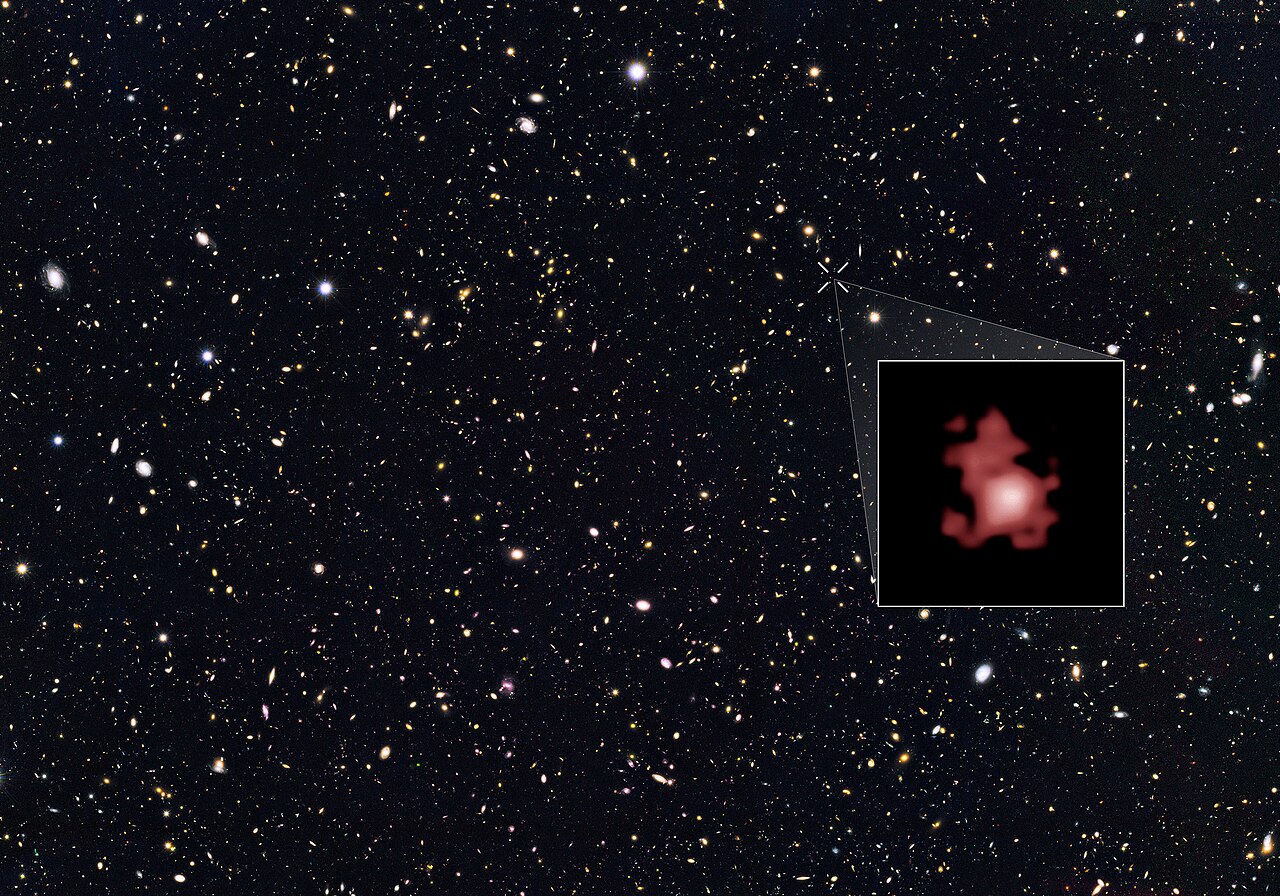
GN-z11 is a galaxy identified at very high redshift and observed as it appeared in the first few hundred million years after the Big Bang. It gained attention because observations placed it among the most distant objects then confirmed, offering a direct glimpse of galaxy formation in the early universe. Its study helps astronomers test models of how the first luminous systems grew and how the intergalactic medium became ionized.
Image gallery
5 Images


Key characteristics
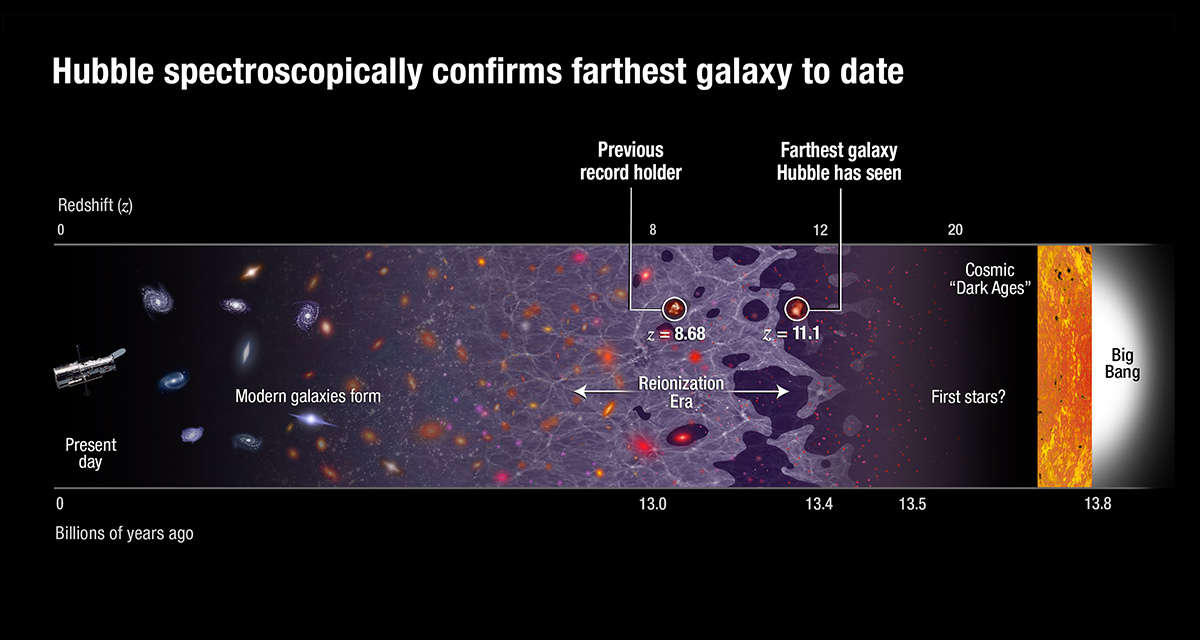
GN-z11 is compact and unusually bright for its epoch, with a spectrum showing a strong ultraviolet output produced by young, massive stars. Because it is observed at high redshift, the light we receive is stretched to longer, redder wavelengths. Measurements of its redshift indicate it is seen at an age when the universe was only a small fraction of its current size.
Discovery and confirmation
The object was identified in deep survey data and later confirmed through spectroscopic observations. The initial announcement relied on analyses of photometric and grism data from space- and ground-based facilities; more detailed follow-up reinforced its high-redshift interpretation. For the original report and technical details see the discovery references: discovery study.
Scientific importance
GN-z11 served as a milestone for observational cosmology. It provided evidence that substantial star formation and relatively massive stellar systems existed at very early times, constraining theories of how galaxies assembled and how quickly heavy elements and ionizing photons were produced. Studies of such objects inform our understanding of the epoch of reionization and the first generations of stars.
Observational challenges and later developments
Confirming and characterizing galaxies at extreme distances is difficult because their light is faint and redshifted into the infrared. Until new facilities obtained deeper infrared spectroscopy, GN-z11 was widely cited as the most distant confirmed galaxy; it remained notable as instruments continued to push detection limits and new candidates were reported after 2022. For summaries comparing records and later findings, see further discussion.
Notable facts
- GN-z11 illuminated how quickly structures could form after the Big Bang.
- Its brightness and compactness make it a useful case for testing high-redshift galaxy models.
- It highlights the need for sensitive infrared observations to study the early universe.
Related articles
Author
AlegsaOnline.com GN-z11 — an early, distant galaxy Leandro Alegsa
URL: https://en.alegsaonline.com/art/39311