
Great Attractor: a nearby gravitational concentration in the local universe
A large mass concentration in the nearby cosmos whose gravity produces coherent peculiar motions of galaxies; partly hidden by the Milky Way and studied with redshifts, X-rays and infrared surveys.
The Great Attractor is the informal name given to a region of space in the nearby universe that exerts a measurable gravitational pull on the Milky Way and many other galaxies. It was inferred from systematic deviations of galaxy velocities from the smooth expansion of the universe (the Hubble flow). Galaxies in our neighborhood show coherent peculiar velocities — additional speeds superimposed on cosmological recession — that point toward a common region of excess mass whose influence extends over hundreds of millions of light years.
Image gallery
5 Images
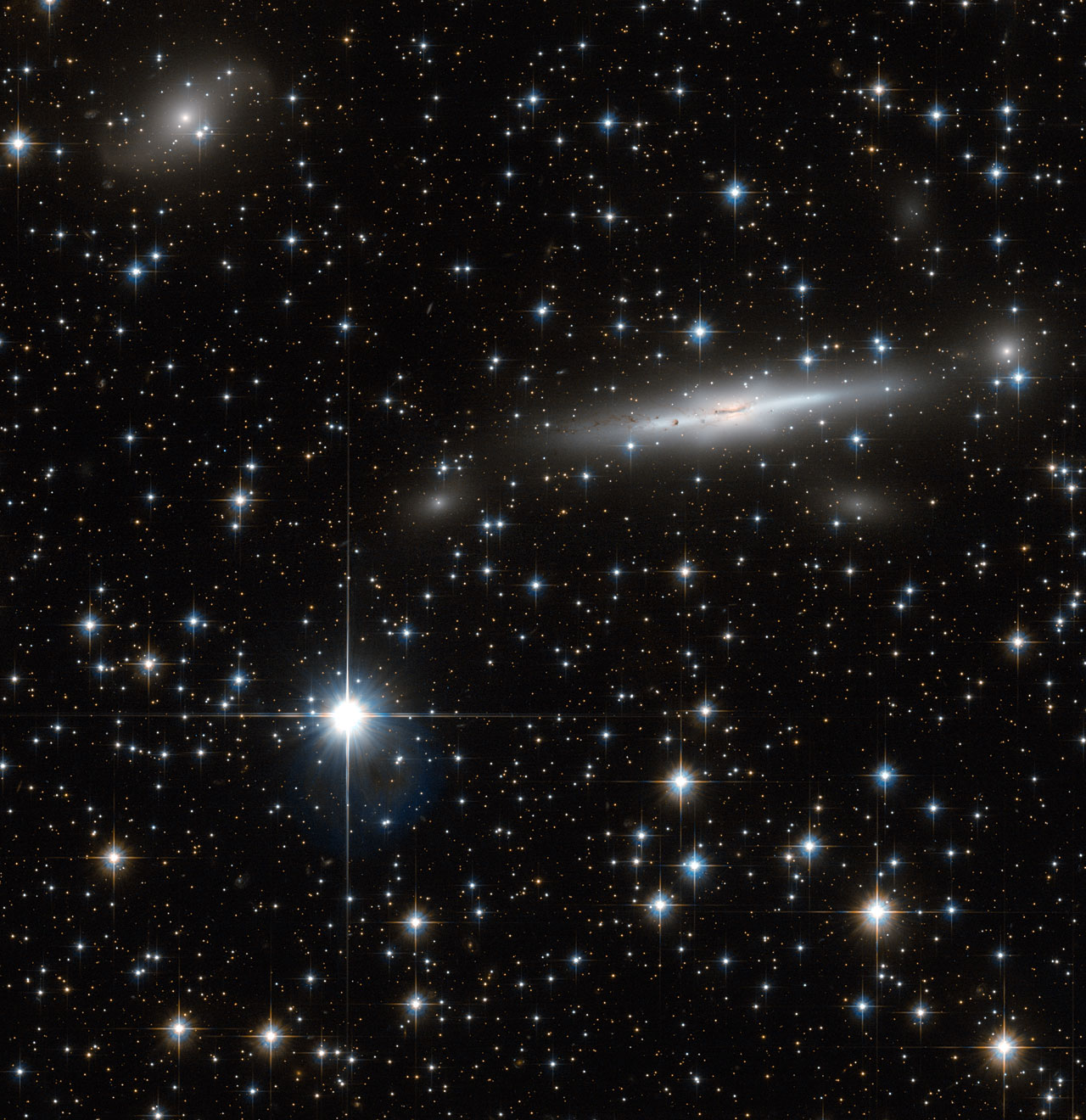



Location and observational challenges
The approximate direction of the Great Attractor lies in the general area of the constellations Centaurus and Norma. Much of the putative mass concentration sits close to the plane of the Milky Way, where interstellar dust and stars obscure optical observations; this obscured region is often called the "Zone of Avoidance." To overcome that obscuration, astronomers use X-ray, infrared and radio (21-cm) surveys, which can penetrate dust and reveal clusters of galaxies otherwise hidden in visible light. X-ray observations in particular have identified the Norma Cluster (Abell 3627) as a prominent mass concentration in the same general region.
How it was discovered and measured
Evidence for the Great Attractor emerged in the late 20th century from studies of galaxy redshifts combined with distance indicators. When the redshift-derived recession velocity of a galaxy is compared to an independent distance estimate, the difference reveals the galaxy's peculiar velocity. Mapping these peculiar velocities showed a systematic flow of galaxies toward a common area. This flow also contributes to the dipole anisotropy seen in the cosmic microwave background (CMB), which indicates that the Local Group is moving relative to the CMB rest frame. Measured peculiar velocities associated with the region can reach several hundred kilometers per second — variations of about ±700 km/s have been reported depending on position and method.
Nature, mass and broader context
Rather than a single compact object, the Great Attractor is best understood as a complex of galaxy clusters, groups and dark matter overdensity. Early descriptions estimated its mass as equivalent to tens of thousands of Milky Way galaxies, but exact totals remain uncertain because of observational limits and the contribution of structures behind it. Subsequent work has shown that some of the Local Group's motion is also influenced by more distant concentrations, notably the Shapley Supercluster beyond the Great Attractor region. Modern reconstructions of local cosmic flows place the Great Attractor within a larger basin of attraction, sometimes associated with the Laniakea Supercluster, which describes a broader region of convergent galaxy motions.
Methods and modern surveys
Techniques used to study the region include:
- Redshift surveys combined with independent distance indicators to map peculiar velocities and flow patterns.
- X-ray surveys to detect hot intracluster gas and identify massive clusters behind the Milky Way's dust.
- Infrared and radio observations that pierce the Zone of Avoidance and reveal obscured galaxies.
Ongoing and recent projects continue to refine the mass distribution and clarify how much of our Local Group's motion is caused by the Great Attractor versus more distant concentrations. For accessible summaries and data portals see Great Attractor studies and survey pages such as local flow and cluster catalogs.
Significance and open questions
The Great Attractor is important because it highlights how local structure perturbs the uniform expansion of the cosmos and provides a laboratory for studying large-scale structure, dark matter distribution and the dynamics of galaxy clusters. Key open questions include precise mass measurements, the detailed composition of the overdensity, and the relative contributions of nearer versus more distant superclusters to observed galaxy motions. As observational techniques improve, especially at wavelengths that penetrate galactic dust, the picture of this nearby gravitational anomaly continues to sharpen.
Questions and answers
Q: What is the Great Attractor?
A: The Great Attractor is a huge mass in space that is attracting the Milky Way and other galaxies towards it.
Q: What effect does the Great Attractor have on the movement of galaxies?
A: The Great Attractor affects the movement of galaxies across hundreds of millions of light years.
Q: What is the mass of the Great Attractor?
A: The mass of the Great Attractor is equivalent to the mass of tens of thousands of Milky Ways.
Q: Are all the galaxies in the Great Attractor redshifted?
A: Yes, all the galaxies in the Great Attractor are redshifted.
Q: Why are the galaxies in the Great Attractor receding relative to us and to each other?
A: The galaxies in the Great Attractor are receding relative to us and to each other due to the expansion of the Universe.
Q: Do the variations in redshift of galaxies show the existence of the Great Attractor?
A: Yes, the variations in redshift of galaxies show the existence of the Great Attractor.
Q: What is the range of variations in redshift of galaxies in relation to the Great Attractor?
A: The variations in redshift of galaxies in relation to the Great Attractor range from about +700 km/s to -700 km/s, depending on their position.
Related articles
Author
AlegsaOnline.com Great Attractor: a nearby gravitational concentration in the local universe Leandro Alegsa
URL: https://en.alegsaonline.com/art/40453