
Great Dark Spot (Neptune)
A transient dark vortex in Neptune's atmosphere discovered by Voyager 2 in 1989; unlike Jupiter's long-lived anticyclone, Neptune's dark spots form, change and vanish over years.
Overview
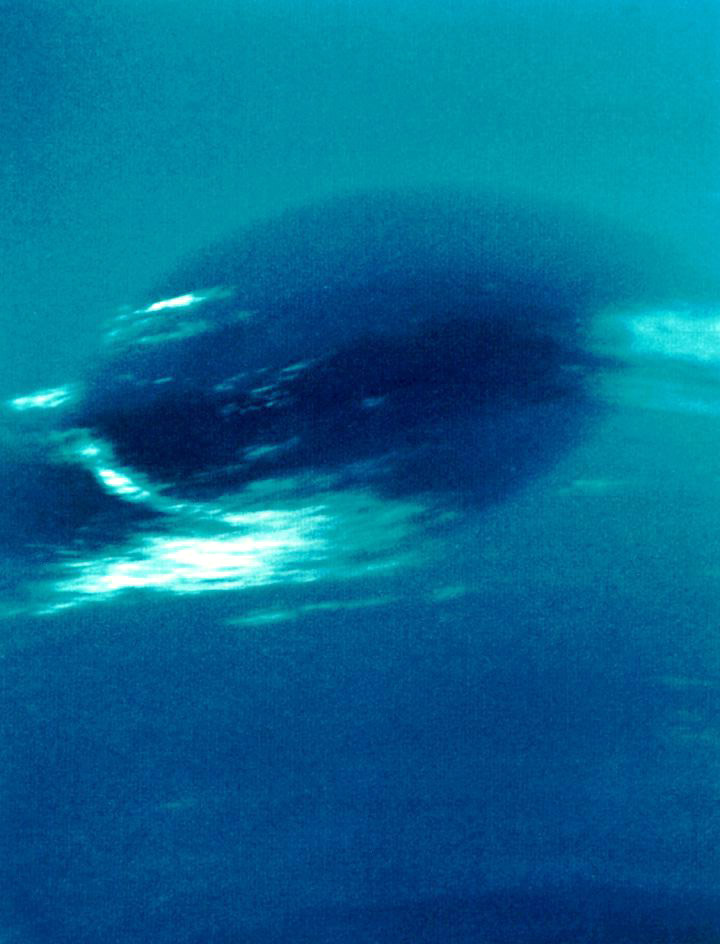
The Great Dark Spot (often abbreviated GDS and specifically GDS-89 for the 1989 feature) was a large, dark, oval disturbance in the upper atmosphere of Neptune first seen in images returned by the Voyager 2 spacecraft. At discovery it attracted attention because its shape and scale resembled Jupiter's famous Great Red Spot, but subsequent study showed important differences in origin, structure, and longevity. The label "dark spot" refers to a contrast feature in visible and near-infrared images rather than a solid surface mark.
Image gallery
8 Images




Characteristics and structure
Dark spots on Neptune appear as deep, roughly oval regions darker than surrounding cloud decks. They are associated with strong zonal winds and localized vortices; observations suggest they behave like high-pressure, anticyclonic systems in a fast, cold atmosphere. The interior of a dark spot is often relatively free of high-altitude clouds, producing the dark appearance, while bright methane-ice clouds commonly form near the edges where air is forced upward. Neptune's upper atmosphere, rich in hydrogen, helium and methane, and driven by internal heat, supports wind speeds among the fastest in the Solar System, which influence the evolution of these vortices.
Discovery and subsequent observations
The original Great Dark Spot was photographed during the 1989 flyby by NASA's Voyager 2, providing the first close views of Neptune's weather systems. Follow-up imaging with the Hubble Space Telescope and ground-based telescopes showed that the particular 1989 spot had disappeared within a few years and that new dark spots can form in other locations. This transient behavior distinguishes Neptune's spots from Jupiter's persistent anticyclone, which has been tracked for centuries.
How they form and why they vanish
Scientists interpret dark spots as vortices—regions of spinning fluid that alter local cloud structure. In the cores of these vortices air tends to descend, suppressing the high reflectivity methane clouds and producing a darker appearance, a process sometimes described metaphorically as a "hole" in the cloud deck. The disappearance of a spot may result from interaction with other atmospheric waves, changes in wind shear, or instabilities that break the vortex apart. Unlike the ozone "hole" in Earth's stratosphere, Neptune's features are dynamical weather phenomena rather than chemical depletion zones; compare the two only as analogies in appearance rather than mechanism (Earth, ozone).
Scientific importance and comparisons
Dark spots provide windows into the three-dimensional circulation and energy transport of an ice giant's atmosphere. By comparing them with vortices on Jupiter and Saturn, researchers probe how planetary rotation rate, internal heat, composition, and solar input shape atmospheric dynamics. Studies of these features help constrain models of wind fields, vertical motion, cloud microphysics, and how transient weather operates on planets with very different conditions from Earth. For context, readers can consult materials on anticyclonic storms and gas-giant meteorology (anticyclonic storm).
Notable facts
- The 1989 Great Dark Spot was comparable in scale to terrestrial-sized storms and displayed companion bright clouds near its edges.
- Hubble observations after the Voyager flyby found other dark spots forming and disappearing, demonstrating that Neptune's spots are often short-lived on human timescales.
- Although visually analogous to Jupiter's Great Red Spot at discovery, Neptune's dark vortices are more transient and are shaped by different atmospheric conditions.
For more imagery and mission details consult resources from the Voyager era and later space-based monitoring programs; these provide the primary observational record of Neptune's changing appearance and the study of its atmospheric vortices.
Jupiter's Great Red Spot | NASA | Voyager 2 | Anticyclonic storm | Earth | Ozone layer | Hubble Space Telescope
Questions and answers
Q: What is the Great Dark Spot on Neptune?
A: The Great Dark Spot is a dark spot on Neptune that is similar in appearance to Jupiter's Great Red Spot.
Q: When was the Great Dark Spot discovered?
A: The Great Dark Spot was discovered in 1989 by NASA's Voyager 2 probe.
Q: Is the Great Dark Spot on Neptune similar in appearance to Jupiter's spot?
A: Yes, the Great Dark Spot on Neptune is similar in appearance to Jupiter's Great Red Spot.
Q: What is believed to be the Great Dark Spot on Neptune?
A: It is believed that the Great Dark Spot on Neptune is an atmospheric hole similar to the hole in Earth's ozone layer.
Q: Are the insides of Great Dark Spots mostly cloud-free?
A: Yes, the insides of Great Dark Spots are mostly cloud-free.
Q: How long do Great Dark Spots on Neptune last?
A: The lifetimes of Great Dark Spots on Neptune appear to be much shorter than Jupiter's spot, forming and disappearing once every few years or so.
Q: How often does Neptune appear to spend with a Great Dark Spot?
A: Based on pictures taken by Voyager and since then with the Hubble Space Telescope, Neptune appears to spend a little bit more than half its time with a Great Dark Spot.
Related articles
Author
AlegsaOnline.com Great Dark Spot (Neptune) Leandro Alegsa
URL: https://en.alegsaonline.com/art/40488
Sources
- doi.org : 10.1126/science.268.5218.1740
- pubmed.ncbi.nlm.nih.gov : 17834994
- lpl.arizona.edu : "EPIC Simulations of Bright Companions to Neptune's Great Dark Spots"
- doi.org : 10.1006/icar.1998.5918
- cips.berkeley.edu : "The altitude of Neptune cloud features from high-spatial-resolution near-infrared spectra"
- doi.org : 10.1016/j.icarus.2003.07.006
- adsabs.harvard.edu : "Cloud Structures on Neptune Observed with Keck Telescope Adaptive Optics"
- doi.org : 10.1086/344943
- adsabs.harvard.edu : "The unusual dynamics of new dark spots on Neptune"
- solarviews.com : Neptune