
Getting Better (Beatles song)
A Beatles song credited to Lennon–McCartney, mainly McCartney’s idea, recorded for the 1967 album Sgt. Pepper’s Lonely Hearts Club Band; notable for its upbeat sound and contrasting lyrical elements.
Overview
"Getting Better" is a track from the Beatles' influential 1967 album Sgt. Pepper's Lonely Hearts Club Band. It is credited to the songwriting partnership of Paul McCartney and John Lennon, with the central musical idea originating with McCartney. The song appears as part of the album’s sequence rather than being released as a standalone single, and it reflects the group’s move toward studio-focused, album-length statements during the mid-1960s.
Image gallery
1 Image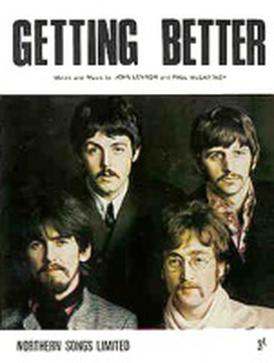
Musical characteristics
The music pairs an upbeat, optimistic chorus with rhythmic drive and close vocal harmonies. Instrumentation combines rock-band elements — electric guitars, bass and drums — with keyboards and layered studio overdubs. Production emphasizes clarity of the vocal refrain and a quietly propulsive groove that supports repeated melodic hooks.
Lyrics and themes
On the surface the chorus asserts improvement and reassurance, but the verses introduce more conflicted material. One verse contains a frank admission of past mistreatment of a partner that was later discussed by band members in interviews, and the juxtaposition of cheerfulness with darker lines has been a focus of critical commentary. The song therefore balances simple, memorable refrains with moments of candid introspection.
Recording and production
Recorded during the sessions for the Sgt. Pepper album, the track benefited from meticulous studio work typical of the Beatles at that time, including multi-tracking and careful blending of instrumental and vocal parts under the oversight of producer George Martin. The arrangement and textures reflect the band’s expanded palette as they moved away from the live-performance format toward more crafted studio recordings.
Release, reception and legacy
As part of a landmark album, the song reached a wide audience and was discussed in the context of Sgt. Pepper’s artistic ambition. Though not issued as a single, it has been noted by critics and scholars as a strong example of the band’s late-1960s pop craftsmanship and has been included on various compilations and tribute recordings. It has also been covered by other performers who recognize its melodic strengths.
Notable facts and distinctions
- The writing credit follows the long-standing Lennon–McCartney convention, while McCartney supplied the principal musical idea.
- The song illustrates the Beatles’ transition to studio-centered composition and production techniques.
- Its mix of sunny chorus and complicated verse material has made it the subject of commentary about tone and authorship within the band’s catalogue.
For further context on the songwriters and the band, see profiles of Paul McCartney, John Lennon, and the Beatles, and consult sources on the album Sgt. Pepper's Lonely Hearts Club Band.
Related articles
Author
AlegsaOnline.com Getting Better (Beatles song) Leandro Alegsa
URL: https://en.alegsaonline.com/art/38586