
General semantics
A 20th-century intellectual movement about how language and mental abstraction shape human reactions and knowledge, founded by Alfred Korzybski with practical techniques for clearer thinking and communication.
General semantics is an interdisciplinary approach to how people create meaning, make judgments, and respond to events through language and mental processes. Rather than treating words as identical to things, it emphasizes that our descriptions, labels, and mental models are abstractions that can never fully capture reality. For a concise introduction see an overview.
Image gallery
1 Image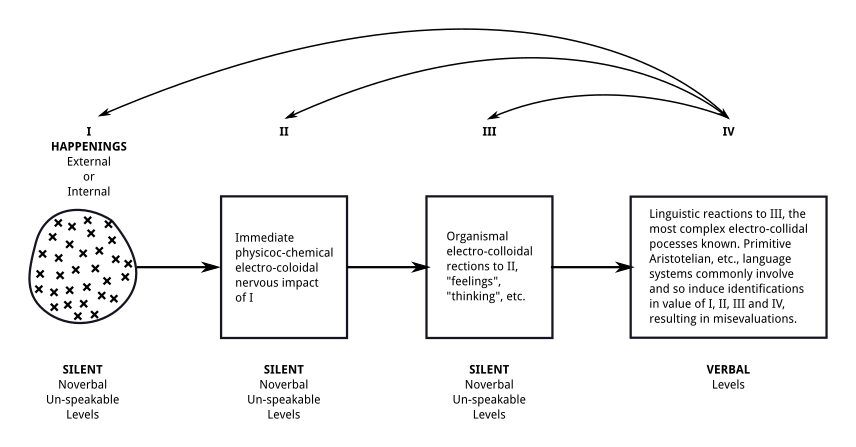
Origins and development
The system was developed in the early 20th century by Alfred Korzybski, who published his major work, Science and Sanity, in 1933 and later helped organize the Institute of General Semantics in 1938. Korzybski drew on contemporary science, mathematics and linguistics to propose an explicitly non-Aristotelian framework that challenges simple identity statements. Biographical and historical context can be found via background and detailed timelines at further resources.
Key concepts
- Map–territory distinction: a central aphorism that a representation (map) is not the reality it represents (territory).
- Abstraction hierarchy: every statement is an abstraction from a complex set of events; higher abstractions omit details of lower levels.
- Non‑identity and non‑allness: words are not identical to objects, and no statement captures all aspects of a situation.
- Time‑binding: the human ability to accumulate and transmit knowledge across generations.
Those ideas lead to practical suggestions for avoiding confusion: treating descriptions as provisional, distinguishing observation from evaluation, and recognizing how assumptions shape perception. Introductory materials and contemporary summaries may be consulted at mental models and discussions of language use at language and cognition.
Practices inspired by general semantics include the use of extensional devices—indexing (e.g., adding identifiers to terms), dating statements to show change over time, and careful operational descriptions—to reduce reactivity and categorical thinking. Some later movements and techniques, such as E‑Prime (avoiding the verb "to be"), draw on Korzybski's emphasis on precise description; additional applied examples are listed at applications.
Reception has been mixed: proponents value its clear checks against overgeneralization and its influence on education, psychotherapy, communication theory, and media literacy; critics question empirical claims and the movement's scientific framing. Nevertheless, many of its practical recommendations—such as separating facts from inferences and revising assumptions in light of new evidence—remain widely used in critical thinking and counseling contexts.
Related articles
Author
AlegsaOnline.com General semantics Leandro Alegsa
URL: https://en.alegsaonline.com/art/37964