
Gandhi (1982 film)
1982 biographical drama directed by Richard Attenborough about Mohandas K. Gandhi, starring Ben Kingsley. Production, reception, awards and legacy of the internationally acclaimed film.
Gandhi is a 1982 biographical drama that dramatizes the life of Mohandas K. Gandhi and his role in India’s independence movement. The film was conceived and directed by Richard Attenborough and presents a broad, chronological portrait of Gandhi’s life from his early years in South Africa to his leadership of nonviolent resistance in India. It stars Ben Kingsley in the title role and aims to balance public events, political struggles, and personal conviction in a cinematic format.
Image gallery
1 Image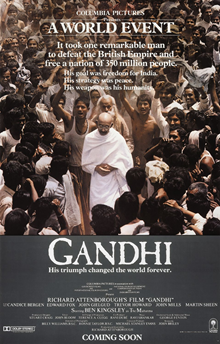
Production and principal contributors
The screenplay was written by John Briley and shaped through collaboration with the director and historical advisers; the film’s musical score was composed by Ravi Shankar, and the cinematography was led by Billy Williams. Attenborough produced the picture with a relatively modest budget and sought to recreate large historical scenes—processions, marches and public gatherings—while retaining a focus on Gandhi’s philosophy and tactics. Information on writing and production choices is frequently discussed under entries for screenplay and film development.
Cast and characters
The film features an international ensemble supporting the lead. Principal cast members included:
- Ben Kingsley as Mohandas K. Gandhi
- John Mills
- John Gielgud
- Trevor Howard
- Daniel Day-Lewis in an early film role
- Richard Griffiths
- Martin Sheen
- Nigel Hawthorne
- Shane Rimmer
- Athol Fugard
- John Ratzenberger
- Bernard Hill
- Shriram Lagoo
- Terrence Hardiman
- Tom Alter
- Om Puri
- Alyque Padamsee
Historical depiction and themes
The film traces Gandhi’s development as a political and moral leader, showing key campaigns such as civil disobedience, the Salt March, and the negotiations that led to Indian independence. It emphasizes nonviolent resistance (ahimsa), the ethics of leadership, and the tensions between colonial power and nationalist movements. As with many historical dramas, filmmakers condensed events and combined characters for narrative clarity; historians and critics have both praised the film’s sweep and noted simplifications and selective emphasis in its treatment of complex historical events.
Release, box office and awards
Release dates placed the picture in late 1982 in multiple territories. With a modest production budget, the film achieved notable commercial success and sustained international interest; sources cite a box office return that far exceeded its costs. The movie received widespread critical acclaim and recognition during awards season: it earned multiple nominations at major ceremonies and won several top honors, including multiple Academy Awards. It also received major awards such as the Golden Globe and the BAFTA, confirming its impact on both sides of the Atlantic.
Legacy and significance
Gandhi remains an influential portrayal of a 20th-century political figure in mainstream cinema. It introduced wider international audiences to Gandhi’s life and methods and helped stimulate debate about filmic representation of history, colonialism, and nonviolent protest. The movie is frequently referenced in discussions of biographical filmmaking, historical scale in cinema, and the responsibilities filmmakers face when dramatizing real events. For further reading and archival materials see entries and resources listed under Gandhi (film) and the other production and award links above.
Related articles
Author
AlegsaOnline.com Gandhi (1982 film) Leandro Alegsa
URL: https://en.alegsaonline.com/art/37449