
Frank Fenner: Australian virologist and environmental scientist
Biography of Frank Fenner (1914–2010), his work on smallpox eradication, the myxoma virus used against rabbits, academic leadership at ANU, and contributions to virology and environmental studies.
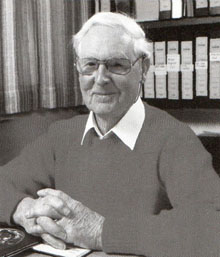
Frank John Fenner (21 December 1914 – 22 November 2010) was an Australian scientist whose career bridged clinical medicine, virology and environmental studies. He is best known for two major contributions: leadership in the global effort that certified the eradication of smallpox, and research on the myxoma virus used in the biological control of invasive rabbits in Australia. Fenner's work combined laboratory investigation, field observation and public health action, and his influence extended through teaching and institutional leadership.
Image gallery
2 Images
Early life, education and wartime service
Fenner was born in Ballarat, Victoria, and trained in medicine at the University of Adelaide, graduating before the Second World War. He completed advanced study and research that culminated in a Doctor of Medicine degree in the early 1940s. During World War II he served with the Australian Army as a medical officer, where his clinical and research interests turned toward parasitology and tropical infectious diseases. In that period he studied the parasite responsible for human malaria (Plasmodium spp. and related transmission questions), an experience that strengthened his skills in both laboratory and field epidemiology.
Research in virology and biological control
After the war Fenner joined the Walter and Eliza Hall Institute of Medical Research in Melbourne, where he conducted studies on poxviruses and allied agents that affect humans and animals. His work on human smallpox contributed to the scientific foundation for eradication efforts and is frequently associated with broader public health campaigns against the disease (smallpox research). Fenner also played a central role in investigating the myxoma virus, a poxvirus that was deliberately introduced into Australia to reduce populations of the invasive European rabbit. His careful field studies documented how virulence, host susceptibility and ecological factors shaped the dramatic but evolving impact of the virus on rabbit numbers.
Academic leadership and the ANU years
In 1949 Fenner was appointed the inaugural professor of microbiology at the newly established Australian National University department of microbiology, where he helped build research programs and train a generation of scientists. He subsequently became Director of the John Curtin School of Medical Research and later led the ANU's Centre for Resource and Environmental Studies. Based in Canberra, his roles combined laboratory science with broader concerns about ecology and resources, reflecting an interest in how infectious agents interact with human activity and the environment.
Smallpox eradication and international work
Fenner chaired the Global Commission for the Certification of Smallpox Eradication and was a key scientific authority during the final stages of the campaign. The commission's work verified the absence of naturally occurring smallpox and supported the World Health Organization's declaration that eradication had been achieved. Fenner's combination of virological expertise, practical field knowledge and institutional credibility helped bridge laboratory science and international public health policy.
Legacy, influence and notable facts
Beyond particular discoveries, Fenner is remembered for an interdisciplinary approach that linked medicine, virology and environmental science. His myxoma studies are a classic example of applied virology influencing agricultural and ecological outcomes, while his role in the smallpox campaign remains a model for coordinated global disease control. In later years he spoke publicly about human impacts on ecosystems and the importance of scientific perspectives in public policy. Fenner received widespread recognition during his life and continued to influence students and colleagues through the institutions he helped shape, including his long association with the Australian National University and earlier work at the Walter and Eliza Hall Institute.
Selected themes and distinctions
- Interdisciplinary practice: combined clinical training, laboratory virology and ecological fieldwork.
- Applied virology: instrumental in demonstrating how a virus could be used in population control of an invasive species.
- Public-health leadership: chaired the panel that certified smallpox eradication and advised international efforts.
- Academic institution builder: first professor of microbiology at ANU and later director of major research centres.
Fenner's career illustrates how careful scientific observation, responsible application and institutional engagement can produce outcomes ranging from the control of an ecological pest to the complete elimination of a human disease. For further reading on aspects of his life and work consult institutional histories and biographical profiles available from scientific archives and national research organizations.
Further reading on malaria research | World War II medical service | Smallpox eradication | Fenner's medical doctorate
Walter and Eliza Hall Institute | Microbiology at ANU | ANU | Canberra
Related articles
Author
AlegsaOnline.com Frank Fenner: Australian virologist and environmental scientist Leandro Alegsa
URL: https://en.alegsaonline.com/art/36161
Sources
- jcsmr.anu.edu.au : "ANU - The John Curtin School of Medical Research - JCSMR"
- theaustralian.com.au : "Frank Fenner, who eradicated smallpox and ended rabbit plague, dead at 95"
- aussmc.org : "RAPID ROUNDUP: Australian scientists pay tribute to Frank Fenner"
- jcsmr.anu.edu.au : "ANU - The John Curtin School of Medical Research - JCSMR"
- jcsmr.anu.edu.au : "ANU - The John Curtin School of Medical Research - JCSMR"