
Foucault pendulum
A large pendulum used to demonstrate Earth’s rotation by showing the steady precession of its swing plane; first exhibited by Léon Foucault in 1851 and now common in museums and universities.
The Foucault pendulum is a simple mechanical device that makes Earth’s rotation visible by the gradual change in the orientation of a pendulum’s swing plane. Named after the French physicist Léon Foucault, the experiment provides a direct, intuitive demonstration that the ground under the pendulum is turning relative to inertial space.
Image gallery
7 Images

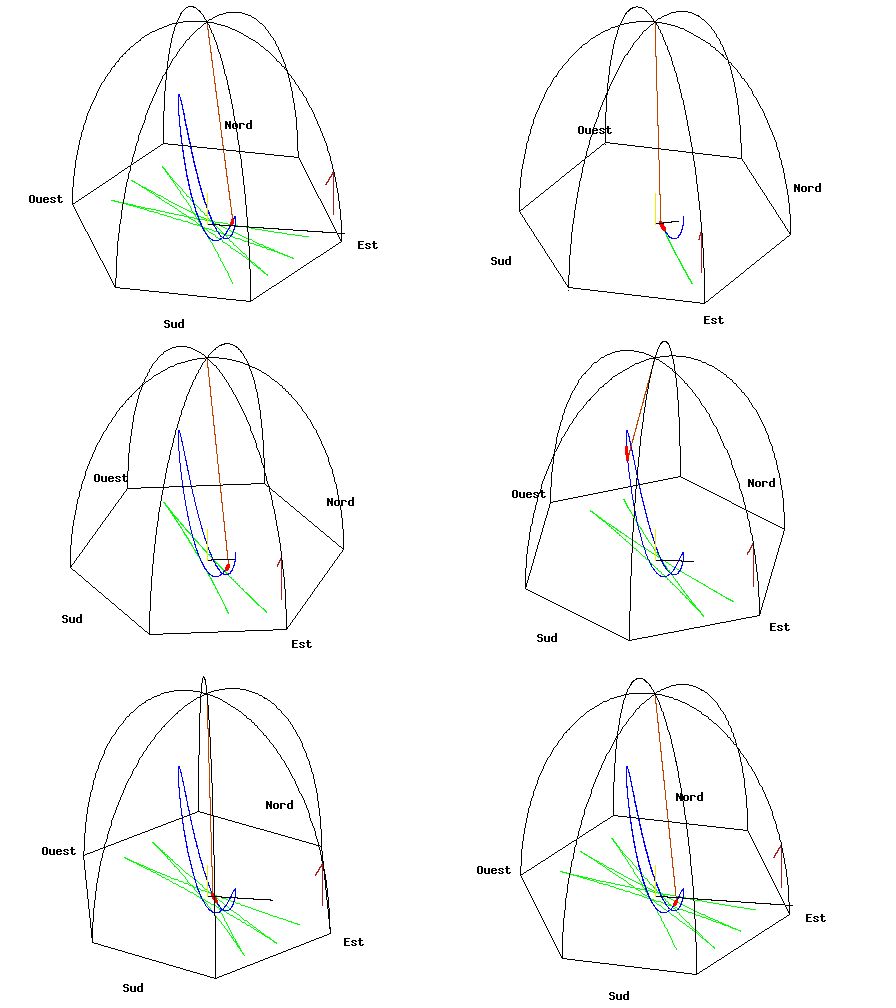


How it works and main components
A Foucault pendulum consists of a heavy bob suspended on a long, nearly frictionless suspension so the mass can swing for many hours. The observable effect is not caused by any force on the bob but by the rotation of the supporting platform beneath it. Key components include:
- a long, rigid suspension cable or rod;
- a dense, streamlined bob to reduce air drag;
- a low-friction pivot or bearing to allow free precession;
- an anchoring point and often a damping or locking mechanism for setup and maintenance.
History and first demonstration
Jean Bernard Léon Foucault presented the most famous demonstration in 1851 at the Panthéon in Paris. That public experiment followed theoretical work and smaller demonstrations; Foucault’s arrangement made the effect unmistakable to observers and brought immediate public attention to the idea that rotation of the Earth could be evidenced in a laboratory-scale experiment.
Uses, examples and significance
Foucault pendulums are installed in science museums, universities, and public buildings as educational exhibits. They serve to illustrate rotating frames of reference, the Coriolis effect, and basic experimental design principles such as minimizing friction and isolating a system from external torques. Many large installations include marked floors or rotating indicators to show the rate of precession.
Notable facts and variations
- The apparent rate of rotation of the swing plane depends on latitude: at the poles the plane completes a full rotation in one sidereal day, while at the equator there is no net precession.
- Small laboratory versions exist, but longer cables and heavier bobs produce clearer results by reducing disturbance from air resistance and building vibrations.
- A technical discussion of pendulum behavior and limiting factors can be found in treatments of simple harmonic motion and rotating reference frames; see a general entry on pendulums for background.
Related articles
Author
AlegsaOnline.com Foucault pendulum Leandro Alegsa
URL: https://en.alegsaonline.com/art/35848