
Fornax (constellation)
Fornax is a faint southern constellation introduced in the 18th century. It contains several notable galaxies and a dwarf satellite of the Milky Way and is best known among astronomers for the Fornax Cluster.
Overview
Fornax is a minor constellation of the southern celestial hemisphere whose name means "the furnace" in Latin. It is relatively dim compared with many classical constellations and contains few bright stars, but it is important in extragalactic astronomy because it hosts a nearby group and several notable galaxies.
Image gallery
7 Images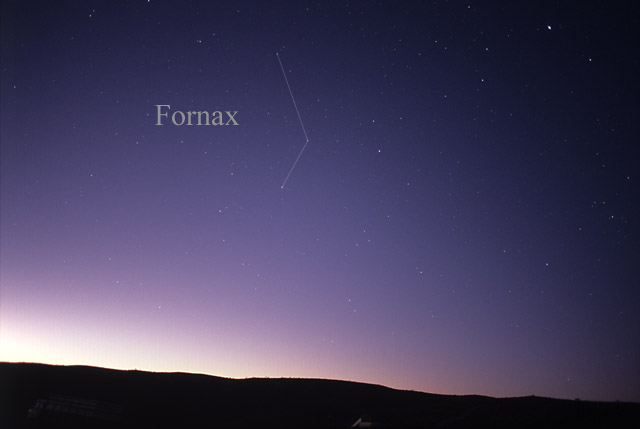





Location and main stars
Positioned south of the celestial equator, Fornax lies amid other southern constellations and is visible mainly to observers in the southern hemisphere and low northern latitudes. The brightest star is Alpha Fornacis, a multiple-star system; the remainder of the stellar pattern is composed of faint to moderate stars rather than a distinctive bright outline.
Deep-sky objects
Despite its faint stars, Fornax contains several important deep-sky features. Most prominent is the Fornax Cluster, a nearby cluster of galaxies that includes a number of elliptical and lenticular systems. The constellation also hosts the Fornax Dwarf, a small satellite galaxy of the Milky Way, and a few radio and peculiar galaxies that attract scientific study.
History and naming
Fornax was created in the 18th century by the French astronomer Nicolas-Louis de Lacaille, who charted many southern constellations during an extended observing campaign. Lacaille gave it a technical name referring to a chemical furnace; the shorter Latinized form "Fornax" became the standard. It was later adopted into modern star charts and the official list of constellations.
Observing and significance
For amateur stargazers the constellation offers modest binocular targets and interesting galaxies for small telescopes on dark nights. For professional astronomers it is better known as a region rich in extragalactic objects, a target for studies of galaxy clusters, dynamics, and radio sources. The Fornax Dwarf remains of particular interest as a nearby example of a satellite galaxy
Further reading and maps can be found through general constellation guides and observational resources: Fornax constellation.
Related articles
Author
AlegsaOnline.com Fornax (constellation) Leandro Alegsa
URL: https://en.alegsaonline.com/art/35702