
Foreign exchange market (Forex)
The global marketplace for buying and selling currencies. Explains market structure, history, instruments, participants, trading hours, uses like hedging and speculation, and key risks and facts.
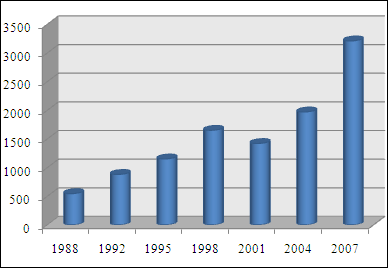
The foreign exchange market, commonly called Forex or FX, is the global system through which participants buy, sell and exchange national money. It performs the essential economic function of converting one currency into another for purposes such as cross-border payments, financing and investment. The market is highly liquid and around-the-clock on weekdays; widely cited estimates from the mid-2010s placed daily turnover at over $5 trillion.
Image gallery
4 Images


Characteristics and structure
Forex is primarily an over-the-counter (OTC) market rather than a single central exchange. Trading occurs via banks, brokers and electronic platforms, and it spans multiple time zones so trading moves from Asia to Europe to North America during each 24-hour period. Instruments commonly traded include spot transactions, forwards, swaps and options.
Who participates
- Commercial firms: importers and exporters who convert money for international trade.
- Financial institutions: banks, hedge funds and asset managers conducting investment and arbitrage.
- Central banks: intervening to influence exchange rates or to manage reserves.
- Retail traders: individual investors accessing FX through brokers and platforms.
Brief history
The modern FX market expanded after the breakdown of the Bretton Woods system in the early 1970s, when many countries adopted floating exchange rates. Prior to this, exchange rates were often fixed to gold or a dominant currency; the shift to flexible rates created the environment for today's continuous global trading.
Uses, examples and importance
Foreign exchange facilitates cross-border commerce, capital flows and tourism. Companies hedge currency risk with forwards or options; investors and speculators seek profit from changes in pair prices such as EUR/USD or USD/JPY. Central banks may buy or sell their currency to stabilise markets.
Key features and risks
Notable aspects include very high liquidity, 24-hour coverage on weekdays and a tiered market structure. Currency values respond to interest rates, economic data, political events and market sentiment. Risks include leverage-related losses, counterparty exposure and sudden volatility. For more on the role of currencies in the global economy, see further resources.
Related articles
Author
AlegsaOnline.com Foreign exchange market (Forex) Leandro Alegsa
URL: https://en.alegsaonline.com/art/35610
Sources
- reuters.com : "Daily FX trading volume falls 5.5 pct to $5.1 trillion -BIS"
- coinbureau.com : "Online Trading Platforms"