
Fire engine — design, equipment, history and types
A fire engine is a specialized emergency vehicle that transports firefighters and tools for firefighting and rescue. This article summarizes its equipment, common types, historical development and typical roles.
A fire engine is a purpose-built emergency vehicle that carries personnel, water, pumps and specialized tools to incidents where fire suppression, rescue or hazardous‑materials response is needed. In everyday language the terms "fire engine" and "fire truck" are often used interchangeably, though some services distinguish between pump‑focused vehicles and ladder or rescue platforms. A fire engine provides mobility, water supply and mechanical advantage so crews can begin firefighting and life‑saving tasks as soon as they arrive.
Image gallery
10 Images


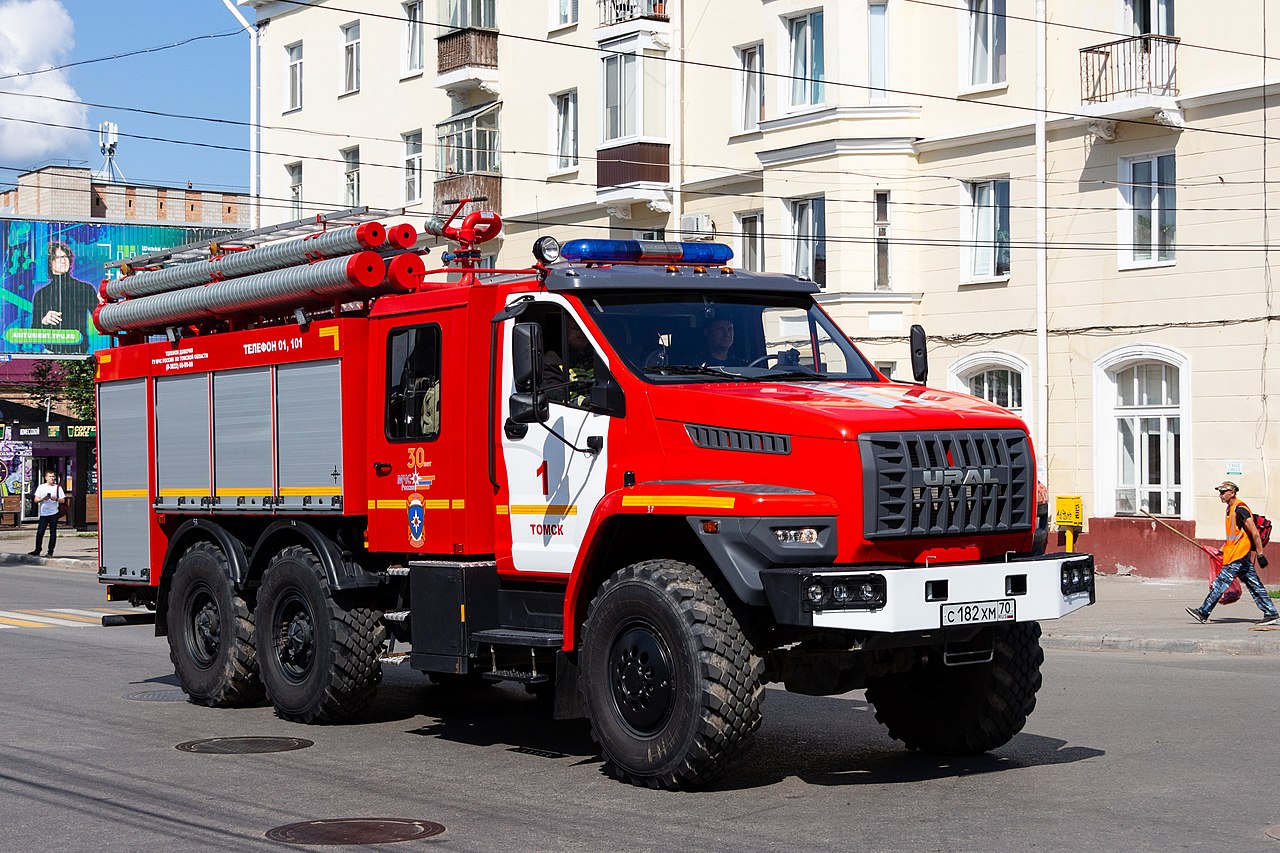


Typical components and equipment
A modern fire engine combines a number of systems and stores to support firefighters. Core elements include an engine‑driven water pump, hose reels and connections to feed nozzles, an on‑board water tank and fittings to draft from external sources. Many engines also carry foam concentrates and proportioning systems for flammable liquid fires.
- Pumping and water delivery: centrifugal or gear pumps, supply and discharge hoses.
- Water and foam: tanks, portable tanks and foam proportioners.
- Tools and rescue gear: ladders, forcible‑entry tools, hydraulic cutters/spreaders, rope rescue equipment.
- Life support and safety: first aid kits, defibrillators, breathing apparatus (SCBA) and protective clothing.
- Communications and warning: radios, incident command aids, sirens and warning lights for safe transit.
Common types and special vehicles
Fire services organize vehicles by role. A "pumper" or engine focuses on water and pumping capacity; an "aerial" or ladder truck carries large ladders or hydraulic platforms for elevated access. Rescue units concentrate on vehicle extrication and technical rescue equipment. Other variants include tankers (water tenders) for rural areas, brush or wildland engines for off‑road fires, and specialized hazmat or command vehicles for complex scenes.
- Pumper / engine — delivers water and supplies hoses.
- Aerial ladder or tower — provides height for rescues and elevated streams.
- Rescue company — equipped for vehicle rescue, confined‑space and structural collapse.
- Tanker / tender — transports large volumes of water to areas without hydrants.
- Wildland engine — lighter, with pumps and off‑road mobility for vegetation fires.
History and development
Methods for fighting fires have evolved from community bucket brigades to mechanized and motorized apparatus. Hand‑powered pumps appeared in early modern Europe and were gradually improved; by the 18th and 19th centuries horse‑drawn pumpers increased mobility. Steam power later provided both motive and pumping force on larger appliances. The transition to motor vehicles in the late 19th and early 20th centuries produced the first purpose‑built motorized fire engines; one early example of a gasoline‑powered fire apparatus was produced by Knox in 1905. Since then, developments in materials, internal combustion engines, hydraulics, breathing protection and communications have continuously shaped apparatus design.
Roles, operation and notable distinctions
On arrival, crews use the engine to establish water supply and deploy hoselines, ventilate structures and perform rescues. Fire engines are staffed according to local protocols, often with a driver/operator who manages the pump and a crew for hose and rescue tasks. Sirens and lights are used to warn traffic during response, while vehicle construction and equipment reflect standards for safety and firefighting performance.
Regional language and organizational practice affect terminology: in some countries "fire engine" emphasizes pumping capability and "fire truck" denotes ladder or platform vehicles. Modern fleets are modular, so a single fire station may operate several specialized units to match local risks. For further reading about design standards, operational doctrine and terminology, see resources linked here: fire apparatus overview, firefighting equipment, station and response, historical devices and vehicle classifications.
Related articles
Author
AlegsaOnline.com Fire engine — design, equipment, history and types Leandro Alegsa
URL: https://en.alegsaonline.com/art/34465