
Faraday cage: principles, history, and practical uses
A Faraday cage is a conductive enclosure that blocks external electric fields and electromagnetic interference. This article explains how it works, its history, typical uses, limitations and design considerations.
A Faraday cage is an enclosure formed from a conducting material that reduces or blocks the passage of external electric fields and many forms of electromagnetic radiation into its interior. Named after Michael Faraday, who demonstrated the basic idea in 1836, the device relies on the redistribution of electric charge across the conductor to cancel the field inside. The term is used broadly to describe metal boxes, rooms, mesh screens, bags and other structures that provide electromagnetic shielding for equipment, experiments or people.
Image gallery
6 Images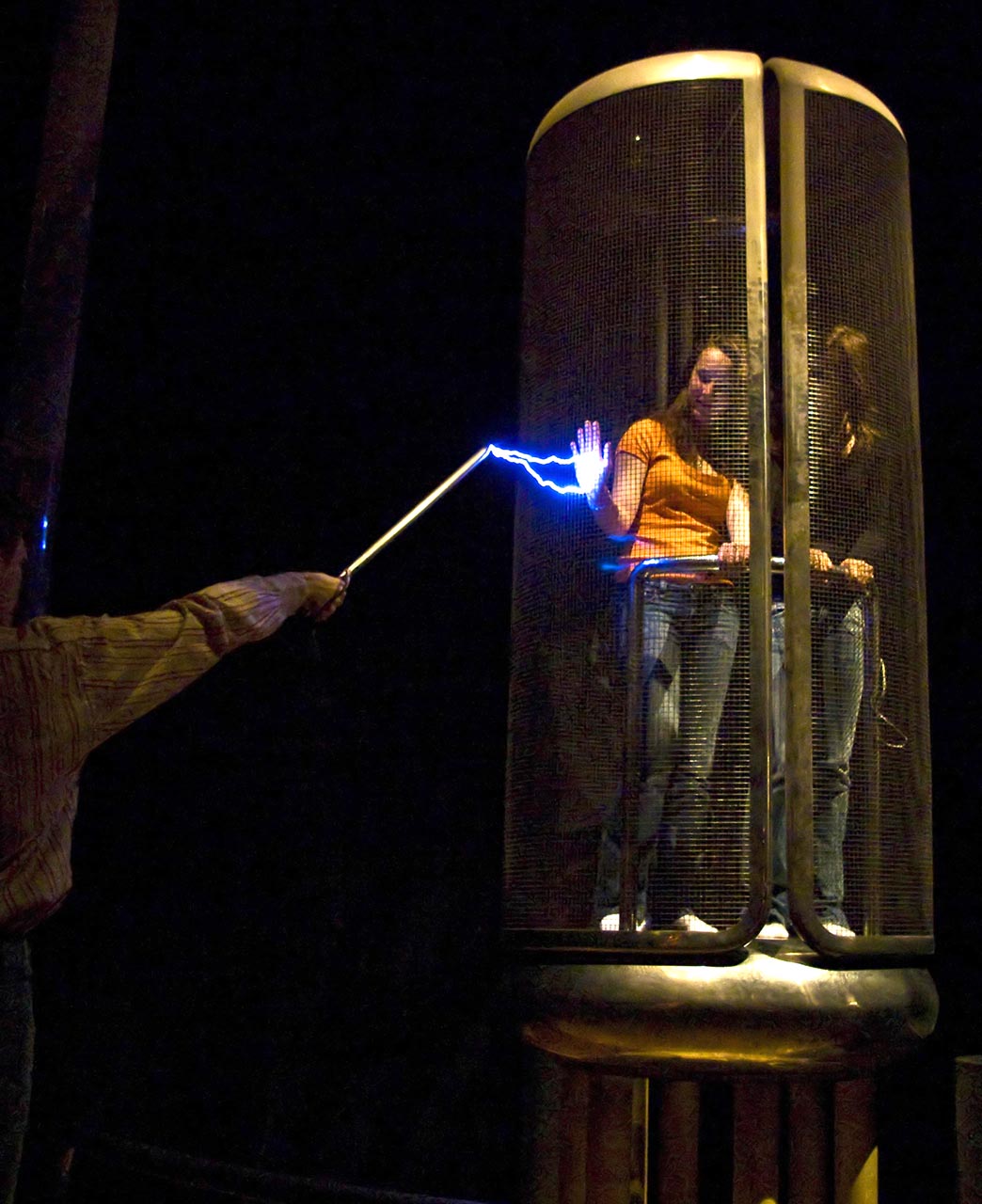



How it works and key characteristics
When an external electric field impinges on a conductive shell, free charges in the conductor move until they create an internal field that opposes and cancels the external influence, leaving the interior region with little or no net electric field. For time-varying fields (radio and microwave frequencies), the effect depends on several physical factors including conductivity, wall thickness, the presence of gaps or seams, and the size of any apertures relative to the wavelength.
- Conductivity and thickness: Better conductors and thicker walls usually give stronger attenuation, especially at lower frequencies.
- Mesh size and wavelength: A screen or perforated metal can act as an effective shield if its holes are significantly smaller than the shortest wavelength to be blocked.
- Skin effect: At high frequencies, currents induced by electromagnetic waves are confined to the conductor surface; this influences required thickness and material choice.
- Seams and penetrations: Doors, windows, cable feedthroughs and imperfect joins can allow leakage; proper gasketing and filtered connectors are commonly used in critical installations.
History and development
Michael Faraday first documented the phenomenon when he showed that a charge placed on a conducting cage resides on the exterior, leaving the interior unaffected. Since then the principle has been adapted for laboratory enclosures, industrial shielding, and consumer devices. Over time engineering practice has refined how to treat vents, connectors and grounding to create predictable shielding performance across frequency bands.
Common applications and examples
Faraday cages appear in many forms and settings. They protect sensitive instruments from radio frequency interference during measurements; they form the metal enclosure of a microwave oven to keep microwaves inside; they are used to reduce electromagnetic emissions from transmitters; and they protect equipment or spaces during lightning events by conducting strike currents around an interior volume. Examples include:
- Shielded rooms and test chambers for electromagnetic compatibility (EMC) testing and medical imaging (e.g., MRI suites).
- Faraday bags used to block wireless signals for security, digital forensics, or preventing remote access to devices.
- Enclosures for radio transmitters and receivers to prevent mutual interference.
- Vehicle bodies can act as partial Faraday cages, which helps explain why occupants are usually safe from direct lightning effects if the vehicle structure remains intact.
Limitations and important distinctions
Faraday cages are effective against electric fields and many electromagnetic waves, but performance varies with frequency and field type. They are generally poor at shielding low-frequency static or slowly varying magnetic fields (for example, the field inside a large DC magnet requires different techniques). A cage must be continuous enough to prevent unwanted coupling; small holes, poorly sealed doors, or unfiltered cable penetrations can compromise effectiveness. Grounding the enclosure is often helpful but not always required for shielding to function.
For practical guidance and design standards, engineers consult specifications and test methods. For introductory material see an overview resource such as basic shielding concepts and applied guides on shielded rooms and connectors at practical EMC. For historical context and Faraday's original experiments consult historical summaries. For product-level solutions like faraday bags or shielding fabrics see commercial options. For safety and standards used in testing laboratories see regulatory and testing references.
In engineering practice, the phrase "Faraday cage" serves both as a conceptual description and a design target: the goal is to achieve predictable attenuation across the frequencies of interest while managing access, ventilation and connectivity in a way that does not defeat the shielding.
Related articles
Author
AlegsaOnline.com Faraday cage: principles, history, and practical uses Leandro Alegsa
URL: https://en.alegsaonline.com/art/33507