
Fermilab (Fermi National Accelerator Laboratory)
Fermilab is the U.S. Department of Energy's flagship particle physics laboratory near Chicago, known for the Tevatron collider, major neutrino programs, accelerator technology and prairie restoration.
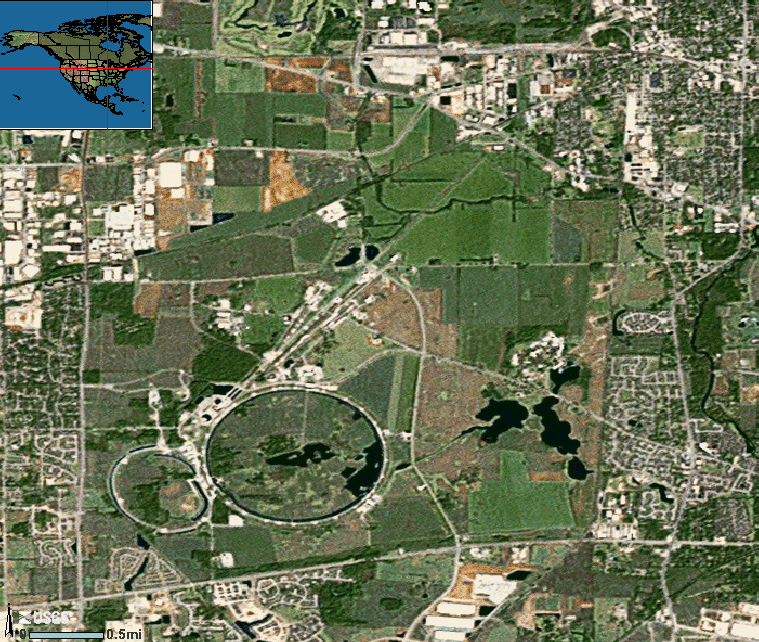
Fermilab, formally the Fermi National Accelerator Laboratory, is a United States government research center focused on experimental and theoretical particle physics. It is located just outside Batavia, in Illinois, near Chicago, and is operated under the auspices of the U.S. Department of Energy. The laboratory hosts a collection of accelerators, detectors, computing facilities and support infrastructure devoted to understanding the fundamental constituents of matter, the forces between them, and related questions in astrophysics and cosmology.
Image gallery
10 Images




Origins and organization
The laboratory began in the late 1960s as a national accelerator site and was later named in honor of physicist Enrico Fermi. Over time its management and partnerships have evolved; today Fermilab is operated in collaboration with research universities and industry partners. The institution maintains formal relationships with major academic centers such as the University of Chicago and the Illinois Institute of Technology, among others, and contributes to national and international experimental programs.
Facilities and major machines
For many decades the laboratory's signature machine was the Tevatron, a circular particle accelerator with a circumference of roughly 3.9 miles (6.3 km). The Tevatron was one of the world's most powerful colliders until it ceased operations on September 30, 2011. Its role is often compared to Europe’s accelerators run by CERN, including the Large Hadron Collider, which is larger in scale. Fermilab has maintained a succession of injector and fixed-target accelerators, as well as advanced detector halls and neutrino beamlines used by international collaborations.
Research programs and discoveries
Fermilab experiments have yielded landmark results in particle physics. Teams operating the collider detectors CDF and DØ announced the discovery of the top quark in 1995. Beyond collider physics, Fermilab is a global center for neutrino research and long-baseline experiments. Dedicated beamlines produce intense streams of neutrinos for detectors that study oscillations, interactions and rare processes. Fermilab-built neutrino technology and associated computing resources remain essential to worldwide neutrino programs.
Notable experiments and capabilities
- MiniBooNE — a spherical detector containing mineral oil and many phototubes used to record neutrino interactions.
- SciBooNE — a fine-grained tracker sited in the same beam as MiniBooNE to study interaction details.
- MINOS — a long‑baseline oscillation experiment that used the NuMI beam to send neutrinos through the Earth to detectors far from the source, including a site at the Soudan Mine.
- Various fixed‑target, test‑beam and accelerator development programs that advance superconducting magnets, high‑power targets and beam diagnostics.
Landscape, public programs and notable facts
Fermilab occupies a large campus where much of the accelerator infrastructure lies underground. The surface area has been developed as an environmental and educational resource: staff and volunteers have restored sections of native Illinois prairie and maintain an interpretive landscape used for outreach and biodiversity projects. The site also houses a herd of American bison, kept as part of a conservation and public‑history initiative. The laboratory supports outreach, K–12 education, visitor programs and international scientific partnerships. An asteroid, 11998 Fermilab, was named in recognition of the laboratory's contributions to science.
Today Fermilab continues to transition from a single-machine era into a broad portfolio of accelerator science, neutrino physics and supporting technologies. Its combination of large-scale infrastructure, international collaborations and public engagement keeps it central to questions about particle interactions, cosmic origins and the development of accelerators and detectors used across high-energy physics.
Questions and answers
Q: What is Fermi National Accelerator Laboratory?
A: Fermi National Accelerator Laboratory (Fermilab) is a US Department of Energy national laboratory specializing in high-energy particle physics.
Q: Who operates Fermilab?
A: As of January 1, 2007, Fermilab is operated by the Fermi Research Alliance, a joint venture of the University of Chicago, Illinois Institute of Technology and the Universities Research Association (URA).
Q: What was the Tevatron particle accelerator used for?
A: The Tevatron particle accelerator was used to discover the top quark and conduct high energy collider physics experiments.
Q: What other types of experiments are conducted at Fermilab?
A: In addition to high energy collider physics, Fermilab also hosts smaller fixed-target and neutrino experiments such as MiniBooNE (Mini Booster Neutrino Experiment), SciBooNE (SciBar Booster Neutrino Experiment) and MINOS (Main Injector Neutrino Oscillation Search).
Q: How large is the MiniBooNE detector?
A: The MiniBooNE detector is a 40-foot (12 m) diameter sphere which contains 800 tons of mineral oil lined with 1520 individual phototube detectors.
Q: How far does the NuMI beam travel from Fermilab?
A: The NuMI beam travels 455 miles (732 km) from Fermilab to the Soudan Mine in Minnesota.
Q: What programs has Fermilab started on its land surface?
A: On its land surface, Fermilab has started an experiment in restoring Illinois original prairie as well as a farm to raise a herd of American bison.
Related articles
Author
AlegsaOnline.com Fermilab (Fermi National Accelerator Laboratory) Leandro Alegsa
URL: https://en.alegsaonline.com/art/34035
Sources
- fnal.gov : "Safety and the Environment at Fermilab"
- fermilabnaturalareas.org : "Fermilab Natural Areas"
- history.fnal.gov : "Before Weston"
- fnal.gov : "About Fermilab - The Fermilab Campus"
- history.fnal.gov : "Early URA"
- history.fnal.gov : "Accelerator History - Main Ring"
- uslhc.us : "The US and LHC Computing"
- fnal.gov : "Fermilab | Illinois Accelerator Research Center"
- history.fnal.gov : "Technology - Cancer Therapy Facility"