
Fair catch (American football)
A fair catch lets a punt returner signal for an unopposed catch that ends the play at the spot of the catch; it protects the receiver and has specific rules, penalties, and strategic uses across levels of play.
Overview
In American football, a fair catch is a procedure that allows the receiving team to claim a kicked ball—most commonly a punt—without attempting a return. When a player on the receiving team (the receiver) makes a valid fair-catch signal, the play is treated as complete at the spot where the ball is caught and the receiving team gains possession.
Image gallery
1 Image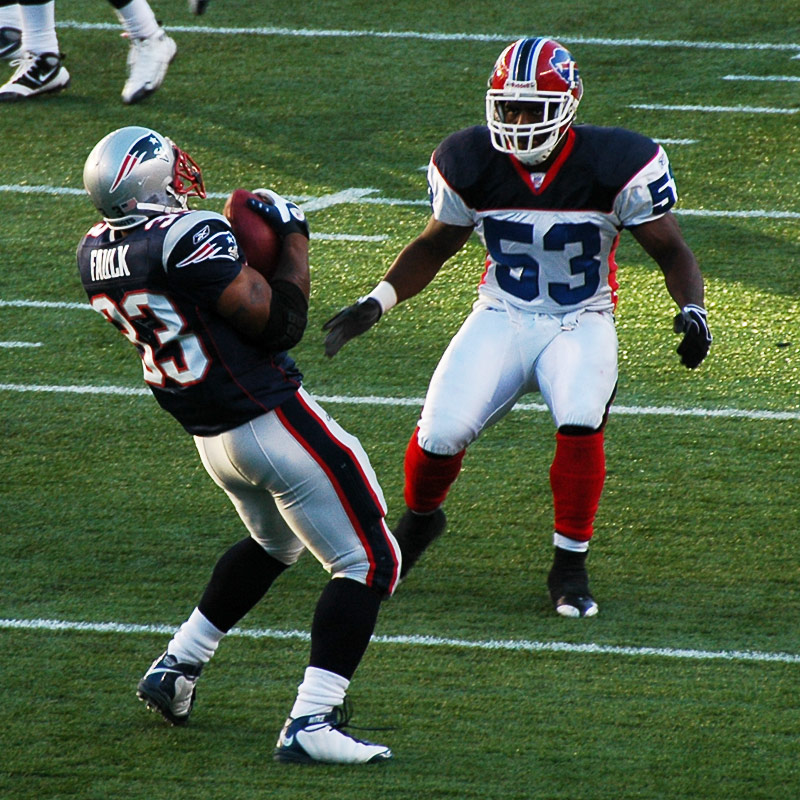
How the signal works
To request a fair catch the receiver must visibly signal before making the catch, typically by waving one arm from side to side above the head or by using another league-approved motion. A clearly made signal gives the receiver immediate protection: members of the kicking team are not permitted to touch or tackle the receiver while he attempts the catch.
Rules and outcomes
When a fair catch is granted, the receiver cannot advance the ball; the play is whistled dead at the spot of the catch and the receiving side takes possession. If the signal is absent or improperly given, the ball remains live and a return may be attempted. Contact by the kicking team after a valid signal can result in penalties for illegal contact or unnecessary roughness under the applicable rulebook.
- Protection: defenders must avoid contacting a player who has signaled.
- No advancement: the catch ends the play and there is no return.
- Penalty: illegal contact following a valid signal is penalized.
Variations and notable exceptions
Different levels of play (professional, collegiate, and high school) include specific nuances about placement after a fair catch and enforcement. A relatively rare option in many rulebooks is the "fair-catch kick," which permits the receiving team to attempt a free kick resembling a field goal from the spot of the catch under strict conditions. Other special-case outcomes, such as catches made in or near the end zone, are handled according to the competition's rules.
History, purpose, and strategy
The fair catch developed to reduce dangerous collisions on punt returns by giving returners a protected option to secure possession when a return would be risky. Strategically, teams use the fair catch to avoid poor field position or injury risk when the kicking team arrives quickly. If a player muffs the catch after signaling, the ball can become live and subject to recovery according to the rules, so the option carries trade-offs when kicks are difficult to handle.
Examples and further reading
Coaches often instruct return specialists to signal a fair catch when coverage is imminent or when field position after a return would be unfavorable. League rulebooks and officiating guides provide the precise language and enforcement mechanics for fair catches; readers can consult the governing body for their competition for authoritative details. See official rule summaries for more information.
Related articles
Author
AlegsaOnline.com Fair catch (American football) Leandro Alegsa
URL: https://en.alegsaonline.com/art/33242