
Punt (kicking play in football and related sports)
A punt is a kick made by dropping the ball and striking it before it hits the ground. Used in American and Canadian football and other codes, punts are a strategic tool to influence field position.
A punt is a type of kick in which the player releases the ball from the hands and kicks it before it touches the ground. In gridiron football this play is most often used on the team's final allowed down to transfer possession while trying to improve the kicking side's defensive field position. The punt contrasts with other kicking plays such as the drop kick and placekick, which differ in how the ball is handled or struck. For a concise explanation of kicking plays and rules, see related rule material.
Image gallery
4 Images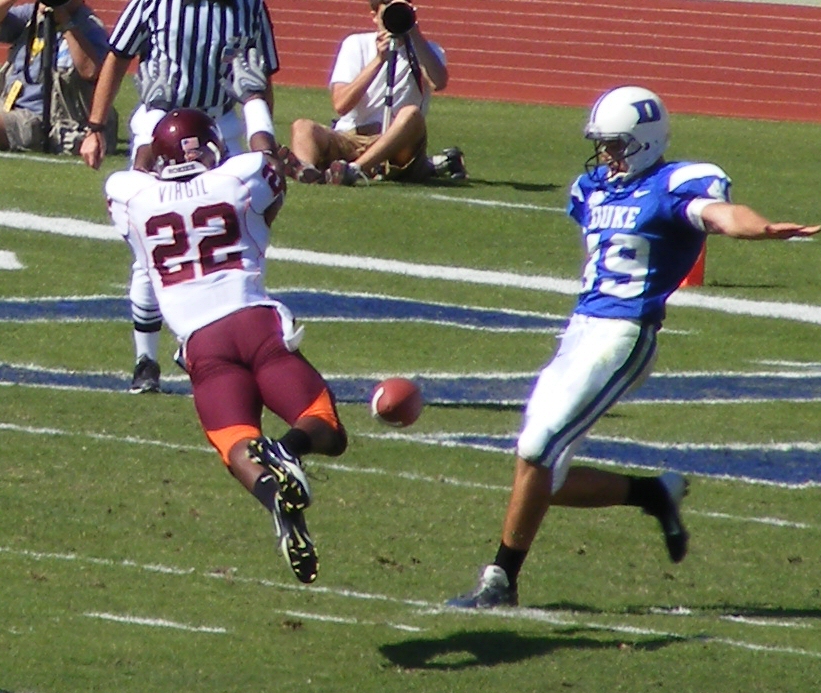


Execution and typical techniques
Successful punting combines timing, ball control and leg mechanics. A standard sequence begins with a snap to the punter, a short run-up, a controlled drop of the ball, contact with the foot, and a follow-through. Key attributes punters seek are distance, hang time (how long the ball stays aloft), and placement to limit the returner’s options. Teams sometimes use specialized varieties such as the directional punt, the high "hang" punt to allow coverage to arrive, or a shorter "pooch" punt to avoid a touchback and pin opponents close to their goal line.
Rules and strategy in North American football
In American football the punt is usually taken on fourth down; in Canadian football it commonly occurs on third down. The kicking team aims to make the receiving team start its subsequent possession as far back as possible. Receivers may signal for a fair catch to avoid the return, or the play may result in a touchback if the ball crosses into the end zone, with different field-position consequences depending on the code. Coaches weigh risks: a long return or a blocked punt can be game-changing, while a well-executed punt can flip the field. Special-teams units also practice fake punts, which are designed plays that attempt to keep possession rather than kick it away. For rule specifics and strategy, consult resources on professional and collegiate rules at American football rules and Canadian football rules.
Variations and other sports
Punting is not unique to American and Canadian football. In rugby codes, kicking from hand is a central tactical option and includes punts executed during open play to gain territory or contest possession. Australian rules football favors the "drop punt" for accuracy when passing and kicking for goal, while other styles such as the torpedo or end-over-end kicks serve different purposes. In association football (soccer), goalkeepers commonly punt the ball to clear it downfield after a catch. Further comparisons and historical context can be found in broader kick-related discussions at drop kicks and related kicks.
Terms, tactics and notable considerations
- Hang time: Allows coverage to reach the returner before the ball is caught.
- Coffin corner: Aiming to land the ball out of bounds near the opponent's goal line to pin them deep.
- Returner: The receiving player assigned to catch and attempt to advance the punt.
- Block risk: Protection schemes are critical to prevent the punt from being blocked.
Punting remains a specialized but crucial facet of many football codes. Its proper use reflects a team's broader strategic approach to field position, clock management and risk control. For further reading on special teams play and punting technique, see introductory and coaching materials linked at rule overview and tactical guides such as kicking techniques.
Author
AlegsaOnline.com Punt (kicking play in football and related sports) Leandro Alegsa
URL: https://en.alegsaonline.com/art/129047