
Error detection and correction
Methods and algorithms that detect and often correct errors in stored or transmitted information by adding redundancy and using mathematical checks to ensure data integrity.
Overview
Error detection and correction refers to a set of techniques that detect whether information has been altered by noise, interference, or faults during storage or transmission, and in many cases restore the original data. These methods add deliberate redundancy to messages so that receivers can recognize inconsistencies and either request retransmission or reconstruct lost bits. They are essential for reliable digital communication across imperfect channels and for dependable data storage.
Image gallery
1 Image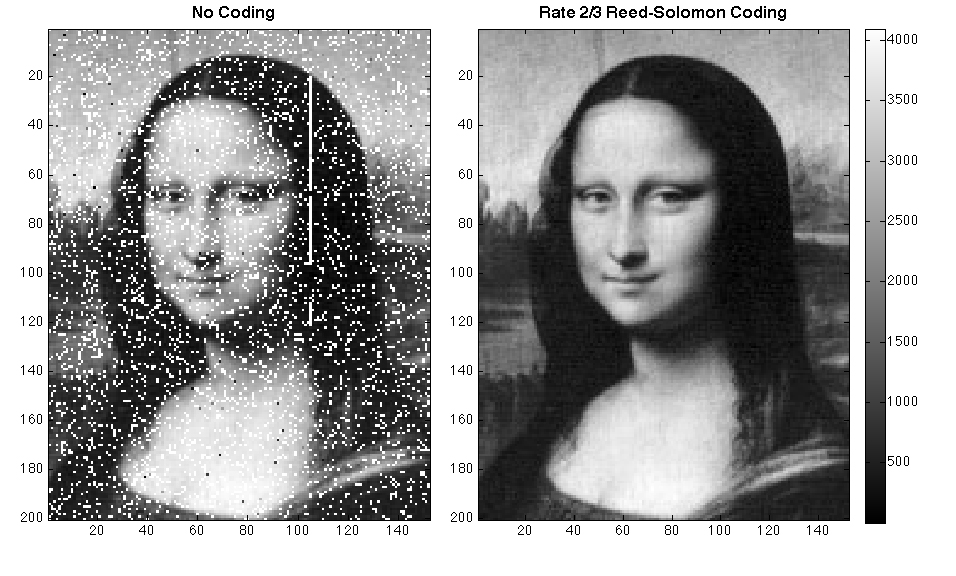
Core principles and common techniques
The basic idea is to trade extra bits, processing, or time for greater reliability. Simple detection schemes append a short summary of the message; if the summary does not match, an error is flagged. More advanced schemes allow the receiver to infer the correct content without asking for a resend.
- Parity checks: Add a single bit that makes the count of 1s even or odd; useful for detecting single-bit errors.
- Checksums and cyclic redundancy checks (CRC): Compute a compact digest; widely used to detect bursts of errors in network packets and files.
- Error-correcting codes (ECC): Include Hamming codes, Reed–Solomon, convolutional and turbo codes; these enable correction of a limited number of errors and are used in memory, storage, and wireless systems.
- Automatic repeat request (ARQ): Combines detection with retransmission; common in reliable transport protocols when latency permits.
History and development
The theoretical foundation of error control grew alongside the development of digital communication and information theory in the 20th century. Early practical schemes addressed telegraph and telephone noise; later, formal coding theory produced systematic constructions that balance redundancy, error tolerance and computational cost. Over time, advances in algorithms and hardware have enabled increasingly efficient codes for modern high-speed networks and storage mediums.
Applications and examples
Error control appears across computing and communications: in hard drives and solid-state memory (ECC memory), optical and magnetic media (compact discs and DVDs use specific error-correcting layers), satellite and cellular communications (specialized FEC in radio links), barcodes and QR codes (Reed–Solomon), and internet protocols (packet checksums and retransmission strategies). The choice of method depends on channel characteristics, required reliability, acceptable latency and available bandwidth.
Trade-offs and notable distinctions
Detection-only schemes are compact and cheap but cannot fix corrupted data without another transmission. Correction schemes require more redundancy and processing but can recover data immediately. Designs also differ by block vs convolutional structure, whether they operate on symbols or bits, and whether they rely on hard decisions or soft metrics in the receiver. System architects weigh complexity, delay, and overhead when selecting an approach.
For practical introductions and specifications, see resources on data integrity and coding theory: data integrity overview, protocol and checksum guides at protocol resources, and technical material on coding methods at coding theory references.
Related articles
Author
AlegsaOnline.com Error detection and correction Leandro Alegsa
URL: https://en.alegsaonline.com/art/32057