
Erinome (Jupiter XXV): an irregular, retrograde moon of Jupiter
Erinome is a small, non-spherical irregular satellite of Jupiter discovered in 2000. It belongs to the retrograde Carme group and orbits far from Jupiter with a period of about 712 days.
Overview
Erinome, officially designated Jupiter XXV and provisionally S/2000 J 4, is one of Jupiter's many small irregular moons. It is a distant, non-spherical natural satellite that follows a retrograde orbit around the planet. Erinome is too small and faint to show surface details with current ground-based telescopes, so most of what is known comes from orbital measurements and comparisons with other members of its dynamical group.
Image gallery
1 Image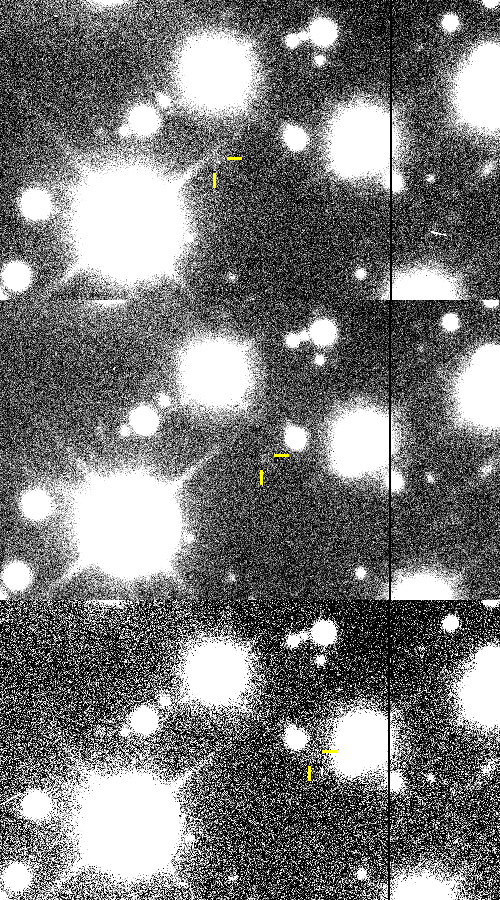
Physical and orbital characteristics
Erinome is estimated to be roughly 3.2 kilometres in diameter. Its orbit around Jupiter is distant and elongated: the mean orbital radius is about 22,986,000 kilometres and the orbital period is approximately 711.965 days. The inclination of Erinome's orbit is steep and retrograde, about 164° to the ecliptic (roughly 162° relative to Jupiter's equator), and its orbital eccentricity is about 0.2552. These traits classify it as an irregular satellite rather than a regular, equatorial moon.
Key parameters at discovery and subsequent tracking include:
- Diameter: ~3.2 km
- Semi-major axis (average distance): ~22,986,000 km
- Orbital period: ~711.965 days
- Inclination: ~164° to the ecliptic
- Eccentricity: ~0.2552
Discovery and naming
Erinome was discovered in the year 2000 by a team of astronomers from the University of Hawaii led by Scott S. Sheppard. The object received the provisional designation S/2000 J 4 following its detection. After follow-up observations confirmed its orbit, the International Astronomical Union assigned the permanent Roman numeral designation Jupiter XXV and the name Erinome in October 2002, drawn from Roman mythology in which Erinome is associated as a lover of Jupiter.
Primary discovery and follow-up work are associated with professional surveys and observers; for more on the discovery team and observing programs see the University of Hawaii group and materials by Scott S. Sheppard. Additional context about designations is available via the announcement notices linked at discovery circulars.
Group membership and origin
Erinome is a member of the Carme group, a collection of irregular, retrograde moons that orbit Jupiter at similar distances and inclinations. The Carme group typically lies between about 23,000,000 and 24,000,000 km from Jupiter and has an inclination near 165°. Members of this group share similar orbital elements, which suggests a common origin, most likely the fragmentation of a single captured progenitor body.
Characteristics of the Carme group and evidence for a collisional origin can be explored further in resources about irregular satellites and group dynamics: Carme group overview, general classification notes at irregular satellite entries, and orbital data records at ecliptic/inclination summaries and eccentricity catalogs.
Scientific importance and notable facts
Although Erinome is small, studying moons like it helps astronomers understand the capture and collisional history of the Jovian system and the population of small, dark bodies in the outer Solar System. Because Erinome and its Carme-group companions share similar orbits, they serve as natural laboratories for researching how gravitational interactions, collisions, and tidal forces shape populations of irregular satellites.
For observational records, naming history, and additional technical details see the relevant notices and databases linked here: naming announcement, mythological background at Roman mythology, and discovery notes at satellite catalogs. Further ephemerides and dynamical studies are available through professional archives referenced at researcher pages and observatory logs.
Observing Erinome
Erinome is too faint for amateur telescopes and requires large professional telescopes and long-exposure imaging to detect and track. Its small size and dark surface make photometric or spectroscopic studies challenging, but comparisons with other Carme-group members allow inferences about composition and surface properties. For technical observation data and planning, consult the ephemerides and discovery papers at orbital element lists and survey summaries at mission archives.
Questions and answers
Q: What is Erinome?
A: Erinome is a non-spherical moon of Jupiter that belongs to the Carme group.
Q: When was Erinome discovered and by whom?
A: Erinome was discovered in 2000 by a team of astronomers from the University of Hawaii led by Scott S. Sheppard et al.
Q: What is the diameter of Erinome?
A: Erinome has a diameter of about 3.2 kilometres.
Q: What is the average distance of Erinome from Jupiter?
A: Erinome orbits Jupiter at an average distance of 22,986,000 km.
Q: What is the orbital period of Erinome?
A: Erinome has an orbital period of 711.965 days.
Q: Why was Erinome named after the Roman mythological figure Erinome?
A: Erinome was named after the Roman mythological Erinome, who was a lover of Jupiter.
Q: What is the range of distance between Jupiter and the Carme group?
A: The distance between Jupiter and the Carme group, of which Erinome is a part, ranges between 23,000,000 and 24,000,000 km.
Related articles
Author
AlegsaOnline.com Erinome (Jupiter XXV): an irregular, retrograde moon of Jupiter Leandro Alegsa
URL: https://en.alegsaonline.com/art/31947
Sources
- cfa-www.harvard.edu : IAUC 7555: Satellites of Jupiter
- cfa-www.harvard.edu : MPEC 2001-A28: S/2000 J 2, S/2000 J 3, S/2000 J 4, S/2000 J 5, S/2000 J 6
- cfa-www.harvard.edu : IAUC 7998: Satellites of Jupiter