
Emblem of Bhutan
Official national emblem of Bhutan featuring a double thunderbolt, lotus, jewel and two dragons—rich in Buddhist symbolism and reflecting the nation's religious and secular unity.
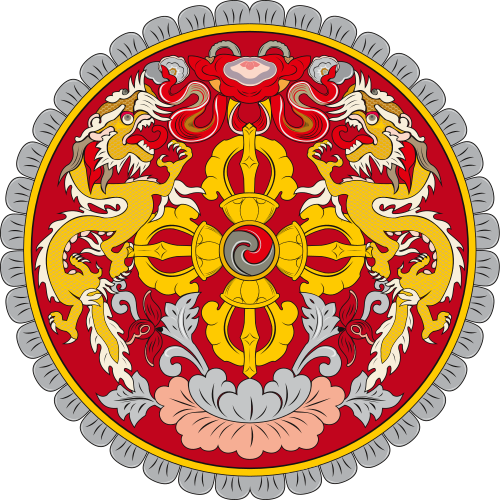
The emblem of Bhutan is a compact, highly symbolic device used by the state to represent national identity and authority. It shares visual themes with the flag of Bhutan but is rendered with distinct artistic detail. In its finished form the emblem is enclosed in a circular field and combines Buddhist religious motifs with explicit statements about the balance of spiritual and temporal power that guides the country.
Image gallery
6 Images


Design and main elements
The emblem integrates four principal components. Their arrangement and meanings are often cited in official descriptions and educational materials, see the official emblem summary for one formulation.
- Double thunderbolt (dorji or vajra) — represented as a double diamond-shaped thunderbolt, this element symbolizes indestructibility and the union of opposites. The dorji also signifies the harmony between secular and religious power that is central to Bhutanese governance.
- Lotus — a stylized lotus platform under the thunderbolt stands for spiritual purity and the blossoming of enlightened qualities; it echoes broader Buddhist usage where the lotus represents purity arising from the murky world, see lotus symbolism.
- Jewel (norbu) — placed above the thunderbolt, the jewel denotes sovereign authority, the nation's wellbeing and the wish-fulfilling qualities associated with the Buddhist cintamani.
- Two dragons (druk) — flanking the central motif are a male and a female dragon. These male dragon and female dragon embody the country's traditional name—Land of the Thunder Dragon—and their fierce voices are likened to thunder.
Symbols and meanings
Each part of the emblem carries a layered meaning rooted in Vajrayana Buddhist iconography. The dorji is at once a ritual implement and a metaphor for the indestructible nature of enlightened mind; the lotus underscores moral purity and spiritual aspiration (purity). The jewel connotes both the monarch's role and the aspirations of the polity. The circular framing (circle) emphasizes unity and the completeness of the composition.
History, usage and official status
The emblem appears on official documents, government seals, some currency designs and formal stationery, and it is used by state agencies to mark authority and authenticity. While designs have varied in minor artistic details over time, the core motifs remain constant. The emblem's combination of religious imagery with symbols of statecraft reflects Bhutan's historical development, in which religious institutions and the monarchy have long-standing complementary roles.
Variants, reproduction and notable facts
Artistic renditions of the emblem can differ in color, line style and proportion depending on application (print, embroidery, metalwork). Protocols govern when and how the emblem is displayed, and reproductions for commercial use are typically controlled to preserve dignity and meaning. The presence of both a male and a female dragon is a distinctive feature, underscoring balance and continuity in Bhutanese culture and echoing the nation's self-identification through the dorji-centered iconography and the roaring dragon motif found on the national flag.
For further visual and technical references consult official government resources and museum catalogues that document national emblems and regalia in Bhutanese art and statecraft.
More on the emblem · Relation to the flag · Circle framing · Dorji detail · Lotus meaning · Secular-religious harmony · Purity explained · Male dragon · Female dragon · Thunder and Druk
Related articles
Author
AlegsaOnline.com Emblem of Bhutan Leandro Alegsa
URL: https://en.alegsaonline.com/art/31076