
East London line (London Overground)
Railway line in East London that reuses the historic Thames Tunnel; converted from Underground to London Overground and extended to form an inner-London orbital link.
The East London line is a core suburban railway running through the eastern part of London and now forms part of the London Overground network. It follows a roughly north–south corridor across East London, linking residential and commercial districts and connecting with other rail and Underground services. The line is notable for incorporating one of the world's earliest underwater tunnels beneath the River Thames and for its transformation from a branch of the Underground into a major Overground artery.
Image gallery
2 Images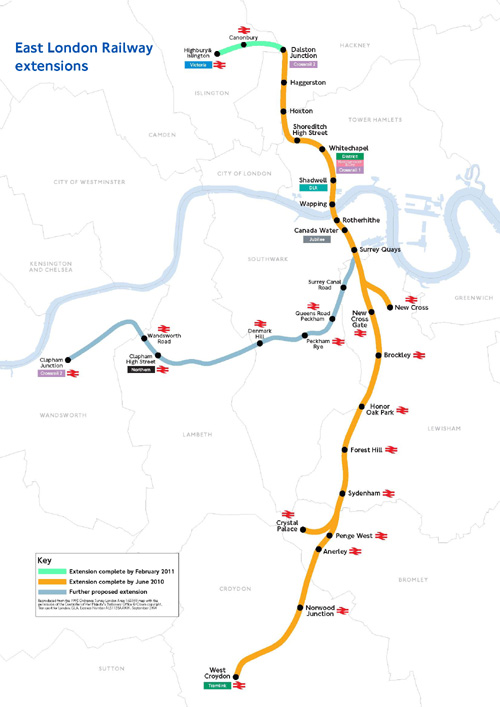

Route and infrastructure
The modern East London line uses a mix of surface track, cuttings and historic tunnels. Trains traverse central East London and serve a series of interchanges that provide cross-city connections. Key features include the stretch that runs through the refurbished Thames Tunnel and several elevated viaducts and purpose-built stations added during the line's conversion and extension.
- Core corridor linking northern and southern districts of East London.
- Integration with major stations and other rail lines, improving orbital journeys around central London.
- Combination of Victorian-era engineering and contemporary upgrades to signaling, platforms and passenger facilities.
History and development
The line traces its origin to the reuse of the Thames Tunnel, completed in the mid-19th century by architects and engineers including Marc Isambard Brunel and his son. Built originally for horse‑drawn vehicles and pedestrians, the tunnel was repurposed for railway use when the East London Railway Company formed in 1869. The route was absorbed into the London Underground network in the early 20th century and later underwent major changes in the 21st century.
Following decades of Underground operation, the line closed in December 2007 for comprehensive refurbishment and expansion. It reopened in April 2010 as part of the London Overground, with improved stations and extended services. A second construction phase, completing a link to the South London line and terminating at Clapham Junction, opened in December 2012 and helped to create a largely orbital route around inner London.
Services, trains and operations
After conversion the East London line became an important suburban route with frequent all-day services. The line is operated by trains typical of the Overground fleet and designed for rapid boarding and high-capacity commuter flows. Upgrades included new signaling, longer platforms and accessibility improvements to accommodate growing passenger demand and modern standards.
- Regular, high-frequency suburban services forming part of the London Overground timetable.
- Use of modern electric multiple units built for commuter duties and walk-through carriages to maximise capacity.
- Interchange possibilities with Underground lines and regional rail at several points along the route.
Importance and notable distinctions
The East London line's reuse of the historic Thames Tunnel is one of its defining characteristics, blending early Victorian engineering with 21st-century rail planning. Its reintegration into the Overground network shifted the line from a peripheral Underground branch to a central element in London's orbital rail strategy, enhancing cross-city travel without requiring transit through the central core. The project demonstrates how historic infrastructure can be adapted to meet modern urban transport needs and has been influential in shaping London's wider rail connectivity.
For background on the network and related routes see general Overground material and historical accounts of the Thames Tunnel and the East London Railway Company. Further technical and timetable details are available from official transport sources and local service guides.
East London is the primary area served, and the line has long-standing links with the historic London Underground network as well as newer orbital services provided through the Overground system.
Related articles
Author
AlegsaOnline.com East London line (London Overground) Leandro Alegsa
URL: https://en.alegsaonline.com/art/29672
Sources
- gold.ac.uk : "East London Line alternative transport strategy update"
- railnews.co.uk : "First train runs on East London Railway"
- tfl.gov.uk : "Archived copy" · web.archive.org