
Donald Watson — founder of the Vegan Society
Donald Watson (1910–2005) was an English woodworker and teacher who coined the word 'vegan' and helped establish the Vegan Society in 1944, promoting a lifestyle that excludes all animal products.
Donald Watson (2 September 1910 – 16 November 2005) was an English woodworker and educator best known for coining the term "vegan" and helping to establish the Vegan Society in 1944. His choice of the word and the organisation he helped found gave a name and structure to a growing movement that rejects the use of all animal-derived foods and products.
Image gallery
1 Image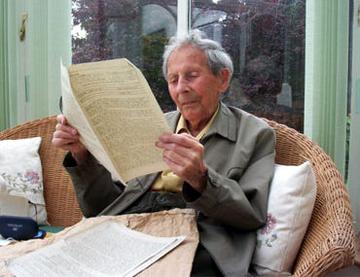
Early life and formation of belief
Watson was born in Mexborough, Yorkshire. As a teenager he witnessed the killing of a pig on a relative's farm, an event that he later described as decisive in his decision to stop eating meat and become a vegetarian at age fourteen. He left formal schooling at fifteen to take up an apprenticeship in woodworking, and later worked as a woodwork teacher and craftsperson, a career that remained part of his life while he organised with like-minded vegetarians and wrote about animal ethics. Mexborough, Yorkshire and the rural environment where he grew up are often mentioned in accounts of his early influences.
Founding the Vegan Society and the word "vegan"
In 1944 a small group of vegetarians sought a term and a framework for those who avoided dairy, eggs and other animal products as well as meat. Watson proposed the word "vegan" and helped launch the Vegan Society as a membership organisation to promote the idea. The name was formed deliberately as a contraction related to "vegetarian" to mark a clear ethical and dietary distinction. The Society began to publish informational material, and Watson contributed to that effort while continuing his teaching work. 1944 is the commonly cited year for the society's formal start.
Principles, activities and distinctions
Veganism, as articulated by Watson and early members, combined dietary practice with an ethical stance against exploiting animals. The movement distinguished itself from vegetarianism by excluding all animal-derived foods (dairy, eggs, honey) and by encouraging avoidance of animal products in clothing and other goods. The Vegan Society offered guidance, membership services and publications that helped spread the idea, and Watson's role in naming and organising is frequently noted in histories of the movement. For more on his profession and public role see woodwork teacher resources and accounts of his activism.
Legacy and notable facts
- He coined the terms "vegan" and "veganism" to describe a lifestyle excluding animal products.
- He was a founder of the Vegan Society, an organisation that helped formalise and disseminate the idea.
- His personal experience on a farm influenced his early commitment to animal welfare; the incident with a pig is often cited in biographies. The pig incident is part of many biographical sketches.
- Watson remained associated with the movement throughout his life and is commonly referenced in discussions of modern vegan history; contemporary accounts and retrospectives discuss his influence on the movement's values and language. See a general overview: background and context.
Donald Watson's contribution is primarily linguistic and organisational: by providing a concise name and an institutional home, he helped create a recognizable identity for an ethical and dietary position that has since expanded into a global movement with varied cultural, nutritional and environmental discussions.
Related articles
Author
AlegsaOnline.com Donald Watson — founder of the Vegan Society Leandro Alegsa
URL: https://en.alegsaonline.com/art/28411
Sources
- news.bbc.co.uk : "Obituary: Donald Watson"