
Switch (electrical and logical device)
Device that opens, closes, or redirects a signal or power path; includes mechanical and electronic types and the concept of logic gates used in computing.
A switch is a device that opens, closes, or redirects the pathway of a signal, current, or operation. In electrical contexts a switch interrupts or connects the flow within an electrical circuit, allowing control over power and signals. The same basic idea—selecting one course out of two or more—applies in non-electrical settings such as railroad turnout mechanisms and mechanical selectors. Modern technology uses the term for both physical contacts and semiconductor elements that perform equivalent roles.
Image gallery
10 Images


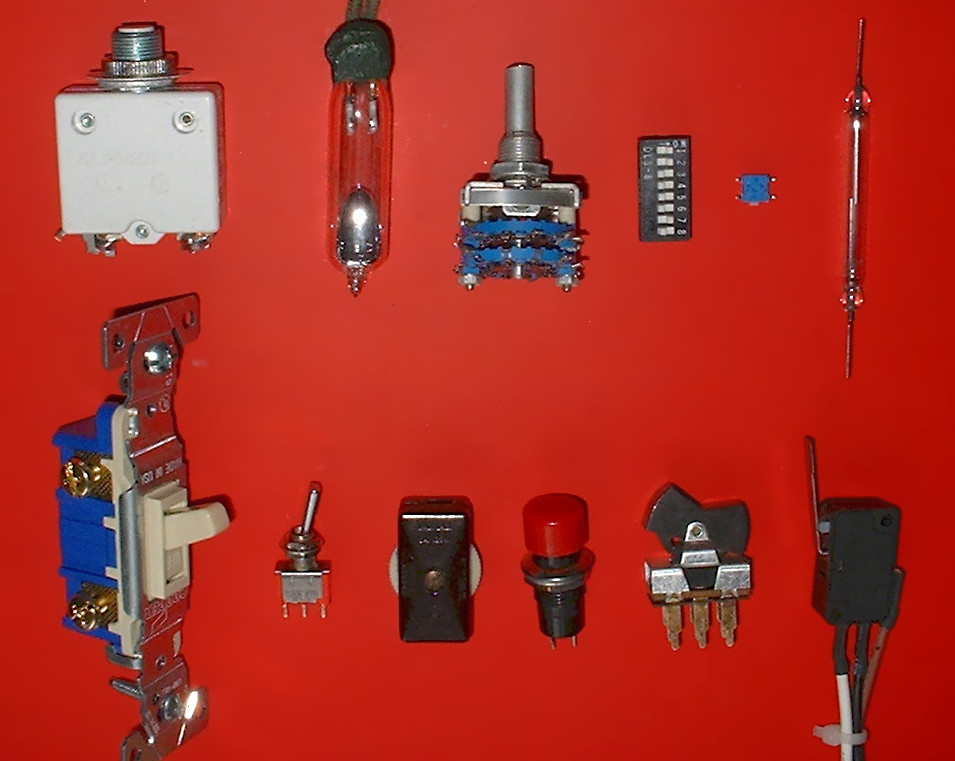


Basic characteristics and common forms
Switches have a few defining parameters: number of poles and throws (how many separate circuits they control and how many positions they provide), current and voltage ratings, contact material, and actuation method. Typical household examples include toggle and rocker light switches; industrial examples include knife switches and rotary selectors. Electronic equivalents are implemented with transistors, diodes, or integrated circuits that serve as solid-state switches without moving parts. Some notable types are:
- Mechanical: toggle, push-button, rotary, slide, reed, and microswitches.
- Electromechanical: relays and contactors that use coils and contacts to switch larger currents.
- Solid-state: semiconductor switches such as bipolar junction transistors, MOSFETs, and thyristors.
- Network and digital: packet switches in networking and logic elements in computing.
History and development
Early switching was entirely mechanical or manual. In telephony, electromechanical systems such as the Strowger switch automated call routing before being superseded by electronic exchanges. The mid-20th century shift from vacuum tubes to transistors and then to integrated circuits replaced many moving-contact switches with solid-state devices that switch faster and with greater reliability. As electronics scaled, switches became the building blocks of digital logic: arrangements of transistors implement Boolean operations.
Logical switches and computing
In mathematical and computational contexts a switch is often described as a gate. Logic gates combine simple switching elements to implement functions in mathematical logic and formal logic. In everyday phrasing, electrical or electronic components that change state act as gates that represent arguments or truth values; a modern computer is fundamentally an enormous network of such switching elements, arranged to perform arithmetic and decision-making tasks.
Uses, examples, and safety considerations
Switches appear in almost every electrical and electronic system: lighting and appliances, industrial machinery, communication systems, power distribution, and digital circuits. Design considerations include contact wear, arcing, contact bounce, switching speed, and thermal performance. Protective devices such as fuses and circuit breakers are related but intended primarily for overload protection rather than routine on/off control. In telecommunications and networking, the word "switch" also denotes devices that route information, for example telephone exchanges historically and modern data switches in Ethernet networks.
Notable distinctions and facts
- Mechanical switches physically move conductive contacts; solid-state switches change electrical properties without motion.
- Contact rating and durability are critical in power applications; semiconductor switches are favored where speed and longevity matter.
- Terminology overlaps: the same word describes railroad turnouts, telephone exchanges, networking equipment, and logic gates—each reflecting the idea of choosing a path or state.
For more detailed technical or historical information, follow resources on basic circuit components, switching technology, and the evolution of telephony and computing systems. See related topics via flow concepts, circuit fundamentals, electrical principles, telephony history, logic gates, mathematical logic, formal logic, argument representation, and computing basics.
Questions and answers
Q: What is a switch?
A: A switch is something that changes the flow of an electrical circuit.
Q: What is the most common type of switch?
A: The most common kind of switch is something like a railroad switch which can be taken off of one course and put onto another.
Q: What does the term "switch" usually mean?
A: The term "switch" usually means electrical power.
Q: Why have mechanical switches been replaced by electronic switches in applications where more than one switch is needed?
A: Mechanical switches have been replaced by electronic switches in applications where more than one switch is needed because electronic switches can be controlled automatically.
Q: What is a switch called when used in a mathematical form?
A: The switch is called a "gate" when used in a mathematical form.
Q: How are arguments represented in logic?
A: In logic, arguments are represented as logic gates.
Q: What is the basic idea behind a computer?
A: The basic idea behind a computer is the use of electronic gates to work as a system of logical gates, i.e. a computer is a lot of electronic switches that work as logic gates.
Related articles
Author
AlegsaOnline.com Switch (electrical and logical device) Leandro Alegsa
URL: https://en.alegsaonline.com/art/95552