
Disc-detainer lock (disc-tumbler / Abloy style) — mechanism and uses
A disc-detainer (disc-tumbler or Abloy) is a key-operated high-security lock that uses rotating discs. This article explains its mechanism, history, uses, advantages, and notable distinctions.
A disc-detainer lock, often called a disc-tumbler or by the trade name Abloy, is a class of high-security keyed lock that relies on a stack of rotating discs rather than pins. Unlike a conventional pin-tumbler cylinder, a disc-detainer design positions several thin discs on a central shaft; the correct key rotates each disc so that aligned notches allow a sidebar or cam to move and the lock to open. Disc-detainer mechanisms are widely regarded for resistance to common forced-entry techniques such as bumping and conventional picking.
Image gallery
3 Images
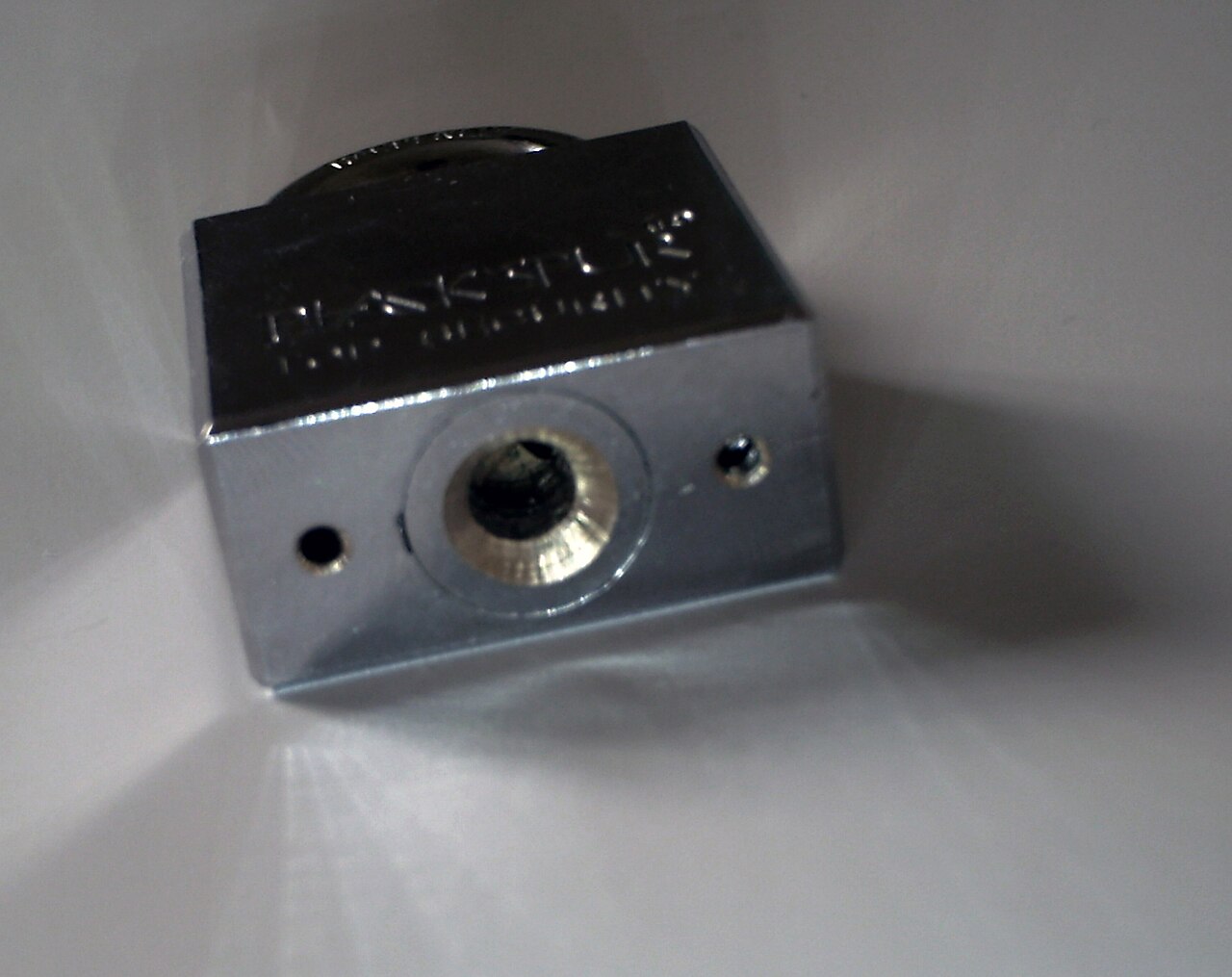

How it works
Internally, a disc-detainer assembly contains a series of circular discs, each with a partial cut or gate. The user inserts a uniquely shaped key that engages each disc and turns it to a prescribed rotational angle. When all gates line up beneath a spring-loaded sidebar, the sidebar drops into the aligned gates and permits the plug or locking cam to rotate freely. Because the correct opening requires rotational alignment rather than vertical displacement, the system behaves differently from pin- or wafer-based locks.
Components and variations
- Discs: Thin rotating plates with a cut or gate that must be oriented correctly.
- Sidebar or actuator: A bar that engages the discs' gates when they are aligned.
- Key: A flat, often uniquely contoured profile that turns the discs to the required positions.
- Housing types: Disc-detainer systems appear in cylinders, padlocks, and integrated door locks; some designs are single- or double-sided or employ different disc counts for variable security levels.
History and manufacturers
Disc-detainer principles have been developed and refined in Europe and elsewhere over the past century. The Finnish company Abloy became strongly associated with the design through commercial success, so "Abloy" is often used generically to describe similar high-security disc locks. Various manufacturers today produce compatible or proprietary variants for applications that demand enhanced tamper resistance.
Uses, strengths, and limitations
Disc-detainer locks are commonly chosen for commercial, institutional, and high-value residential use where resistance to picking, bumping, and some forms of manipulation is important. They are found in padlocks, door cylinders, safes, and certain vehicle or equipment locks. Strengths include mechanical robustness, tolerance for environmental exposure, and difficulty for casual attackers to defeat. Limitations include generally higher cost, fewer locksmiths trained on specialized servicing compared with pin-tumbler systems, and the fact that no mechanical design is completely impervious to attack if sophisticated tools and time are applied.
Notable distinctions
Disc-detainer locks differ from combination-style disc mechanisms such as those in a dial-based combination lock because the discs are set by a physical key rather than by manual dialing. Compared with pin-tumbler locks, disc-detainers trade vertical pin alignment for controlled disc rotation, which alters both attack surfaces and maintenance considerations. For general information about high-security products and to compare options, manufacturers and locksmith resources often list disc-detainer designs among recommended high-security locks.
Overall, the disc-detainer remains a widely respected choice where a balance of mechanical simplicity and elevated resistance to common entry techniques is desired. Its enduring use across many sectors reflects the practical advantages of a disc-based alignment system.
Questions and answers
Q: What is a disc-detainer lock?
A: A disc-detainer lock is a type of high-security keyed lock that utilizes a set of discs.
Q: What are some other names this type of lock goes by?
A: Some other names for disc-detainer locks include disc-tumbler locks, Abloy locks, and disc locks.
Q: How does the disc-detainer lock differ from a combination lock?
A: While a combination lock uses a dial to rotate the discs, a disc-detainer lock utilizes a key.
Q: What is the purpose of a disc-detainer lock?
A: The purpose of a disc-detainer lock is to provide greater security than a standard keyed lock, making it harder for an intruder to pick or bypass the lock.
Q: What makes a disc-detainer lock more secure than other locks?
A: The use of rotating discs makes it more difficult for someone to pick the lock, as the correct positioning of each individual disc must be known in order to unlock the mechanism.
Q: Are disc-detainer locks commonly used in everyday applications?
A: No, disc-detainer locks are typically used in high-security applications, such as on safes or in government buildings.
Q: Are disc-detainer locks more expensive than other types of locks?
A: Yes, due to the advanced design and manufacturing processes involved in creating disc-detainer locks, they tend to be more expensive than traditional keyed locks.
Related articles
Author
AlegsaOnline.com Disc-detainer lock (disc-tumbler / Abloy style) — mechanism and uses Leandro Alegsa
URL: https://en.alegsaonline.com/art/27634