
Dijkstra's algorithm
A single-source shortest-path algorithm for graphs with nonnegative edge weights, used in routing, mapping, and network optimization. Explains operation, complexity, history, uses, and limitations.
Overview
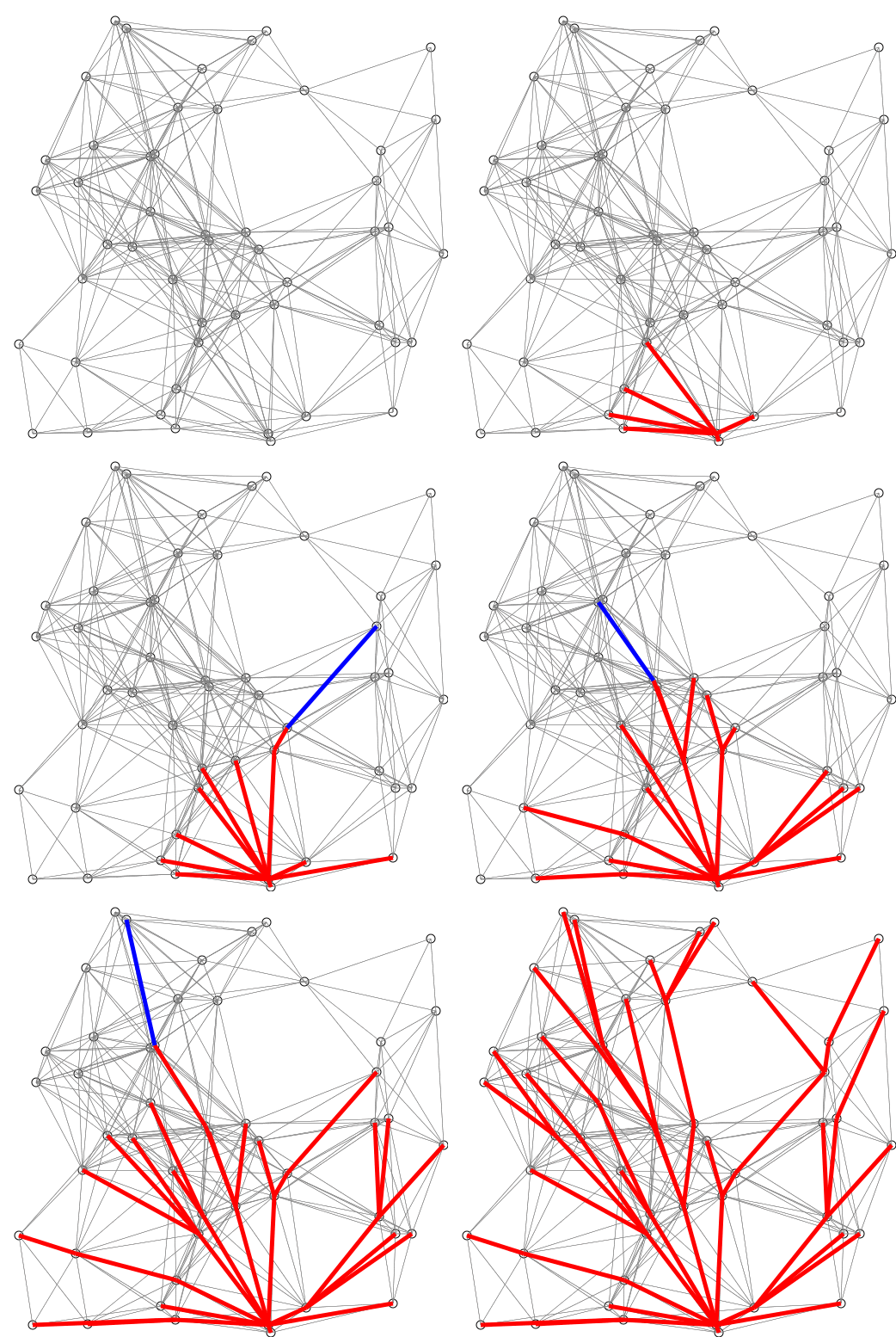
Dijkstra's algorithm finds the shortest paths from a single start node to all other nodes in a weighted graph. It applies to directed or undirected graphs where every edge weight is nonnegative. The method produces a shortest-path tree and is widely used in routing, map navigation, and network analysis. For more background see Dijkstra's algorithm.
Image gallery
4 Images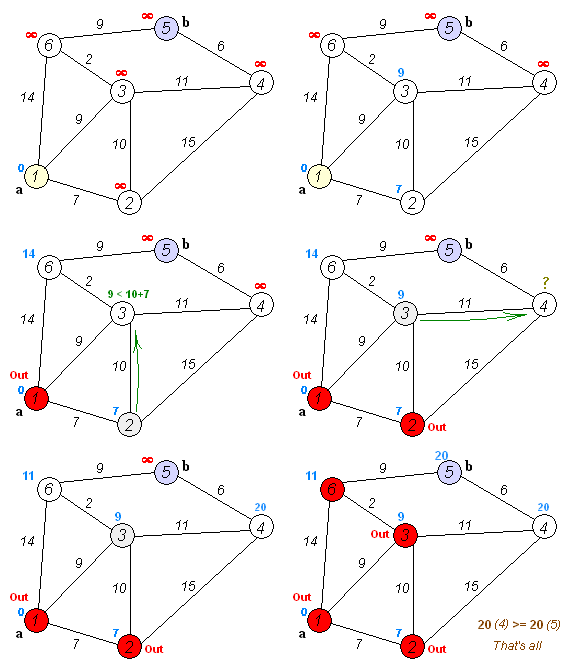


Key characteristics
The algorithm is greedy: it repeatedly selects the not-yet-processed node with the smallest tentative distance and relaxes its outgoing edges. Important elements include:
- Vertices and edges: nodes and connections with numerical weights.
- Nonnegative weights: required to guarantee correctness.
- Tentative distances: provisional shortest-path estimates updated during execution.
How it works
At a high level the steps are:
- Initialize the start node distance to zero and all others to infinity.
- Select the unvisited node with smallest distance.
- For each neighbor, compute a candidate distance through the selected node and update if smaller ("relaxation").
- Mark the selected node as visited and repeat until all reachable nodes are processed.
Complexity and variations
Performance depends on the data structure used for selecting the minimum-distance node. Using a binary heap yields roughly O((V + E) log V). A Fibonacci heap reduces this to O(E + V log V) in theory. A dense graph with an adjacency matrix can be implemented in O(V^2). Practical implementations trade memory and overhead against theoretical bounds.
History, uses and limitations
Named after Edsger W. Dijkstra, who published the method in 1959, the algorithm became foundational in computer science. Common applications include shortest-path routing in GPS and internet routing protocols, pathfinding in games, and resource optimization. Its main limitation is that it cannot handle negative edge weights; algorithms such as Bellman–Ford are used when negative weights or negative cycles must be considered.
Related articles
Author
AlegsaOnline.com Dijkstra's algorithm Leandro Alegsa
URL: https://en.alegsaonline.com/art/27409