
Discrete cosine transform: concept, properties, and common applications
Overview of the discrete cosine transform (DCT), its mathematical role in frequency analysis, main properties and types, historical development, and typical uses such as image and audio compression.
The discrete cosine transform (DCT) is a linear transformation that converts a finite sequence of real numbers into a sum of cosine functions oscillating at different frequencies. It is widely used in signal processing because it concentrates energy: typical signals or images can be represented compactly with a few large coefficients and many near-zero coefficients. That property makes the DCT useful for compression and for separating slow variations from rapid changes in sampled data.
Image gallery
7 Images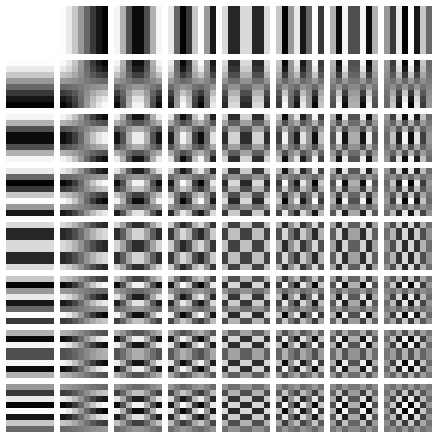




Basic idea and key properties
At its core the DCT projects data onto a set of orthogonal cosine basis functions. Unlike complex-valued Fourier transforms, the standard DCT works with real numbers and uses only cosine terms, which often produces better energy compaction for real, even-symmetric signals. Important properties include separability (a 2-D DCT can be computed by applying 1-D DCTs along each dimension), strong decorrelation of typical image samples, and the availability of fast algorithms that reduce computation cost.
Common types and distinctions
- Several DCT variants exist (commonly called DCT-I through DCT-IV); each differs in boundary conditions and symmetry.
- The modified discrete cosine transform (MDCT) is a related, overlapping transform used in many audio codecs.
- Choice of type affects implementation details, energy compaction, and how block boundaries are handled in compression schemes.
History and development
The DCT became widely adopted in the late 20th century as computational speed and digital sampling proliferated. Its use in digital image and video coding standards followed from early research showing that many natural signals concentrate most of their information in low-frequency cosine terms. Standardization and efficient implementations helped the DCT become a building block of practical compressors.
Applications and examples
The most prominent application is image compression: formats like JPEG use an 8×8 block 2-D DCT to transform pixel blocks into frequency coefficients, then quantize and encode them to reduce file size. In audio, perceptual coders rely on transforms related to the DCT; for example, many audio codecs use the MDCT for time-frequency analysis in audio compression. More generally, the DCT is useful wherever frequency analysis of sampled real-valued data is needed, such as denoising, watermarking, and feature extraction—an aspect tied to classical frequency analysis.
Because the DCT is conceptually close to the Fourier transform but tailored for real, finite sequences, it remains a practical and theoretically grounded tool across imaging and signal processing disciplines.
Related articles
Author
AlegsaOnline.com Discrete cosine transform: concept, properties, and common applications Leandro Alegsa
URL: https://en.alegsaonline.com/art/27663