
Dirac delta function
Overview of the Dirac delta: informal definition, rigorous status as a distribution, main properties, common representations, and applications in mathematics, physics, and engineering.
Overview
The Dirac delta, commonly denoted δ(x), is a mathematical object used to model an idealized point concentration of mass, charge, or impulse. Informally it is described as being zero everywhere except at a single point and having unit integral. That loose description is useful in physics and engineering, but strictly speaking the delta is not an ordinary function: it is most consistently treated as a distribution (generalized function) that assigns a value to integrals against well-behaved test functions. The name honors the physicist Paul Dirac, who introduced the concept in the context of quantum mechanics.
Image gallery
1 Image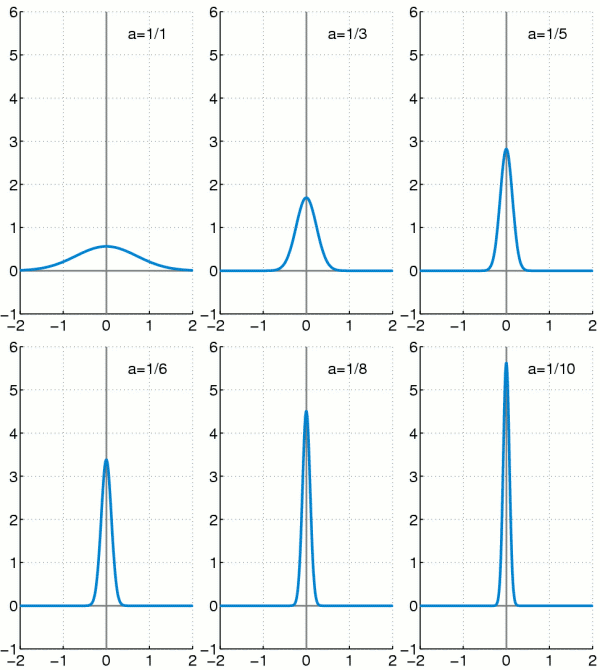
Definition and rigorous interpretation
In the language of distributions, the delta at a point a is defined by its action on a test function φ: ⟨δ_a, φ⟩ = φ(a). Equivalently, for continuous functions f, the defining identity is ∫_{-∞}^{∞} f(x) δ(x - a) dx = f(a). This is often called the sifting or sampling property. Because δ is defined by how it integrates, many limiting constructions produce the same distribution: for example, a sequence of Gaussians with fixed area and vanishing variance, or a sequence of narrow rectangular pulses, converge to δ in the distributional sense.
Key properties and identities
- Normalization: ∫ δ(x) dx = 1.
- Sifting: ∫ f(x) δ(x - a) dx = f(a), when f is continuous at a.
- Scaling: δ(ax) = (1/|a|) δ(x) for nonzero a.
- Translation: δ(x - a) is concentrated at x = a.
- Convolution: f * δ = δ * f = f for suitable f.
- Derivative: The derivative δ' is a distribution defined by ⟨δ', φ⟩ = -φ'(0); derivatives model pointwise moments and appear in multipole expansions.
- Composition with functions: If g has simple zeros x_i, then δ(g(x)) can be written as a sum of scaled deltas at the roots: δ(g(x)) = Σ_i δ(x - x_i)/|g'(x_i)| under appropriate conditions.
Representations and limits
The delta can be obtained as a limit of ordinary functions whose area remains 1 while their support shrinks. Common approximations include normalized Gaussians with variance tending to zero, rectangular pulses of shrinking width and unit area, and sinc kernels in the context of Fourier analysis. In frequency theory, the Fourier transform of δ(x) is the constant function 1, and conversely the transform of a constant is a delta at zero frequency. These relationships make δ central in spectral analysis and signal processing.
History and mathematical development
Paul Dirac introduced the delta in physical arguments, treating it informally as an infinitely tall, infinitely narrow spike with unit area. Mathematicians later provided rigorous frameworks: the theory of distributions (generalized functions) developed by Laurent Schwartz and others gave the delta a solid foundation, clarifying how it and its derivatives operate under integration and differentiation.
Applications and examples
The delta appears in many fields. In physics it models point masses, point charges, and concentrated sources in differential equations. In engineering and control theory it represents ideal impulses and is used to define impulse responses of linear time-invariant systems: the output to δ(t) is the system's Green's function. In partial differential equations the delta on the right-hand side produces fundamental solutions that describe how a localized source influences a field. In sampling theory the delta train models ideal sampling; multiplying a continuous signal by a comb of deltas yields discrete sample values via the sifting property.
Notable distinctions and cautions
Although the informal picture of δ as a genuine function is often convenient, treating it as an ordinary function leads to contradictions and misuse. Operations such as multiplying two deltas or assigning a pointwise value to δ are not defined in the usual distribution framework and require additional algebraic structures (for example, Colombeau algebras) if pursued. For most practical purposes in analysis, physics, and engineering, the distributional interpretation—defined by integration against test functions—provides the correct and reliable basis for using the Dirac delta.
For concise formal references and further reading see introductions to generalized functions and textbooks on Fourier analysis and partial differential equations; for a historical perspective follow notes on the Heaviside step function and on the development of distribution theory.
Related articles
Author
AlegsaOnline.com Dirac delta function Leandro Alegsa
URL: https://en.alegsaonline.com/art/27583