
Dhatki (Dhati, Thari): a Rajasthani sociolect
Dhatki (also Dhati or Thari) is a variety of Marwari Rajasthani spoken in parts of Rajasthan, India and Sindh, Pakistan, notable for glottalized and implosive sounds and cross-border cultural links.
Overview
Dhatki, also called Dhati or Thari, is a regional variety of the Marwari branch of Rajasthani languages. It is best described as a sociolect with its own phonological identity and local vocabulary rather than a fully separate language in standard classifications. Dhatki speakers are found on both sides of the India–Pakistan border, and the variety carries features shaped by contact with neighbouring languages and dialects.
Image gallery
2 Images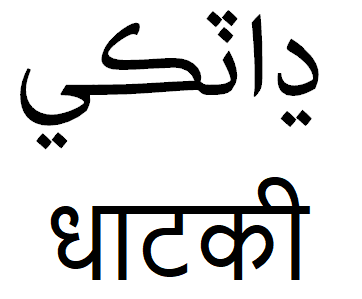

Geographic distribution
The core Dhatki-speaking area lies in the western Indian state of Rajasthan and adjoining parts of Sindh province in Pakistan. In India, it is traditionally spoken in and around the desert districts of western Rajasthan, notably Jaisalmer and Barmer. In Pakistan, significant communities speak Dhatki in the eastern Sindh districts including Tharparkar, Umarkot, Mirpurkhas, Sanghar and Badin; see local accounts for district-level details at Sindh sources and broader context at Pakistan regional language resources.
Linguistic classification and characteristics
Classified within the Indo-Aryan family, Dhatki is usually treated as a form of Marwari Rajasthani. It shares grammar and much of its lexicon with other Rajasthani varieties, but is distinguished by characteristic phonetic features, most notably the presence of glottalized consonants and implosive-like articulations that are uncommon in many neighbouring dialects. Other distinguishing traits include particular vowel qualities and local lexical items used for familial, pastoral and agricultural activities.
Typical features (at a glance)
- Phonology: glottalization and implosive sounds, distinct regional vowel patterns.
- Lexicon: loanwords and influences from Sindhi, Urdu and standard Rajasthani forms.
- Mutual intelligibility: generally high with nearby Marwari varieties, but marked by local terms and pronunciation.
Writing, literature and oral traditions
Dhatki has a strong oral tradition: songs, folktales and poetry circulate in the local speech. Where written, speakers commonly use Devanagari script in India and Perso-Arabic based scripts in Pakistan, reflecting broader regional practices. Formal literature is limited, but oral genres preserve cultural memory and local knowledge. Efforts to document folk material and make bilingual recordings have increased in recent decades.
History, migration and cross-border communities
The historical homeland of Dhatki communities is the Thar Desert region, where sedentary and pastoral lifestyles shaped vocabulary and social usage. Large-scale population movements at the time of the 1947 partition led many Dhatki-speaking families to relocate within the new borders of India and Pakistan; some migration occurred in 1947 and continued in smaller numbers afterwards. These movements created diasporic pockets and influenced language contact and borrowing. For historical background related to migration, see colonial-era and partition-era studies at partition migration resources.
Status and current trends
Today Dhatki remains a living vernacular in many communities but faces pressures common to regional languages: urbanisation, language shift to national or regional standards (Hindi, Urdu, Sindhi), and limited representation in formal education and media. Community-driven documentation, bilingual education materials and recordings of oral literature are among practical measures that supporters and linguists have suggested to preserve the variety. Scholars and local activists continue to record and describe Dhatki to ensure its phonological and cultural distinctiveness is not lost.
Note: This article summarizes broadly known linguistic and sociocultural features. Precise speaker numbers, dialectal boundaries and orthographic conventions vary by source and local practice.
Related articles
Author
AlegsaOnline.com Dhatki (Dhati, Thari): a Rajasthani sociolect Leandro Alegsa
URL: https://en.alegsaonline.com/art/27045