
Dew point — atmospheric moisture and its measurement
Dew point: the temperature at which air becomes saturated and water vapor begins to condense. Explains physical basis, measurement methods, practical uses, differences from relative humidity, and notable facts.
Overview
The dew point is the temperature at which air holding water vapor reaches saturation and vapor begins to condense into liquid. In practical terms, it indicates how much moisture the air contains: a higher dew point means more water vapor. You can think of it as the temperature to which air must be cooled (at constant pressure) for condensation to start. For a concise definition see temperature at which air becomes saturated.
Image gallery
2 Images
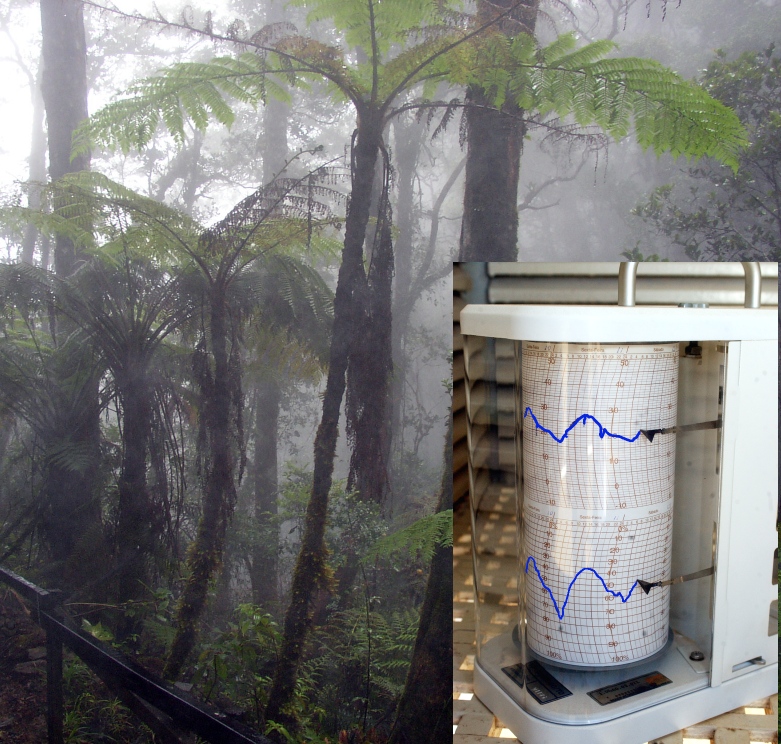
Physical basis
Air contains an amount of water vapor determined by temperature and pressure. When the vapor concentration reaches the saturation vapor pressure for that temperature, condensation occurs. This is governed by thermodynamic relationships related to vapor pressure and the Clausius–Clapeyron principle. Condensation can produce dew, fog, or cloud droplets depending on where it occurs. The transformation of vapor into liquid on surfaces is often described simply as condensation, and the collected moisture is ordinary liquid water in most temperate situations.
Measurement and calculation
Several instruments and methods estimate dew point. Direct methods include chilled‑mirror (dew point hygrometers) that cool a surface until condensation appears. Indirect techniques use dry‑ and wet‑bulb temperatures or relative humidity readings and convert them via empirical formulas. For common instrument information see hygrometer. Meteorological reports often provide dew point alongside air temperature to summarize moisture conditions.
Uses and practical importance
- Weather forecasting: Dew point helps predict fog, frost, and precipitation potential.
- Human comfort: Dew point correlates with how muggy the air feels—lower values feel dry; higher values feel oppressive.
- Engineering and industry: Controls in HVAC, drying processes, and refrigeration depend on dew point to avoid condensation and corrosion.
- Aviation and agriculture: Helps assess icing risk, crop dew formation, and disease conditions.
Distinctions and notable facts
Dew point differs from relative humidity: relative humidity is a ratio that depends on current air temperature, while dew point is an absolute indicator of moisture content. When dew point is below 0°C the corresponding temperature for condensation is called the frost point, and deposition forms ice rather than liquid. Rough comfort guidelines often cite dew points below about 10°C as dry, 10–16°C as comfortable, and values above roughly 20–24°C as increasingly uncomfortable or oppressive.
History and context
The concept has long been part of meteorology and climatology. Measurement techniques have evolved from simple psychrometers to precise electronic and chilled‑mirror instruments, improving the accuracy of forecasts and environmental control. Understanding dew point remains central to interpreting atmospheric moisture in both everyday and technical contexts.
Related articles
Author
AlegsaOnline.com Dew point — atmospheric moisture and its measurement Leandro Alegsa
URL: https://en.alegsaonline.com/art/26997