
Hygrometer — Instrument for measuring atmospheric humidity
Overview of hygrometers: principles, common types (psychrometer, hair, capacitive, chilled mirror), history, applications in meteorology, HVAC, museums and calibration considerations.
A hygrometer is an instrument designed to measure the amount of water vapor in air. It is commonly used to determine relative humidity, dew point and to monitor moisture conditions for weather forecasting, climate control, industrial processes and preservation. Modern hygrometers range from simple mechanical devices to precise electronic sensors and laboratory standards.
Image gallery
7 Images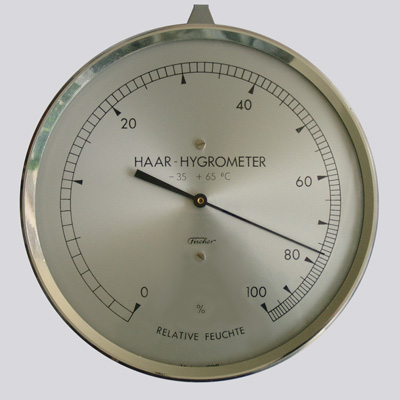



How hygrometers work
Different hygrometer designs exploit physical responses to moisture. One classical approach is the psychrometer, which uses two thermometers: a dry bulb and a wet bulb. Evaporation from the wet bulb lowers its temperature; the difference between the two readings is used, with reference tables or formulas, to calculate relative humidity. Other instruments measure a material property that changes with humidity—electrical resistance, capacitance, or a mechanical length change of a hygroscopic element.
Common types and components
- Psychrometers (wet-and-dry bulb) — often made as a sling psychrometer or aspirated psychrometer; widely used for field and teaching purposes. See a simple explanation here.
- Hair hygrometers — use natural or synthetic hairs that lengthen or shorten with moisture; they provide an analog indication and date back to early scientific instruments. More on historic designs here.
- Capacitive and resistive sensors — electronic probes that change electrical properties with humidity; common in HVAC controllers, weather stations and data loggers. Technical notes are available here.
- Chilled-mirror (dew-point) hygrometers — determine dew point by cooling a mirror until condensation appears; among the most accurate for laboratory use. Instrument descriptions can be found here.
- Other types — optical, gravimetric and chemical hygrometers are used for specialized applications and calibration standards.
History and development
Observations linking air and moisture date back centuries. Practical hygrometers evolved in the 18th and 19th centuries as scientists created devices that made humidity measurable and repeatable. During the 20th century, electrical sensing technologies and digital electronics supplanted many mechanical instruments, enabling compact sensors, automatic logging and networked environmental monitoring.
Uses, examples and importance
Hygrometers are used across many fields: meteorology and climatology to report humidity for forecasts; building management and HVAC to control indoor comfort and prevent mold; museums and archives to protect sensitive artifacts; agriculture and food storage to maintain quality; and industrial processes where moisture affects product properties. Portable psychrometers, fixed electronic sensors and chilled-mirror standards each serve different accuracy and durability needs. Practical guidance for selecting sensors appears here.
Key distinctions and practical notes
It is important to distinguish relative humidity (a percentage expressing current vapor relative to saturation at that temperature), absolute humidity (mass of vapor per volume), and dew point (the temperature at which air becomes saturated). Selection and placement of a hygrometer affect readings: sensor type, response time, contamination, ventilation and calibration all matter. Routine calibration against a known standard or salt solutions helps maintain accuracy. Understanding these factors allows correct interpretation of readings and effective environmental control.
Questions and answers
Q: What is a hygrometer?
A: A hygrometer is a meteorological instrument used to measure the humidity of the air.
Q: How does a hygrometer work?
A: A hygrometer works by using a material that attracts moisture. This material changes depending on how hydrated it is. A hygrometer has two bulbs: one wet and one dry. Both bulbs are like thermometers, though one is covered with a wet or dry towel. After a period of time, the water on the bulb evaporates and at that time, the temperature is measured on each bulb. The difference between the temperatures is noted.
Q: What is relative humidity?
A: Relative humidity is a ratio, so it has no unit.
Q: How is relative humidity calculated?
A: Each of the temperatures are used on a chart to find the relative humidity of that temperature and area.
Q: What does a small difference between the temperature of the bulbs show?
A: A small difference between the temperature of the bulbs shows a high relative humidity coming from a low evaporation rate.
Q: What does a large difference in temperature show?
A: In dry air, evaporation takes place faster showing a large difference in temperature thus giving a low relative humidity.
Q: How many bulbs does a hygrometer have?
A: A hygrometer has two bulbs: one wet and one dry.
Related articles
Author
AlegsaOnline.com Hygrometer — Instrument for measuring atmospheric humidity Leandro Alegsa
URL: https://en.alegsaonline.com/art/46131