
Curl‑crested manucode (Manucodia comrii)
A large, glossy bird of paradise from Papua New Guinea islands, notable for curled head feathers, twisted tail feathers, fruit diet, and a restricted island range. Named after Peter Comrie.
The curl‑crested manucode (Manucodia comrii) is a distinctive member of the birds of paradise family (Paradisaeidae) found in a small group of islands off eastern New Guinea. Medium‑large for the family, it is primarily a frugivore with striking glossy plumage and several unique feather shapes that give the species its common name.
Image gallery
3 Images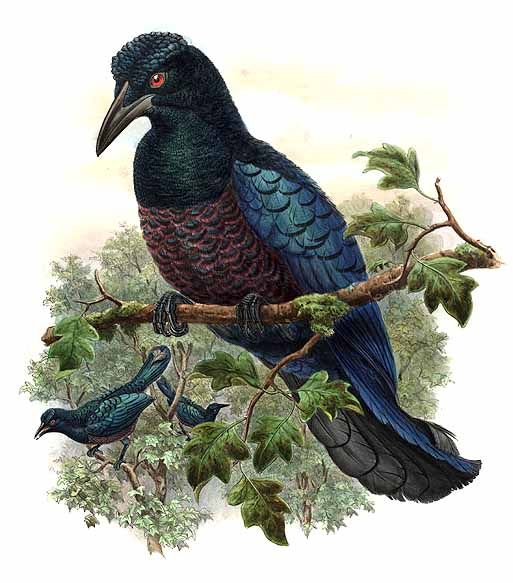


Description
This species reaches roughly 43 cm in overall length. Its feathers are glossy with shades of purple, black and green that change with light. The upper breast and neck bear crinkled, yellowish‑green feathers that contrast with the darker body. The head carries curled feathering that appears ruffled or curled at the crown, and the central tail feathers are twisted rather than straight. The iris is red, a noticeable detail when the bird is observed closely.
- Size: about 43 cm long; among the larger birds of paradise by body mass.
- Plumage: iridescent black, green and purple tones; crinkled upper breast feathers.
- Distinctive features: curled crown feathers and twisted central tail feathers; red eye.
Distribution and habitat
The curl‑crested manucode is restricted to island groups in southeastern Papua New Guinea, including the Trobriand Islands and the D'Entrecasteaux Archipelago, where it was first reported on Fergusson Island. It inhabits lowland and foothill rainforest, where fruiting trees provide the main food resources. Its limited island range means populations are naturally localized rather than widespread across large continental areas.
Behavior and diet
Primarily frugivorous, curl‑crested manucodes feed on a variety of fruits and berries and may supplement their diet with small animals or arthropods when available. Compared with some of the more flamboyant birds of paradise, manucodes as a group are relatively subdued in display and often show less extreme sexual dimorphism; males and females resemble one another more closely. They are known for distinct vocalizations and can be territorial around reliable fruiting sites.
Taxonomy and naming
The scientific name is Manucodia comrii. The species was named in the 19th century by the British zoologist Philip Lutley Sclater in honor of Peter Comrie, who discovered the bird on Fergusson Island in 1874. Manucodia is a small genus within Paradisaeidae that groups several similarly built, glossy manucodes distinguished from the more ornate, plume‑rich members of the family.
Conservation and significance
Because the curl‑crested manucode occupies a restricted island range, it can be vulnerable to habitat alteration, invasive species and localized hunting pressure. However, its status depends on the scale of habitat loss and local protection measures. The species is of interest to ornithologists and birdwatchers alike because it illustrates the diversity of form and behavior within birds of paradise—showing how some lineages emphasize iridescent plumage and vocal behavior rather than extreme ornamental displays.
For further reading and species accounts, see additional resources on island avifauna and Paradisaeidae diversity.
Related articles
Author
AlegsaOnline.com Curl‑crested manucode (Manucodia comrii) Leandro Alegsa
URL: https://en.alegsaonline.com/art/24709
Sources
- iucnredlist.org : "Manucodia comrii"
- iucnredlist.org : Manucodia comrii
- macaulaylibrary.org : Cornell Lab of Ornithology