
Cymbospondylus — a large, primitive Triassic ichthyosaur
Cymbospondylus was a long, eel-like ichthyosaur of the Middle and Late Triassic known from Europe and North America; it illustrates an early stage in marine reptile evolution.
Overview
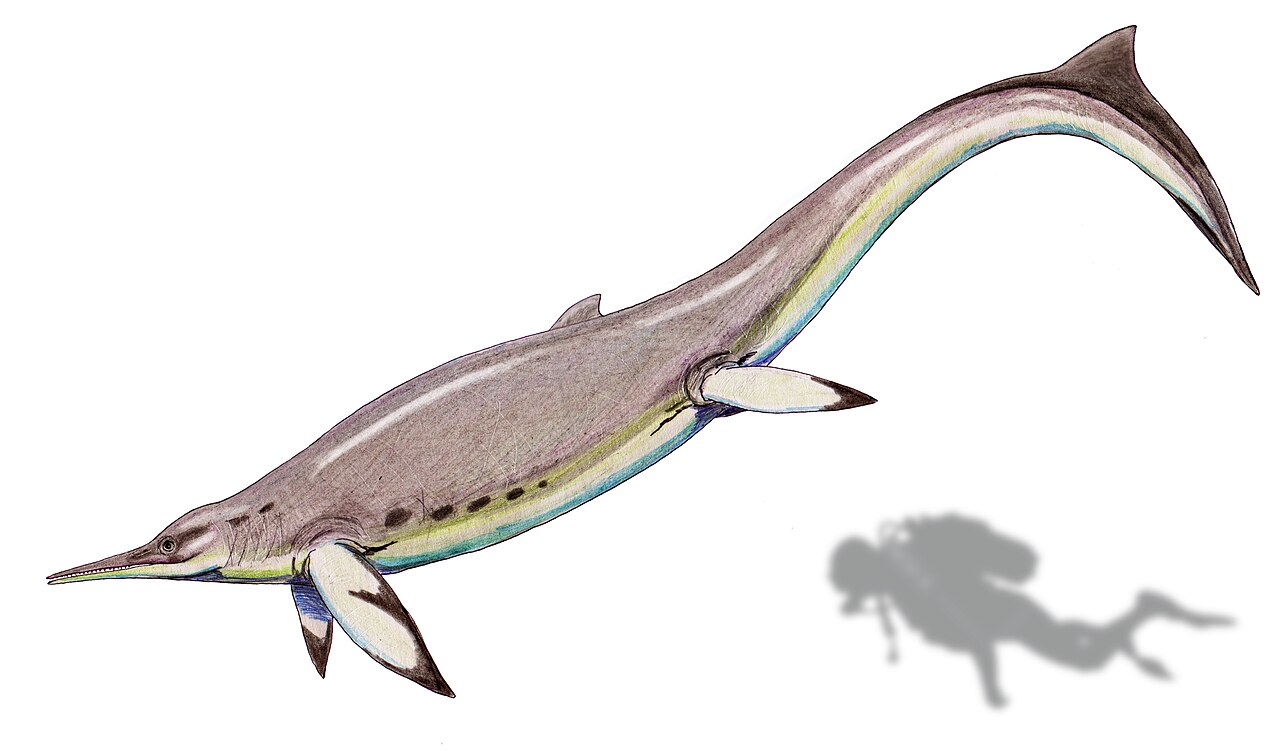
Cymbospondylus was an early, relatively large marine reptile belonging to the group known as ichthyosaurs. It lived during the Triassic, with fossil remains assigned to the Middle and Upper portions of that period. Individuals reached lengths of roughly up to about 10 meters, making them among the largest of the early ichthyosaurs. Fossils have been reported from widely separated regions, which suggests a broad oceanic distribution similar to other large marine reptiles and some modern aquatic mammals.
Image gallery
10 Images





Anatomy and appearance
Cymbospondylus combined primitive features with adaptations for life in open water. Unlike later, dolphin-shaped ichthyosaurs, it retained a long, flexible, eel-like body with an elongated trunk. The skull was relatively long and narrow and bore conical teeth suited to grasping fish and other marine animals. Limbs had evolved into broad paddles, but the tail lacked the strongly downturned fluke seen in more derived ichthyosaurs, indicating a different swimming style.
Key characteristics
- Large body size for Triassic ichthyosaurs.
- Elongated, laterally compressed trunk rather than a short, fusiform shape.
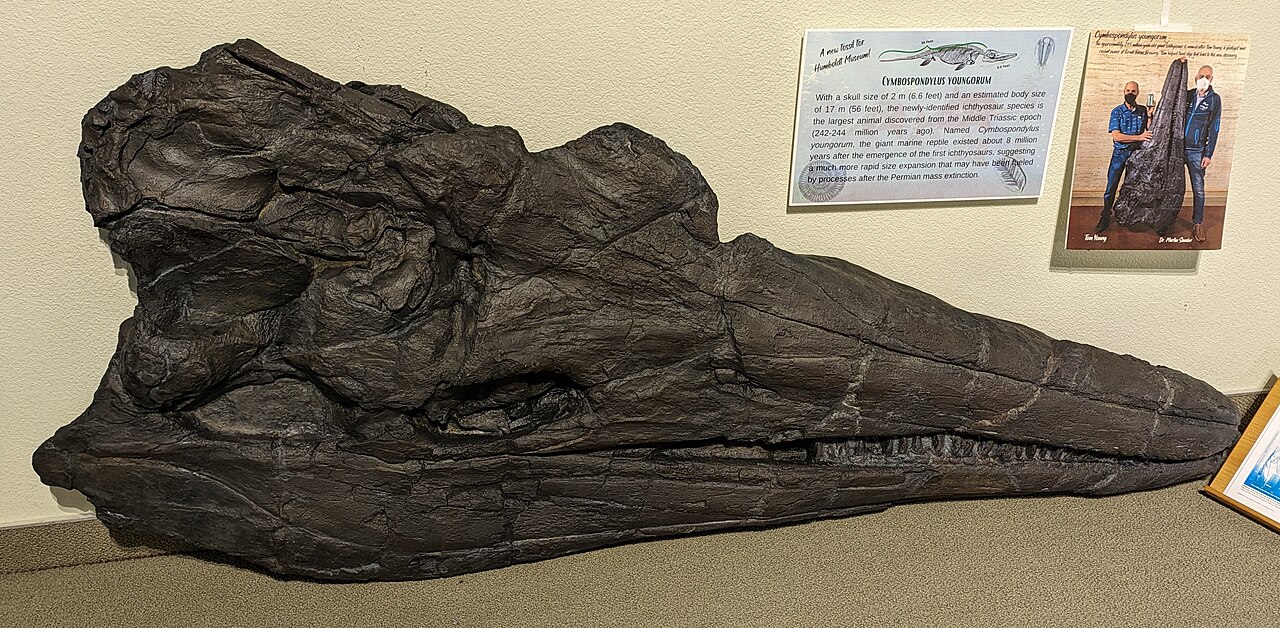
- Long skull with conical teeth adapted for a piscivorous diet.
- Paddle-like limbs and a less specialized tail than later forms.
Fossil record and distribution
Specimens of Cymbospondylus have been found in Europe and North America, notably in regions of Germany and in deposits of Nevada. The geographic spread of finds, coupled with its anatomical features, supports the interpretation that it inhabited open marine environments rather than being restricted to coastal lagoons. Its remains are often incomplete, and much of what is known comes from partial skeletons interpreted within the broader context of Triassic marine faunas.
Ecology and significance
As a large predator, Cymbospondylus likely fed on fish, cephalopods and other available marine prey, using its streamlined head and teeth to seize slippery animals. Its combination of primitive and derived traits makes it important for understanding how ichthyosaurs transitioned from more elongate, serpentine ancestors toward the more fish- or dolphin-like body plans that appear later in the Mesozoic. The genus therefore occupies a key place in studies of marine reptile evolution and early Mesozoic ecosystems.
Notable distinctions
Compared with later ichthyosaurs, Cymbospondylus retained a less specialized swimming apparatus and an overall body form that emphasizes axial undulation over powerful tail-driven propulsion. This distinction highlights the diversity of locomotor strategies among early marine reptiles and helps explain how different lineages adapted to life in the open ocean.
For additional background and fossil updates see resources on the Triassic environment and ichthyosaur research: Triassic overview, ichthyosaur studies, and regional paleontology pages for Germany and Nevada. Comparative materials on large marine reptiles and modern analogues are available via links about marine reptiles and aquatic mammals.
Questions and answers
Q: What is Cymbospondylus?
A: Cymbospondylus is a large but primitive Triassic ichthyosaur.
Q: What is the size of Cymbospondylus?
A: Cymbospondylus had a long eel-like body up to 10 meters or more in length.
Q: Where is Cymbospondylus known from?
A: Cymbospondylus is known from both Germany and Nevada.
Q: What is the time period during which Cymbospondylus existed?
A: Cymbospondylus existed during the Middle and Upper Triassic.
Q: What is the potential oceanic distribution of Cymbospondylus?
A: Like other large marine reptiles and present-day aquatic mammals, Cymbospondylus had a wide oceanic distribution.
Q: What is the age of Cymbospondylus?
A: Cymbospondylus dates back to the Triassic era, which was over 200 million years ago.
Q: How did Cymbospondylus differ from other marine creatures living during the same time period?
A: Cymbospondylus was a large but primitive ichthyosaur whereas other marine creatures of the same time period could be more evolved or differently adapted to their environment.
Related articles
Author
AlegsaOnline.com Cymbospondylus — a large, primitive Triassic ichthyosaur Leandro Alegsa
URL: https://en.alegsaonline.com/art/24901
Sources
- bbc.co.uk : "Cymbospondylus"