
Credo: the Christian statement of faith
Overview of the Credo—its meaning, liturgical placement in the Mass, principal creeds (Nicene, Apostles', Athanasian), musical settings, history and theological role.
Overview
The word credo is Latin for "I believe" and denotes a formal statement of Christian faith. In public worship the Credo is often recited or sung as part of the Eucharistic service or Mass. It functions as a concise summary of core Christian convictions and serves both as a confession of belief by the congregation and as a boundary marker for communal doctrine.
Image gallery
4 Images


Structure and central themes
Though various formularies exist, most creeds cover similar topics: the nature of God as Trinity, the person and work of Jesus Christ, the role of the Holy Spirit, the church, baptism and forgiveness, resurrection and final judgment. A typical outline contains affirmations about:
- God the Father and Creator
- Jesus Christ's divinity, incarnation, death and resurrection
- The Holy Spirit's presence and action
- The church, sacraments, and ultimate hope in eternal life
History and development
Credal statements emerged as the early church sought concise formulas to teach and defend its faith. Councils and theological controversies in the fourth and fifth centuries prompted more formalized creeds. The best known of these is the Nicene Creed, produced in the context of the Council of Nicaea and later revisions, which addressed debates about Christ's divinity. Shorter, baptismal creeds developed earlier for catechesis and baptismal instruction.
Liturgical and musical use
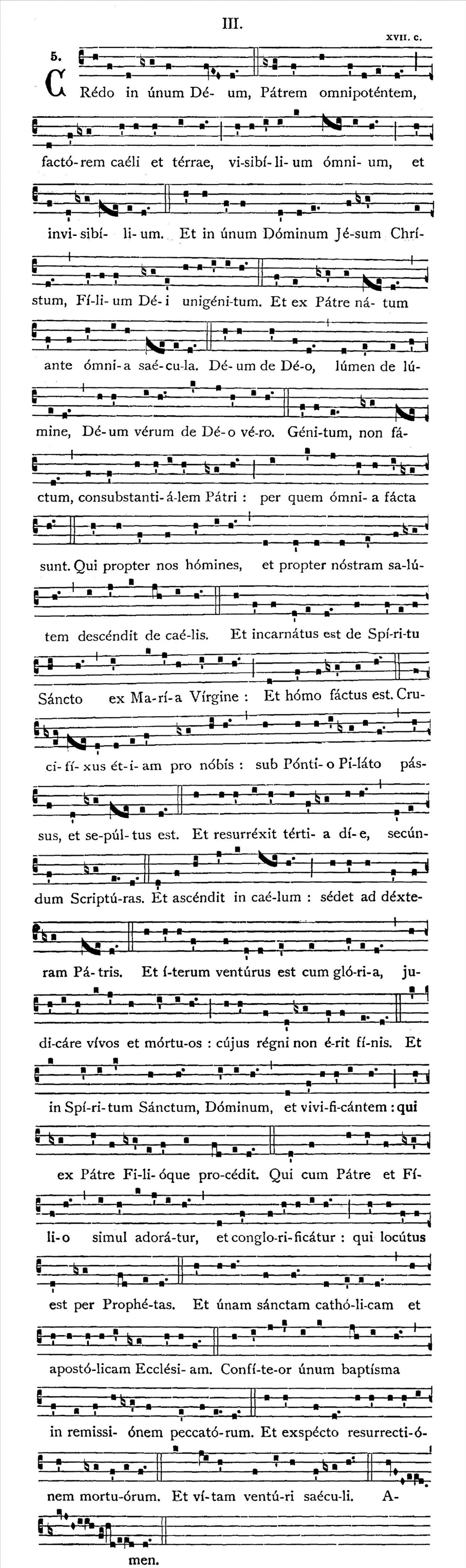
In many Western and Eastern rites the Credo appears at a regular point in the service. In some traditions it is spoken by the congregation; in others it is sung by the choir or congregation. The musical setting of the Credo has attracted composers across centuries — from plainchant to elaborate polyphony and modern compositions. Numerous composers have set the text to music; for example, the Baroque composer Antonio Vivaldi composed settings of the creed, and it continues to appear in choral masses and oratorios.
Principal creeds and distinctions
Several credal texts are widely used and referenced. The Nicene Creed is standard in many liturgical traditions and is especially prominent in Catholicism. The shorter Apostles' Creed is common in baptismal rites and catechesis. The Athanasian Creed is a later, more detailed statement that emphasizes Trinitarian doctrine and Christology. These texts are important for ecumenical dialogue because they articulate shared convictions even amid theological differences.
Importance and contemporary use
Credoes continue to shape worship, instruction and identity in many Christian communities. They serve as teaching tools, liturgical elements, and points of reference in theological discussion. Whether chanted in ancient melodies or spoken in modern services, the Credo remains a compact expression of what a community holds to be true about God, Christ and the world to come.
Mass • Catholicism • Nicene Creed • Athanasian Creed • Apostles' Creed • Vivaldi
Related articles
Author
AlegsaOnline.com Credo: the Christian statement of faith Leandro Alegsa
URL: https://en.alegsaonline.com/art/24070