
AAR wheel arrangement (North American locomotive axle classification)
AAR wheel arrangement is the North American system for describing locomotive axle and truck layouts using letters for powered axles and numbers for unpowered axles.
The AAR wheel arrangement is a concise notation used in North America to describe how locomotive axles are arranged and which of those axles are powered. It was developed as a practical, simpler alternative to the international UIC notation and is widely used by railroad engineers, equipment rosters and technical documents. The system communicates axle counts, powered versus unpowered axles, and grouping by truck or bogie.
Image gallery
1 Image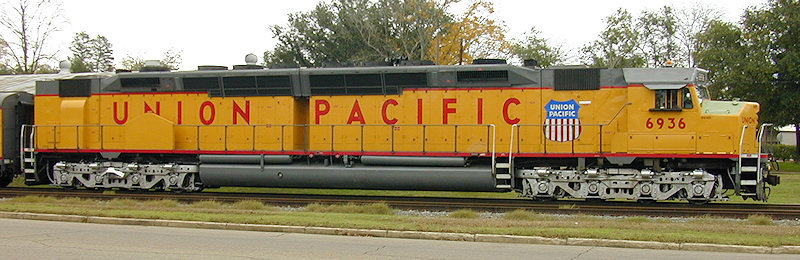
Basic notation and meaning
In AAR notation letters represent powered axles and numbers represent unpowered axles. Common letters are A (one powered axle), B (two), C (three) and D (four). Numerals such as 1 or 2 indicate one or two idle axles. Groups separated by hyphens correspond to trucks or distinct wheel assemblies. For example, B-B denotes two trucks each with two powered axles; C-C indicates two trucks each with three powered axles; A1A-A1A describes two three-axle trucks where the outer axles are powered and the center axle is unpowered.
Characteristics and practical effects
Wheel arrangement affects traction, axle load distribution, and the ability to navigate curves. More powered axles generally increase tractive effort and are common on heavy freight locomotives. Arrangements with intermediate unpowered axles can lower per-axle weight for track-sensitive service such as passenger trains or lightweight branch lines. The AAR format does not explicitly show whether motors are individually driven or how axles are linked; it focuses on counts and grouping.
History and relationship to UIC
The scheme traces its origin to North American practice and is maintained by the American Association of Railroads. It is a simplified alternative to the UIC system used in much of the world; UIC provides more detail about individual axle drives and articulation. For comparisons and further technical background see AAR vs UIC overview and standard references such as locomotive classification guides.
Common examples and uses
- B-B: common for road-switcher diesels and many modern light locomotives.
- C-C: typical for heavy freight locomotives where high tractive effort is required.
- A1A-A1A: used historically on some passenger diesels to reduce axle loading while keeping two powered axles per truck.
Railroads use the notation in equipment rosters, maintenance records and regulatory filings. Electric and diesel-electric locomotives in North America are both commonly described with AAR notation; for additional examples consult technical summaries or fleet listings at roster resources and manufacturer documentation at equipment pages.
While compact and practical, the AAR arrangement is one of several systems used globally. When detailed drive arrangements, articulation, or axle-by-axle motorization must be recorded, specialists may prefer the more expressive UIC or manufacturer schematics. Nevertheless, AAR notation remains the standard shorthand in North American railroad practice.
Related articles
Author
AlegsaOnline.com AAR wheel arrangement (North American locomotive axle classification) Leandro Alegsa
URL: https://en.alegsaonline.com/art/237