
Counties of Northern Ireland
Overview of Northern Ireland’s six historic counties: their geography, history, administrative role, cultural importance, and relation to the island’s 32 counties.
Overview
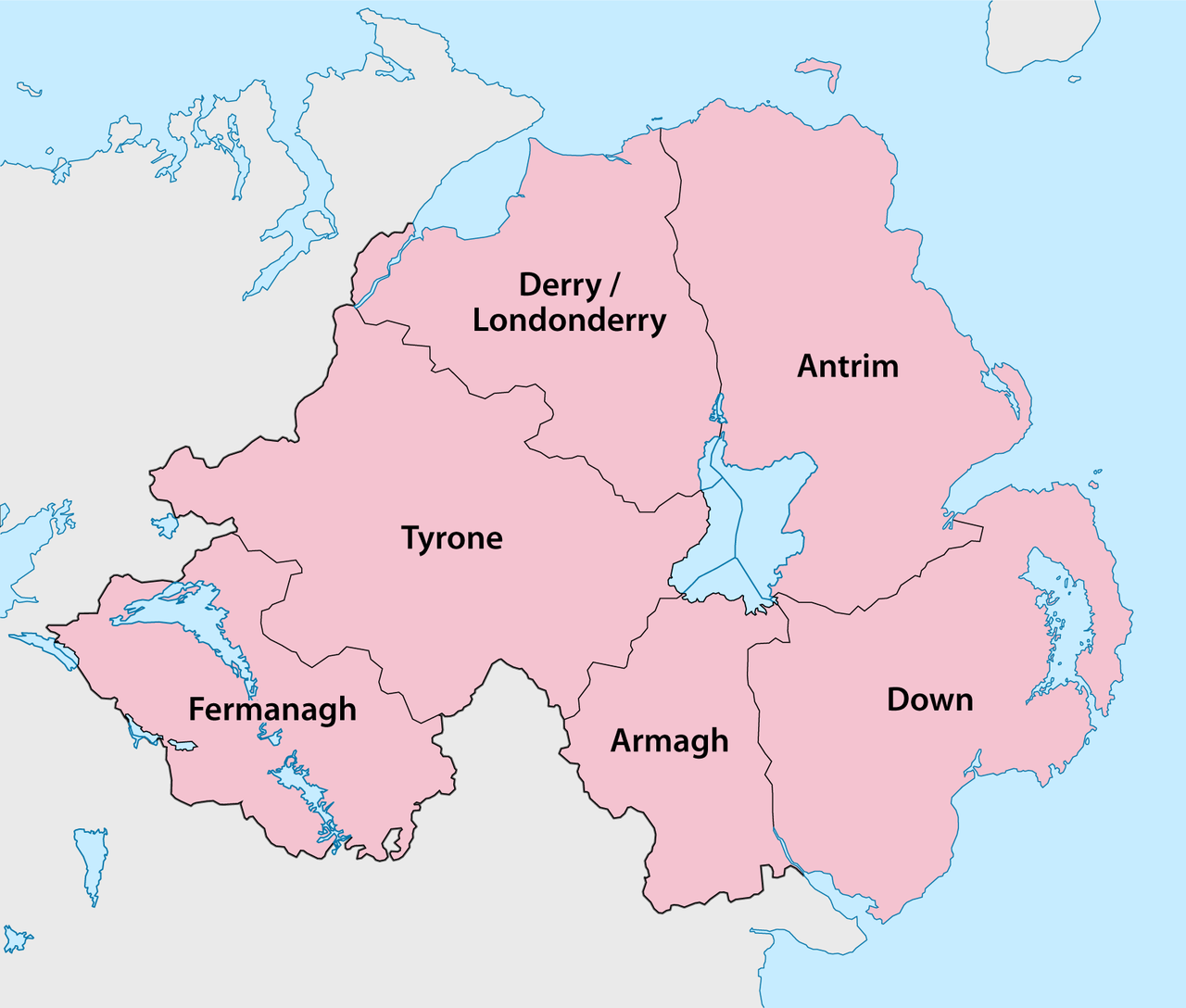
The traditional division of Northern Ireland comprises six counties that are long-established sub‑national units used for geography, identity and many cultural purposes. The six are listed below and form the portion of the United Kingdom commonly called Northern Ireland:
Image gallery
6 Images


Administrative status and modern government
These counties are historic and ceremonial divisions rather than the basis of current local government. County councils were abolished in the early 1970s and administration was reorganised into districts and council areas. Nevertheless, counties continue to appear in everyday use—on maps, in postal addresses, and for certain official or ceremonial roles such as lieutenancies and historic records.
Geography and notable features
The six counties cover a variety of landscapes. For example, County Down contains the Mourne Mountains and scenic coasts, County Fermanagh is noted for its lakelands, and County Antrim includes much of the north‑east coast and part of Lough Neagh, the island’s largest freshwater lake. Rivers, coastal inlets and upland areas contribute to distinct local economies and tourism across the counties.
History and context
The counties originated through medieval and early modern processes of administration and territorial organisation. Over centuries they have been shaped by plantation, migration and economic change. On a wider scale, the six counties of Northern Ireland combine with the 26 counties of the Republic of Ireland to make the 32 counties historically recognised on the island of Ireland.
Cultural and sporting significance
County identity remains important in community life. Sporting associations—most visibly the Gaelic Athletic Association (GAA)—use county teams, and many people express local loyalties by county. Place names, festivals and historical commemorations often reflect county boundaries even where modern governance does not.
Distinctive notes
Certain county names and boundaries carry particular cultural and political resonance. For example, the name of County Londonderry and its principal city is sometimes rendered differently in public discourse, reflecting differing traditions of usage. Overall, the six counties serve as a persistent framework for understanding Northern Ireland’s geography, history and community life within the wider island context.
Related articles
Author
AlegsaOnline.com Counties of Northern Ireland Leandro Alegsa
URL: https://en.alegsaonline.com/art/23489
Sources
- proni.gov.uk : Public Record Office Northern Ireland
- wesleyjohnston.com : Counties and Provinces of Ireland