
Corpora cavernosa: structure, function and clinical significance
The corpora cavernosa are paired erectile tissues present in male and female genitalia. This article explains their anatomy, physiology, development, and common clinical conditions.
The corpora cavernosa are paired columns of erectile tissue found in the penis and clitoris. Their main function is to become engorged with blood, producing rigidity necessary for sexual activity. They are distinct from the corpus spongiosum, which surrounds the urethra in males and contributes to the glans.
Image gallery
3 Images

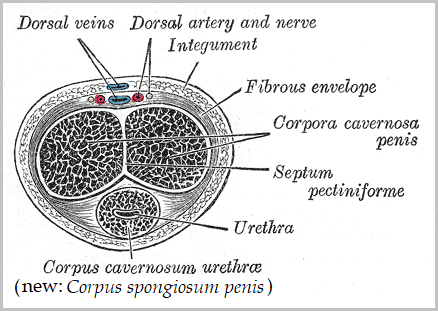
Anatomy and microscopic structure
Each corpus cavernosum contains networks of blood-filled spaces (cavernous sinusoids) supported by trabeculae of smooth muscle and fibrous connective tissue. A dense fibrous sheath, the tunica albuginea, surrounds the corpora and helps trap blood under pressure. Cavernous spaces are lined by endothelium and receive inflow through helicine and deep arteries.
Physiology
Erection results from increased arterial inflow and restricted venous outflow (veno-occlusive mechanism). Parasympathetic nerves trigger smooth muscle relaxation and vessel dilation, allowing the corpora to fill. Sympathetic activity or contraction of smooth muscle returns the tissue to a flaccid state.
Development and homology
Embryologically the corpora cavernosa arise from the genital tubercle and are homologous between sexes: the paired structures form the body of the clitoris in females and the dorsal erectile bodies of the penis in males.
Clinical considerations
- Erectile dysfunction: failure to achieve or maintain adequate rigidity.
- Peyronie’s disease: fibrous plaques of the tunica albuginea causing curvature.
- Priapism: prolonged, often painful erection requiring urgent care.
- Trauma and infections can damage tissue and affect function.
Understanding the corpora cavernosa is important for sexual medicine, urology, and reproductive health because their anatomy and vascular control underlie normal erectile function and many common disorders.
Related articles
Author
AlegsaOnline.com Corpora cavernosa: structure, function and clinical significance Leandro Alegsa
URL: https://en.alegsaonline.com/art/23205