
Convention on the Elimination of All Forms of Discrimination against Women (CEDAW)
UN treaty adopted in 1979 to secure women's rights and prohibit discrimination; establishes state obligations, a monitoring committee and an optional complaints mechanism.
The Convention on the Elimination of All Forms of Discrimination against Women (commonly called CEDAW) is a landmark international human rights treaty adopted by the United Nations General Assembly on 18 December 1979 and brought into force on 3 September 1981. It sets out a comprehensive framework for securing women’s equal rights and obliges states parties to eliminate discrimination against women in political, economic, social, cultural and civil life.
Image gallery
4 Images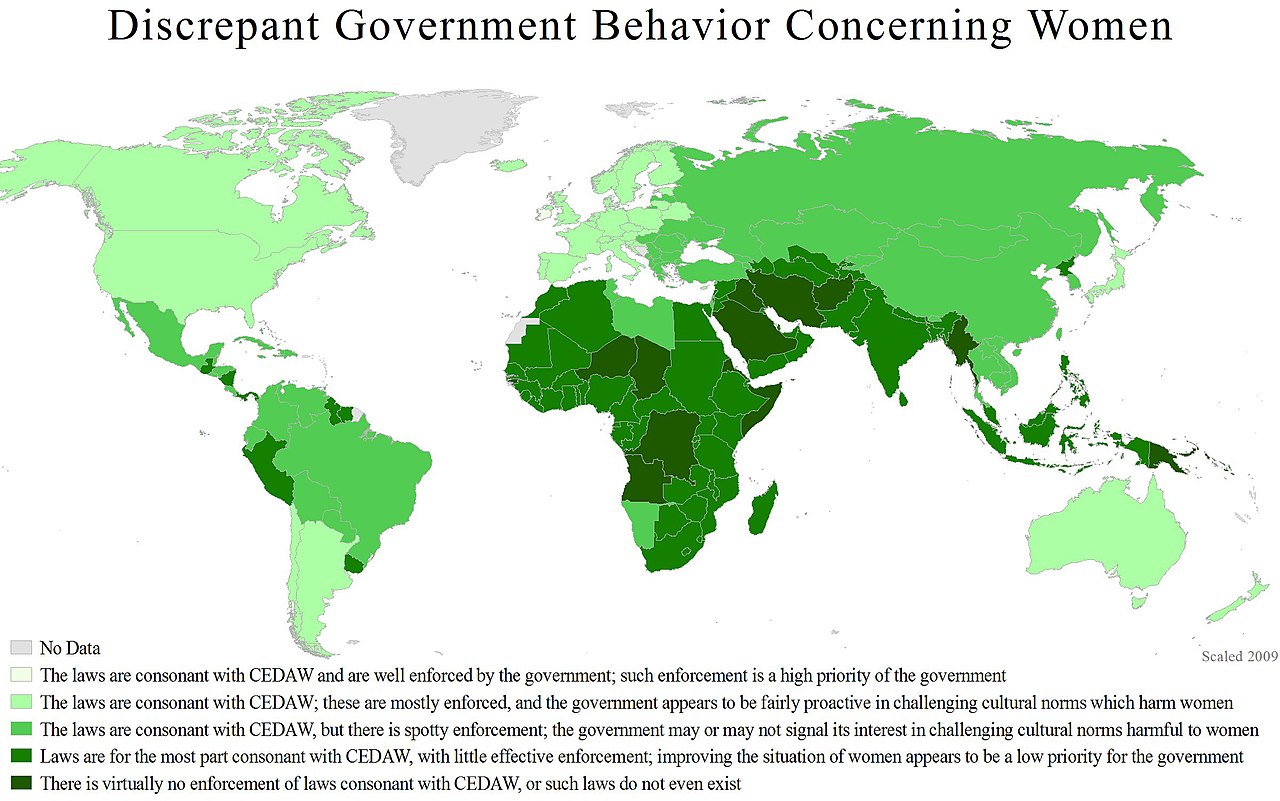


Main content and obligations
CEDAW defines discrimination against women broadly and requires states to take appropriate measures—legislative, judicial, administrative and other—to guarantee equal rights. Key areas addressed include access to education and employment, family and marriage law, health and reproductive rights, protection from violence and equal participation in public and political life. The treaty encourages both removal of discriminatory laws and positive steps to correct past inequalities.
Monitoring and enforcement
A expert body known as the CEDAW Committee monitors implementation. States parties submit periodic reports to the Committee detailing measures taken and progress achieved; the Committee issues concluding observations and recommendations. An Optional Protocol adopted later created a communications procedure and inquiry powers that allow individuals and groups to bring complaints and permit the Committee to investigate patterns of serious violations.
History, adoption and development
The Convention grew out of mid-20th century women’s rights activism and UN efforts to codify human rights. It became one of the core international human rights instruments addressing gender equality and has influenced regional agreements, national laws and international policy. Over time, the treaty’s interpretation has evolved through Committee recommendations and state practice to cover a wide range of structural and social barriers.
Ratification, reservations and notable states
Many United Nations Member States have become parties to CEDAW, committing to its standards. As of 2017 a large majority of countries had ratified the Convention. Some states have ratified with reservations limiting certain provisions; a few have not become parties. Examples often cited in discussions of non-ratification include Iran, Somalia, South Sudan, Tonga, the United States and the Vatican City. The treaty text and UN records provide official status information: see the United Nations sources on the Convention at treaty text and status and the adopting resolution at the UN General Assembly.
Importance, uses and limitations
- National law reform: CEDAW has been cited to support changes to family law, employment rules and anti-violence measures.
- Advocacy and litigation: NGOs and individuals use Committee decisions and concluding observations to press for policy change.
- Limitations: enforcement depends on state cooperation; reservations and uneven reporting can limit impact.
Overall, CEDAW remains a central international instrument for promoting gender equality. Its practical effects vary by country, but it provides a common legal language and monitoring process that civil society and governments use to advance women's rights.
Questions and answers
Q: What is the Convention on the Elimination of All Forms of Discrimination against Women?
A: The Convention on the Elimination of All Forms of Discrimination against Women is a convention and international human rights law adopted by United Nations General Assembly in 1979.
Q: What was the objective of the Convention on the Elimination of All Forms of Discrimination against Women?
A: The objective of the Convention on the Elimination of All Forms of Discrimination against Women was to prohibit all discrimination against women and ensure their human rights and freedom on a basis of equality with men.
Q: When did the Convention on the Elimination of All Forms of Discrimination against Women enter into force?
A: The Convention on the Elimination of All Forms of Discrimination against Women entered into force on 3 September 1981.
Q: How many countries have ratified the Convention on the Elimination of All Forms of Discrimination against Women?
A: As of 2017, 189 countries had ratified the Convention on the Elimination of All Forms of Discrimination against Women.
Q: Which countries had not ratified the Convention on the Elimination of All Forms of Discrimination against Women as of 2017?
A: Iran, Somalia, South Sudan, Tonga, the United States, and Vatican City had not ratified the Convention on the Elimination of All Forms of Discrimination against Women as of 2017.
Q: What does it mean for a country to ratify the Convention on the Elimination of All Forms of Discrimination against Women?
A: When a country ratifies the Convention on the Elimination of All Forms of Discrimination against Women, it has made a promise to realize the Convention and prohibit all discrimination against women while ensuring their human rights and freedom on a basis of equality with men.
Q: How important is the Convention on the Elimination of All Forms of Discrimination against Women for women's rights worldwide?
A: The Convention on the Elimination of All Forms of Discrimination against Women is a crucial international human rights law for women's rights worldwide, as it aims to eliminate all forms of discrimination against women and guarantee their human rights and freedom on a basis of equality with men, promoting gender equality and empowering women.
Related articles
Author
AlegsaOnline.com Convention on the Elimination of All Forms of Discrimination against Women (CEDAW) Leandro Alegsa
URL: https://en.alegsaonline.com/art/22825