
Commutative property
Mathematical property stating that order of operands does not affect result for certain operations, most commonly addition and multiplication; contrasts with noncommutative operations like subtraction.
Overview
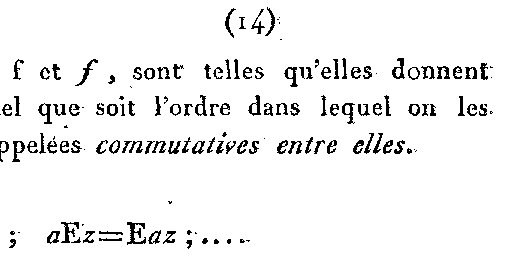
The commutative property is a basic algebraic principle that says the order of the operands can be exchanged without changing the outcome for certain binary operations. In elementary arithmetic it is most familiar for addition and multiplication: a + b = b + a and a × b = b × a. This simple symmetry underlies many manipulations in arithmetic and algebra.
Formal definition and notation
Formally, a binary operation * on a set S is commutative if for every x and y in S, x * y = y * x. When a set equipped with an operation is commutative it often simplifies reasoning: expressions can be reordered, like x + y + z = z + y + x. For products and finite sums, reordering does not change the value when the operation is commutative.
Concrete examples
Simple numeric examples illustrate the idea clearly: 2 + 8 and 8 + 2 both equal 10 . Likewise 5 × 7 and 7 × 5 both equal 35 . The property extends beyond two terms: (1 + 2) + 3 = 3 + (2 + 1), and similarly for multiplication . Visual or algebraic rearrangements exploit commutativity to simplify calculation and proofs .
Image gallery
2 Images
Properties and related laws
Commutativity often appears together with other familiar properties. Associativity lets one change grouping (for example, (a + b) + c = a + (b + c)), and distributivity connects multiplication and addition (a × (b + c) = a×b + a×c). When operations are both associative and commutative, expressions can be freely reordered and regrouped for simplification or computation.
History and formal context
The idea of swapping the order of numbers is ancient, used implicitly by mathematicians for centuries. In modern algebra the property was formalized alongside other axioms of number systems and rings. In abstract algebra, structures in which the group operation is commutative are called abelian groups (after the mathematician Niels Abel), and commutative rings and fields play central roles in algebraic theory.
Uses, examples and practical cautions
Commutativity is used for simplifying calculations, designing algorithms, and proving identities. In computing, commutative operations allow flexible scheduling and parallelization. However, be cautious: with floating-point arithmetic the order of operations can affect rounding and thus numeric results, so addition of real-valued approximations is not strictly commutative in practice. For infinite sums and series, reordering terms can change the sum unless convergence conditions (such as absolute convergence) hold.
Noncommutative operations and notable distinctions
- Common noncommutative operations: subtraction (a - b ≠ b - a), division, matrix multiplication, function composition, and certain products in physics (e.g., cross product).
- Many algebraic systems are noncommutative; recognizing whether an operation is commutative is essential for correct manipulation.
Understanding commutativity helps separate operations that enjoy symmetry from those that do not, guiding both elementary arithmetic and advanced algebraic reasoning.
Related articles
Author
AlegsaOnline.com Commutative property Leandro Alegsa
URL: https://en.alegsaonline.com/art/22185