
Drafting Compass (pair of compasses)
A drafting compass is a two‑legged instrument for drawing circles and arcs, measuring and transferring distances; used in geometry, technical drawing, surveying, navigation and map work.
Overview
A drafting compass, commonly called a pair of compasses, is a precision instrument used to draw concentric circles and arcs and to transfer or measure short distances. It is a familiar tool in technical drawing and education, and appears in fields ranging from Euclidean mathematics to architectural drafting and practical navigation. On maps and charts a compass can also be used as a simple measuring device for distances and for laying out proportional scales on maps.
Image gallery
10 Images
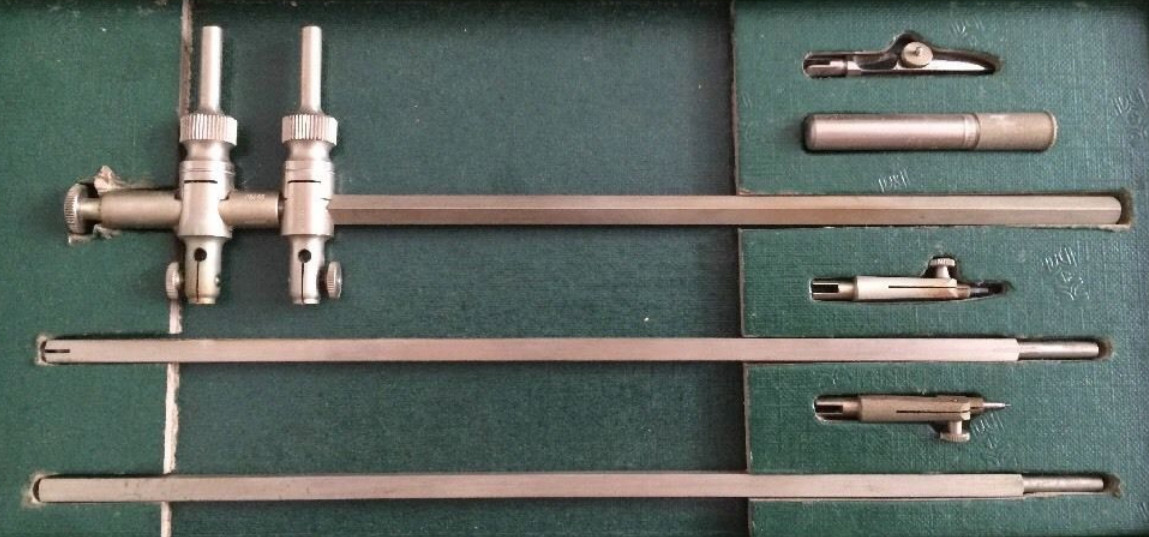


Main parts and characteristics
Typical compasses have two rigid legs joined by an adjustable hinge that controls the span. One leg usually ends in a fixed steel spike that anchors the instrument at the circle’s center; the other leg holds a mark-making point such as a pencil or an ink pen. Most modern instruments are made of metal for rigidity and fine adjustment, often stainless or another hardened metal, though compact and plastic variants exist for students.
Types and variants
There are several common forms. The classic school compass has a removable pencil lead; a mechanical compass accepts a small mechanical pencil refill for consistent line width. A divider replaces the marking tip with a second spike so both legs end in points; it is used to step off distances and to transfer measurements between scales. Specialized compasses may include extension bars for large radii, beam compasses for very large circles, or locking adjustments for repeated accuracy.
History and development
Instruments for drawing circles are ancient in concept, linked to early geometry and practical building. Over centuries the design evolved from simple rope-and-stick methods to metal two-legged compasses with calibrated adjustments. Their use is inseparable from classical geometry and the development of technical disciplines: from hand drafting in engineering to instrumented layout in surveying and early navigation techniques.
Uses and examples
Compasses serve multiple purposes: precise construction of circles and arcs for plans and diagrams; transferring distances measured on plans; dividing segments into equal parts; and laying out angles and tangents. In navigation and chart work a compass or divider will measure distances along a latitude line or between plotted points, helping plot courses. In classrooms they are a basic tool for exercises in Euclidean construction and for illustrating theorems about circles and angles.
Practical notes and distinctions
When selecting or using a compass, consider the material of the points, the stability of the hinge, ease of replacing leads, and whether an extension is needed for larger radii. A divider is distinct from a drawing compass because both ends are sharp and it is intended for measurement rather than marking. Care and periodic tightening keep a compass accurate: a loose hinge or a worn pencil chuck will produce inaccurate arcs. For more on the tool’s uses and technical variations see introductory guides and manufacturer notes on drawing techniques and on the role of drafting tools in professional practice. Other resources discuss drawing perfect circles, compass use in navigation, and measuring on maps with dividers and compasses.
Further reading and manufacturer specifications are available through educational and technical sources; beginners can practice making constructions with simple compasses before moving to precision instruments that include locking mechanisms and fine-adjust screws for repeated accuracy.
Anchor point • Lead • Ink tip • Materials
Questions and answers
Q: What is a compass?
A: A compass is a drawing tool that can draw circles or arcs, and can also be used to measure distances on maps.
Q: What are the two main purposes for which a compass is used?
A: A compass can be used for mathematics, drafting, navigation, and measuring distances on maps.
Q: What are the two parts of a compass, and what is their function?
A: The two parts of a compass are the legs and the hinge. The legs can be moved apart or together to change the size of the circle, and one part has a spike while the other has a pencil or pen.
Q: How many types of compasses are there?
A: There are two types of compasses: the mechanical compass and the normal compass.
Q: What is a divider?
A: A divider is a compass that has two parts with a spike, and is used to show measurements of distances and lengths.
Q: Why is it called a divider?
A: It is called a divider because it is used to divide a distance in two, using geometry.
Q: How do you make a compass work?
A: To make a compass work, you need to change how far the pencil sticks out.
Related articles
Author
AlegsaOnline.com Drafting Compass (pair of compasses) Leandro Alegsa
URL: https://en.alegsaonline.com/art/22223