
Communes of Guadeloupe (French overseas department)
Overview of the 32 communes that make up Guadeloupe: their role, geographic distribution across the archipelago, governance, historical changes (2007 detachments), and administrative cooperation.
Overview
Guadeloupe, an archipelagic overseas department of France, is subdivided into 32 communes, the basic municipal units of local government. Each commune functions like a municipality elsewhere in France: it is governed by a mayor and a municipal council and is responsible for everyday local administration, civil registration and basic public services. For a concise municipal listing see the official list of communes.

Image gallery
3 Images

Geography and examples
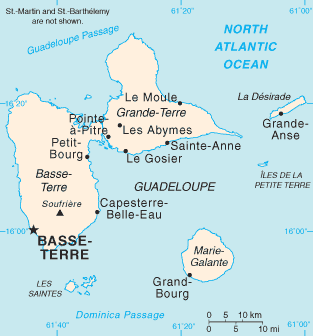
The communes are spread across the main islands of the Guadeloupe archipelago, including Basse-Terre and Grande-Terre as well as the outlying islands of Marie-Galante, La Désirade and the Îles des Saintes. Urban centres such as Pointe-à-Pitre and Basse-Terre mark economic and administrative hubs, while many smaller communes are rural and centred on villages or single settlements.
Organization and responsibilities
As in metropolitan France, communes in Guadeloupe manage local services such as primary schools, local roads, land use planning, waste collection and civil records (birth, marriage, death). They prepare budgets, levy local taxes within national rules, and provide a focal point for municipal elections. Communes often work together in intercommunal structures to deliver services that cross municipal boundaries.
History and notable changes
The municipal system in Guadeloupe follows the general French model developed after the Revolution and refined over two centuries. A prominent recent change occurred on 22 February 2007, when two territories that had previously been administered as part of Guadeloupe were separated and given distinct status as overseas collectivities. Those former communes are:
- Saint-Martin
- Saint-Barthélemy
Administration, cooperation and distinctions
Communes are identified in national statistics by INSEE codes and participate in regional administration through departmental and regional bodies. To manage larger-scale infrastructure and development, several communes form intercommunal public establishments (EPCI) that pool resources for transport, economic development and environmental protection. Although Guadeloupe is an overseas department, its communes have the same legal standing and many of the same responsibilities as communes in metropolitan France, adapted to local geographic and social conditions.
Importance and practical notes
Communes are the primary interface between residents and public administration: they issue official documents, organize local services and represent citizen interests. Their size and population vary widely, making municipal priorities different from one commune to another. For more information about Guadeloupe’s geography and governance, consult general resources on Guadeloupe and the institutions of France.

Questions and answers
Q: How many communes are there in the Guadeloupe department?
A: There are 32 communes in the Guadeloupe department.
Q: When were the former communes detached from Guadeloupe?
A: The former communes were detached from Guadeloupe on February 22, 2007.
Q: What is the Guadeloupe department?
A: The Guadeloupe department is an overseas department of France.
Q: What is a commune?
A: A commune is a small administrative unit in France.
Q: What happened to the former communes of Guadeloupe?
A: The former communes of Guadeloupe were detached from the department.
Q: What is the significance of February 22, 2007, in relation to Guadeloupe?
A: February 22, 2007, was the day when the former communes were detached from Guadeloupe.
Q: Is Guadeloupe independent or part of France?
A: Guadeloupe is part of France as an overseas department.
Related articles
Author
AlegsaOnline.com Communes of Guadeloupe (French overseas department) Leandro Alegsa
URL: https://en.alegsaonline.com/art/22094