
Common Sense (pamphlet)
Common Sense is a 1776 pamphlet by Thomas Paine that argued for American independence, attacked monarchy, and helped shift colonial public opinion toward the Declaration of Independence.
Overview
Common Sense is a short political pamphlet first published on January 10, 1776. Written by Thomas Paine, it presented a plainspoken case for the Thirteen Colonies to break with Great Britain and form an independent republic. Paine's work was deliberately accessible: he addressed everyday readers rather than learned elites, mixing moral, practical, and religious arguments to persuade colonists who had favored negotiation or reconciliation that independence was both necessary and inevitable.
Image gallery
4 Images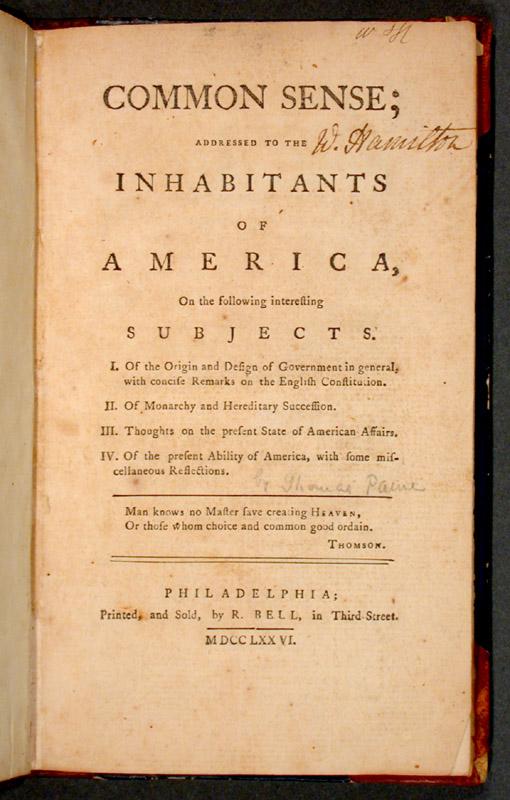



Main arguments and structure
Paine organized his pamphlet into clear sections that examined the nature of government, the faults of monarchy, and the practical benefits of independence. He argued that government exists to protect the rights and welfare of the people and that hereditary rule and distant crowns were inconsistent with liberty. One of his most memorable claims was that it was "against common sense" for a small island to govern a vast continent. The pamphlet included forceful critiques of European monarchies and an outline of how republican government might serve the colonies better.
- Practical critique of monarchy and hereditary succession
- Case for immediate independence rather than continued attempts at reconciliation
- Appeals to natural rights, scripture, and common experience
Style, audience, and publication
Paine wrote in direct, colloquial prose rather than the dense philosophical language common to some Enlightenment writing. He drew occasionally on Biblical language and familiar idioms to speak to Protestant readers of the colonies, which helped his arguments gain traction among a broad public. The pamphlet was printed and distributed in multiple editions and reprints; its wide circulation in 1776 made it one of the most influential political tracts of the Revolutionary period.
Historical context and influence
Common Sense appeared amid growing tensions between the colonies and Britain. Many colonists still hoped for a peaceful settlement, but Paine sought to change that calculation by making the case that continued ties to the crown were impractical and unjust. The pamphlet contributed to a shift in public opinion by articulating republican principles in plain terms and by encouraging active support for separation. Historians consider it a major factor that helped prepare popular opinion for the Declaration of Independence, adopted by the Second Continental Congress later in 1776.
Reception and legacy
Contemporary responses ranged from enthusiastic endorsement to sharp criticism. Many colonists welcomed Paine's arguments and saw the pamphlet as a clarifying voice; others—especially loyalists and some cautious moderates—rejected its calls for immediate rupture. Over time, Common Sense has been remembered as a formative document in the American Revolution and an early American statement in favor of republican government. It is studied for its rhetorical effectiveness, its use of popular argumentation, and its role in shaping revolutionary momentum during the American Revolutionary War.
Notable facts and distinctions
Although brief, the pamphlet married political theory with practical persuasion and religious illustration, a combination that broadened its reach. Paine, an English-born writer who had recently arrived in America, challenged the legitimacy of a distant monarchy and proposed a new political order. His pamphlet contrasted with more scholarly Enlightenment texts by prioritizing clarity and immediacy. Scholars also note how Paine's language used shared cultural references—many readers recognized his Biblical allusions—to bridge political argument and everyday belief systems.
For readers seeking primary texts and commentary, editions of the pamphlet and scholarly introductions are widely available; modern anthologies and digital collections include annotated texts and historical background. Further discussion of the pamphlet's content, publication history, and impact can be found in resources that examine early American political writing and revolutionary pamphleteering. For a concise reference, see a general description of the pamphlet and its format as a pamphlet, more on the author at Thomas Paine, and background on broader intellectual currents such as the Enlightenment Era. To understand Paine's appeals to religion, consult treatments of the Bible in colonial political rhetoric, and for the shifting colonial strategies toward conflict and conciliation, see discussions of efforts to peacefully resolve disputes and the arguments for independence that Paine promoted.
Related articles
Author
AlegsaOnline.com Common Sense (pamphlet) Leandro Alegsa
URL: https://en.alegsaonline.com/art/22018