
Coat of arms of Croatia
National emblem of Croatia: a red-and-white checkerboard shield (šahovnica) topped by five smaller shields representing historic regions; adopted in its current form in 1990.

The coat of arms of Croatia is the country's principal national emblem, combining a prominent chequered shield with a crown of five smaller escutcheons. The large central shield displays the distinctive red-and-white checkerboard pattern known in Croatian as šahovnica, literally "chessboard." In heraldic terms the pattern is described as chequy gules and argent and consists of 25 alternating squares (thirteen red and twelve white). The modern design was formalized by the Republic of Croatia and officially adopted on 21 December 1990.
Image gallery
6 Images


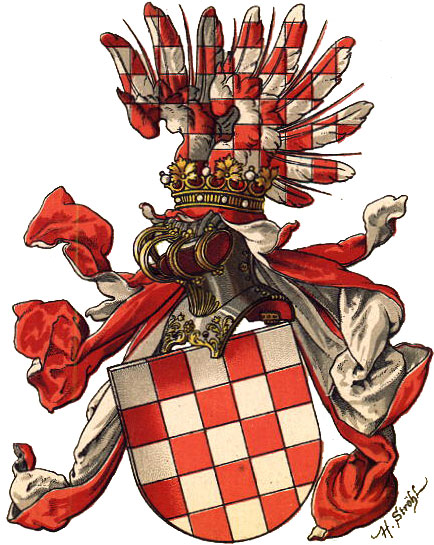

Characteristics and constituent shields
The overall composition pairs a bold, geometric main shield with a row of five smaller shields above it. Each small shield represents a historic or geographic region of Croatia and uses traditional heraldic charges and colours. The five escutcheons are typically described, from left to right, as follows:
- the oldest Croatian emblem (a golden six-pointed star over a silver crescent on a blue field),
- the arms associated with the Republic of Dubrovnik (Ragusa),
- Dalmatia (three crowned golden heads on a blue field),
- Istria (a golden boar's or goat's head depending on stylization), and
- Slavonia (a marten running between two horizontal white stripes on a blue field with a six-pointed star above).
History and development
The chequerboard pattern has deep roots in Croatian visual identity and appears in medieval seals, coins and flags associated with Croatian rulers and towns. Over centuries the šahovnica was incorporated into the arms of various states and local authorities, adapting in detail according to period and political context. The present arrangement—central chequy with five historic shields forming a crown—was codified during Croatia's re-establishment as an independent republic at the end of the 20th century.
Uses, symbolism and recognition
The coat of arms appears on the national flag, government buildings, official documents, military insignia and many civic contexts. Its elements are used to evoke continuity with historical Croatian communities and to express regional diversity within a unified national symbol. The šahovnica in particular is widely recognized inside and outside Croatia as an emblem of Croatian identity.
Notable facts and distinctions
There are a few recurring topics of discussion around the arms: the precise historical origins of the earliest patterns, the interpretation of some medieval charges, and occasional public debate over minor graphic details such as which colour occupies the upper-left square (the legally prescribed design places a red square in that position). For further reference on terminology and official description see the entry for the coat of arms of Croatia and the Croatian-language designation Grb Republike Hrvatske.
The combination of a simple, highly legible chequerboard with richly detailed regional escutcheons makes the Croatian coat of arms both immediately recognizable and laden with historical references. It remains an important national emblem used across ceremonial, administrative and popular contexts.
Related articles
Author
AlegsaOnline.com Coat of arms of Croatia Leandro Alegsa
URL: https://en.alegsaonline.com/art/21251