
Ciliates: structure, life cycles, and ecological roles
Ciliates are single-celled protists bearing numerous cilia. This article summarizes their morphology, nuclear dimorphism, feeding and reproductive strategies, ecological roles, notable genera, and research importance.
Overview
Ciliates are a diverse assemblage of single-celled eukaryotes classified among the larger group of protists. They are defined by the presence of motile hair-like organelles called cilia, arranged in species-specific patterns over the cell surface. Ciliates occur in freshwater and marine environments, in soils and sediments, and as symbionts or occasional parasites of animals. They range in size from a few micrometres to visible multi-millimetre forms and include free-swimming, crawling, sessile and colonial life forms.
Image gallery
6 Images


Structure and distinctive features
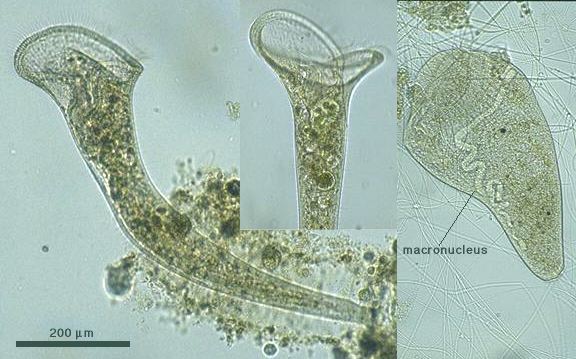
Aside from the external covering of cilia, ciliates show several internal specializations. Many have a firm but flexible pellicle beneath the cilia, contractile vacuoles that regulate water balance, and membrane-bound organelles such as mitochondria and extrusomes used in defense or prey capture. A hallmark of ciliates is nuclear dimorphism: cells possess a large macronucleus that controls everyday metabolic and developmental functions and one or more small micronuclei that serve as the germline nucleus for sexual processes.
Cilia types and functions
Cilia are built on the same basic axonemal structure as eukaryotic flagella but are usually shorter and more numerous. They may form simple rows, tight compound structures called membranelles and cirri, or dense ciliary fields around oral regions. Coordinated ciliary beating enables propulsion, creates feeding currents that direct particles into an oral groove, facilitates adhesion and crawling, and acts in mechanoreception and chemoreception.
Feeding and oral apparatus
Ciliates display diverse feeding modes. Many are heterotrophic predators of bacteria, algae and other protists, using an oral groove and cytostome to ingest particles. Filter-feeding and suspension-feeding forms generate water currents with cilia to collect food, while some groups, such as suctorians, lose motile cilia as adults and capture prey with specialised tentacles. Others harbour photosynthetic endosymbionts and combine autotrophy with heterotrophy.
Reproduction and life cycles
Ciliates typically reproduce asexually by binary fission, during which the macronucleus divides amitotically and the micronuclei undergo mitosis. They also undergo sexual exchange by conjugation, a process in which two cells pair and exchange haploid micronuclear derivatives after meiosis; this leads to nuclear reorganization and formation of a new macronucleus. Many ciliates can also form resting cysts to survive adverse conditions, and some perform autogamy, a self-fertilization process that achieves genetic reshuffling without a partner.
Ecology and importance
Ciliates occupy central roles in aquatic microbial food webs as grazers that transfer bacterial and algal production to larger consumers. They are important in nutrient cycling, control of bacterial populations, and as indicators of water quality in applied ecology. Some form beneficial symbioses in animal guts, while a few are pathogenic. Because of their cellular complexity and experimentally tractable genetics, certain ciliates (for example, Paramecium and Tetrahymena) are widely used as model organisms in cell and molecular biology research.
Notable groups and research
- Paramecium: a well-known free-swimming genus used in teaching and research.
- Tetrahymena: a model ciliate in molecular and genetic studies.
- Vorticella and Epistylis: stalked, sessile filter-feeders.
- Suctoria: tentacled predators with transient ciliation in juveniles.
- Stentor: large trumpet-shaped ciliates noted for regeneration.
Research on ciliates continues to illuminate how complex cellular structures and life cycles evolved in unicellular eukaryotes and how single cells partition somatic and germline functions. For accessible background reading, see introductions to protists and to the biology and mechanics of cilia.
Related articles
Author
AlegsaOnline.com Ciliates: structure, life cycles, and ecological roles Leandro Alegsa
URL: https://en.alegsaonline.com/art/20373