
Chicago metropolitan area (Chicagoland)
A major U.S. metropolitan region centered on the city of Chicago, spanning parts of Illinois, Indiana and Wisconsin; a transportation, economic and cultural hub of about 9.5 million people.
Overview
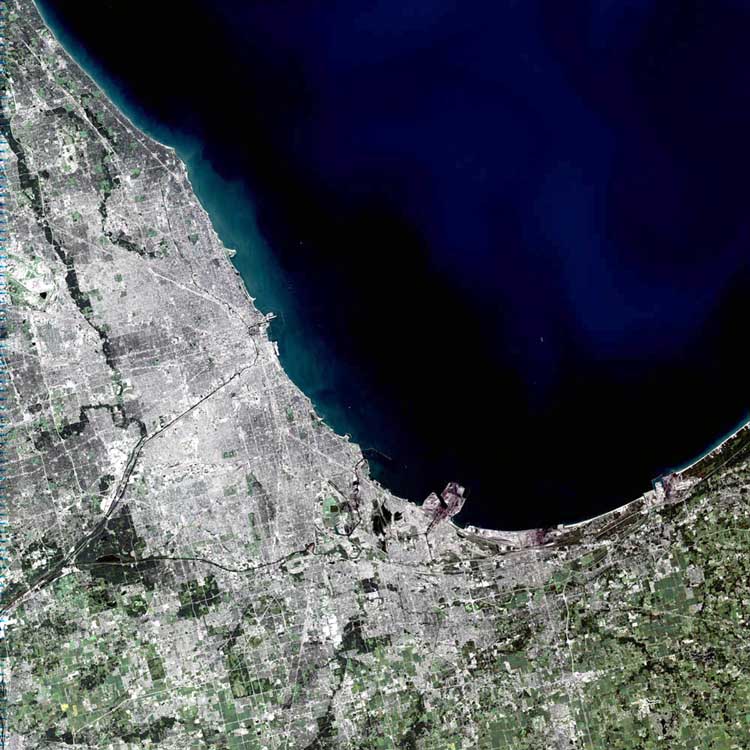
The Chicago metropolitan area, commonly called Chicagoland, is the extensive urban and suburban region built around the city of Chicago. It stretches across northeastern Illinois, reaches into northwest Indiana and includes a small portion of southeast Wisconsin. The contiguous metropolitan population is roughly 9.5 million people, while the larger combined statistical area approaches 9.9 million, making it the third‑largest metropolitan area in the United States (metropolitan rankings).
Image gallery
10 Images



Geography and communities
The region covers multiple counties around Lake Michigan and is defined by a mix of dense urban neighborhoods, older inner suburbs, newer residential developments and industrial corridors. Its boundaries are shaped by natural features such as the lakefront and rivers, and by transportation links that tie downtown Chicago to outlying communities. The metropolitan footprint includes dozens of distinct municipalities with varied local governments and identities, from high‑rise downtown districts to small suburban towns.
Economy and role
Chicago is one of the world’s largest metropolitan economies. The region hosts hundreds of major corporate headquarters and a strong concentration of finance, manufacturing, transportation, professional services, healthcare and higher education institutions. Its gross regional product is well over five hundred billion dollars annually, supported by a labor market of several million workers and a network of ports, airports and rail terminals that serve domestic and international trade.
Transportation and infrastructure
Transportation infrastructure is a defining feature. The area contains two major airports, a dense interstate highway network, extensive commuter rail and freight rail systems, and one of the nation’s busiest inland ports along the waterways. Local transit systems and regional rail connect suburbs to the central business districts, while highway and rail junctions reinforce the region’s long history as a national logistics hub.
History and culture
The metropolitan region grew rapidly in the 19th and early 20th centuries as a center for rail, shipping and industry; projects such as canals and rail terminals helped establish Chicago’s role as a crossroads of North America. The city and its suburbs have also produced notable cultural institutions—museums, theaters, universities and architectural movements—that draw visitors and students from around the world.
Notable facts and distinctions
- Chicagoland is a multi‑state metropolitan area with a large and diverse economy.
- It ranks among the top U.S. regions by population, corporate headquarters, and transportation capacity.
- The metropolitan area combines historic urban neighborhoods with expansive suburban and industrial zones, creating varied land uses and planning challenges.
For more detailed municipal, economic and demographic data, see regional planning documents and statistical profiles from metropolitan authorities and government agencies (metropolitan sources).
Tags
Related articles
Author
AlegsaOnline.com Chicago metropolitan area (Chicagoland) Leandro Alegsa
URL: https://en.alegsaonline.com/art/19513
Sources
- egsc.usgs.gov : "Elevations of the 50 Largest Cities"
- factfinder.census.gov : "Annual Estimates of the Resident Population: April 1, 2010 to July 1, 2014 - United States -- Combined Statistical Area; and for Puerto Rico 2014 Population Estimates"
- worldbusinesschicago.com : "Economy"