
Chennai district (Madras) — Overview, history, and features
Chennai district, formerly Madras district, is Tamil Nadu's smallest district by area and its most densely populated, covering the core of the Chennai metropolitan region and serving as the state's capital hub.
Overview
Chennai district, historically known as Madras district, contains the central urban area of Chennai, the capital city of the Indian state of Tamil Nadu. Although it is the smallest district in the state by land area, it has the highest population density in the region and functions as the principal administrative, commercial, cultural and educational center for the surrounding state and country India.
Image gallery
3 Images

Geography and administration
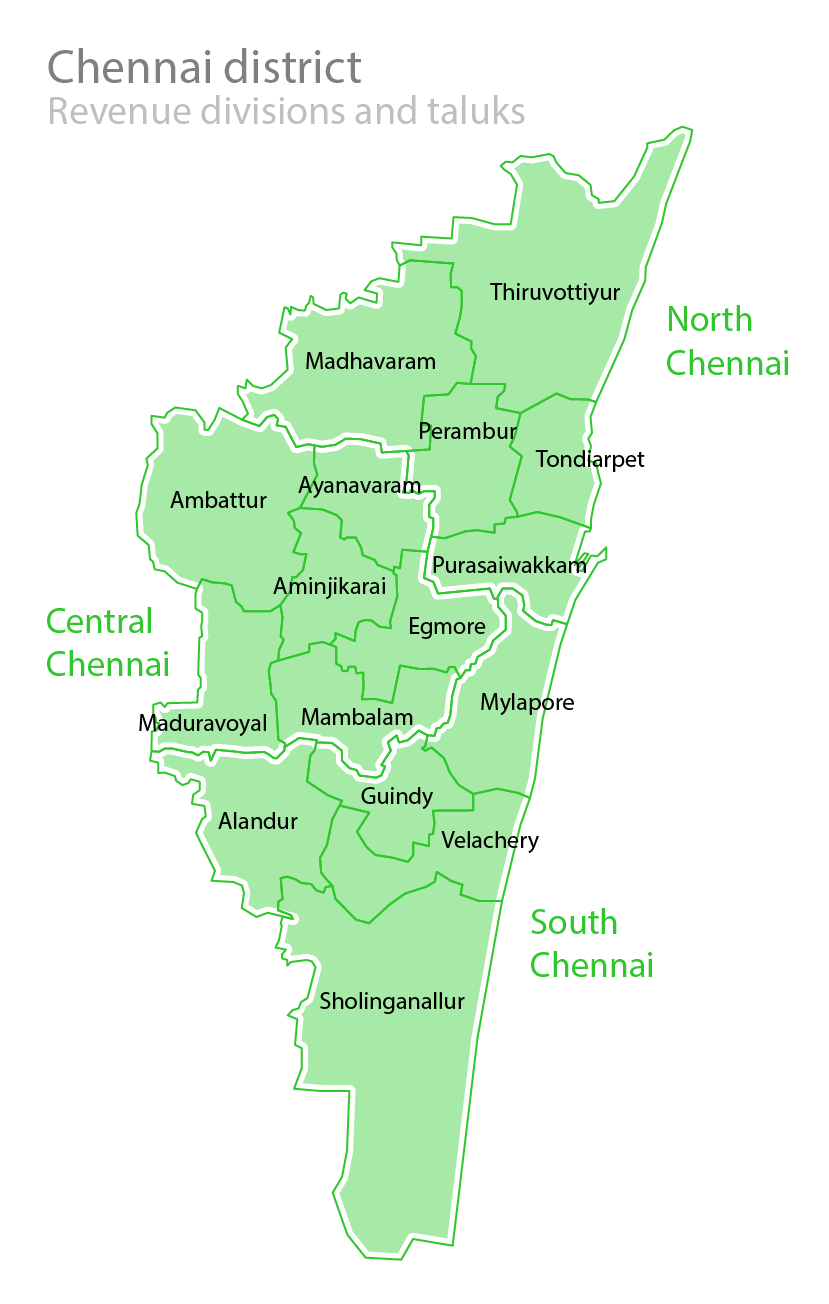
The district lies on the southeastern coast along the Bay of Bengal and is largely urbanized. Administrative responsibilities cover municipal governance, civic services and local law and order within a compact footprint. The district is subdivided into urban localities, wards and taluks that manage day-to-day services; much of the greater metropolitan area extends beyond the district boundaries, but the core city falls within it.
History and development
Chennai's modern identity grew from the colonial-era city of Madras, a major port and trading center during British rule. Over the 19th and 20th centuries the district developed as an administrative seat and an industrial and cultural hub. The city's name was officially changed from Madras to Chennai, and the district name follows that contemporary usage while retaining a continuous urban legacy stretching back several centuries.
Economy and infrastructure
The district hosts key transport and economic nodes, including an international airport, a seaport, major railway terminals and an extensive road network connecting suburbs and industrial zones. It supports diverse economic activities such as manufacturing, information technology, logistics, education and port-related trade. Many institutions, hospitals and universities that serve Tamil Nadu and the wider region are concentrated here.
Characteristics and notable facts
- Primarily urban: the district has very little rural area compared with most other districts in the state.
- High population density: it is one of the most densely populated districts in the country.
- Metropolitan core: a large portion of the Chennai Metro region lies within the district, although the metropolitan area also includes neighbouring districts and municipalities.
- Coastal location: proximity to the sea shapes local climate, economy, and exposure to coastal weather events.
As the seat of state government and a major urban agglomeration, Chennai district plays a central role in Tamil Nadu's public life, economy and infrastructure planning. Its compact area, dense population and concentration of services make it distinct from the larger, more rural districts that surround it.
Questions and answers
Q: What was Chennai district formerly known as?
A: Chennai district was formerly known as Madras district.
Q: How many districts are there in Tamil Nadu state?
A: There are 32 districts in the Tamil Nadu state.
Q: Is Chennai district the largest or smallest district in Tamil Nadu?
A: Chennai district is the smallest district in Tamil Nadu.
Q: Which region of Chennai comes under this district?
A: Most of the Chennai Metro region comes under this district.
Q: Does Chennai district have a high or low population density?
A: Chennai district has the highest population density in Tamil Nadu.
Q: Where is Chennai district located?
A: Chennai district is located in the state of Tamil Nadu in India.
Q: How is Chennai district related to Tamil Nadu state?
A: Chennai district is one of the 32 districts in the Tamil Nadu state of India.
Related articles
Author
AlegsaOnline.com Chennai district (Madras) — Overview, history, and features Leandro Alegsa
URL: https://en.alegsaonline.com/art/19235
Sources
- census2011.co.in : "Chennai District Population Census 2011-2019, Tamil Nadu literacy sex ratio and density"
- timesofindia.indiatimes.com : "Chennai now has 10 taluks, as govt gets close to you"
- cmdachennai.gov.in : cmdachennai.gov.in/pdfs/SeminarOnWaterways/5.pdf