
Catch Me If You Can (2002 film)
Steven Spielberg's 2002 biographical crime drama about Frank Abagnale Jr., a young con artist pursued by an earnest FBI agent. Stars Leonardo DiCaprio and Tom Hanks; blends drama, humor and period detail.
Catch Me If You Can is a 2002 American biographical crime drama film directed by Steven Spielberg and adapted from the memoir of Frank Abagnale Jr. Starring Leonardo DiCaprio and Tom Hanks, the film dramatizes the life of a young con artist who, in the 1960s, forges checks and adopts multiple identities to evade capture. The production is noted for its period recreation, central performances, and a score that underscores both the film's playful and suspenseful tones.
Image gallery
3 Images
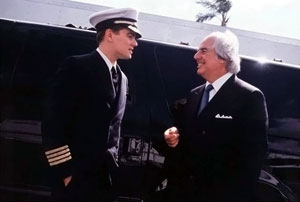

Plot summary
The narrative follows Frank Abagnale Jr., played by Leonardo DiCaprio, who begins his life of deception as a teenager after his parents’ marriage breaks down. To escape family turmoil and financial insecurity, Frank forges payroll checks and impersonates professionals, including an airline pilot, a physician and a lawyer. Tom Hanks portrays Carl Hanratty, a persistent FBI agent whose investigations form the counterpoint to Frank's schemes. Much of the story is a cat-and-mouse pursuit across states and countries, showing both daring escapes and quieter moments that reveal Frank's loneliness, desire for approval and complicated relationship with identity.
Cast and principal crew
The film centers on the performances of Leonardo DiCaprio and Tom Hanks, supported by a cast of character actors in key supporting roles. Steven Spielberg directed from a screenplay by Jeff Nathanson. The film's visual and aural design—costumes, production design, and John Williams's score—was deliberately tuned to evoke the early 1960s and to balance a tone that mixes comedy with drama.
Production and filmmaking
Production sought authenticity in period detail while keeping the pacing brisk to reflect the episodic nature of Frank's scams. Locations and set design recreated airport terminals, hotels and offices of the era. The director and cinematographer used framing and editing to emphasize both the glamour Frank adopts and the underlying vulnerability of his character. John Williams contributed a score that supports both lighter sequences and more suspenseful investigative scenes.
Themes and historical accuracy
The film examines themes of deception, performance, family breakdown and the search for belonging. Frank's ability to assume identities is presented both as a skill and as a symptom of emotional displacement. As an adaptation of a personal memoir, the movie condenses and dramatizes events; some elements of the source material have been debated or clarified over time. Viewers should treat the film as a dramatized interpretation rather than a literal documentary account.
Reception, awards and box office
Upon release the film was widely praised for its entertainment value, strong central performances, and production design. Critics highlighted the chemistry between the lead actors and the film's tonal balance. It reached a broad international audience and received several nominations and awards recognitions in categories such as acting, music and production design. The movie also contributed to renewed public interest in the real-life figure at its center.
Legacy and cultural influence
Catch Me If You Can has become a frequently cited cinematic portrait of confidence schemes and identity fraud. It is often screened in discussions of con artists in popular culture and is used as a case study in classes that consider ethics, criminology or fraud prevention. The film also reinforced the public profile of its principal cast and director, and it brought wider attention to debates about adapting personal memoirs for dramatic effect.
Aftermath and the real Frank Abagnale
Frank Abagnale, whose memoir inspired the film, later worked in the fields of fraud prevention and security consulting, providing expertise to financial institutions and government agencies. The film portrays a negotiated relationship between Abagnale and the investigator who pursued him, and it concludes with the suggestion that the protagonist's skills were eventually redirected toward legitimate uses.
Further reading and resources
For additional context, production notes and interviews, consult contemporary reviews and archival material. The links below point to official and archival resources, cast and crew interviews, the source memoir, and critical analyses:
- Official studio page
- Director and production notes
- Leonardo DiCaprio: role overview
- Tom Hanks: role overview
- Steven Spielberg: director's notes
- Behind-the-scenes features
- Source memoir by Frank Abagnale Jr.
- Interviews with the real Frank Abagnale
- Critical essays and analysis
- Archival reviews and reception
The film remains a notable example of mainstream cinema that blends a true-life premise with genre elements, producing a work that is both entertaining and provocative about questions of truth, performance and consequence.
Tags
Related articles
Author
AlegsaOnline.com Catch Me If You Can (2002 film) Leandro Alegsa
URL: https://en.alegsaonline.com/art/17598
Sources
- bbfc.co.uk : "Catch Me If You Can"