
Carrom: indoor tabletop game — equipment, play, history and variations
Carrom is a finger-flick tabletop game from the Indian subcontinent. Players pocket small discs with a striker on a wooden board. The game has casual and competitive forms governed by international rules.

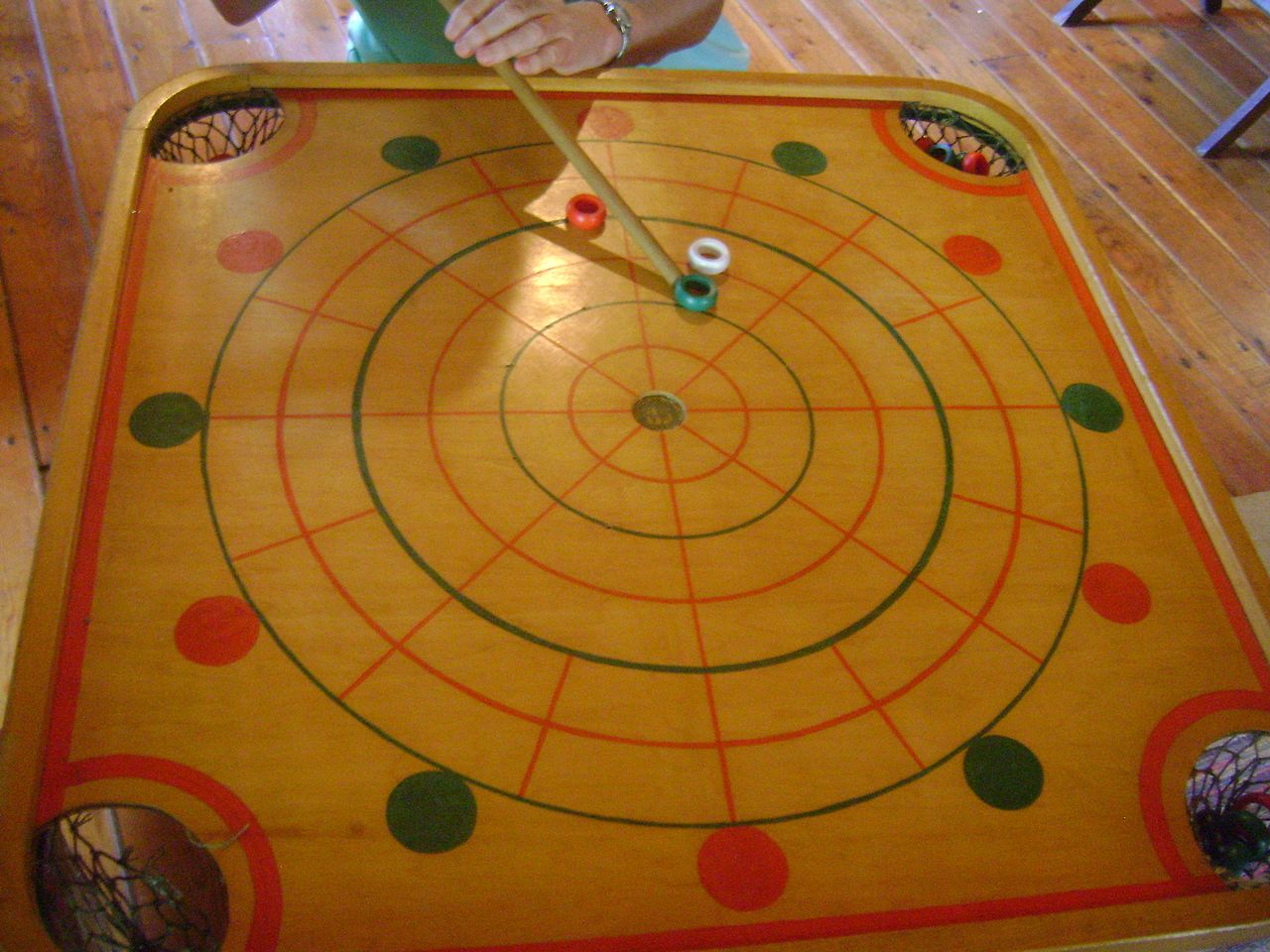
Carrom is a tabletop cueless game in which players use a flicking motion of the finger to propel a heavy disc called a striker and pocket small discs known as carrom men. Played on a smooth, square wooden board with four corner pockets, carrom combines elements of accuracy, strategy and touch. It is popular in South Asia and among diaspora communities worldwide and exists in both informal social settings and formal competition under standardized rules.
Image gallery
10 Images




Overview and objective
The typical carrom game is played by two individuals or two teams of two. The set includes a striker and a number of lighter pieces in two contrasting colours plus a specially marked piece usually called the queen. Players take turns flicking the striker with one finger from within a designated baseline to hit their coloured pieces and send them into the board pockets. The main objective is to pocket all of one side's pieces and safely cover the queen according to the rules of the chosen variation.
Equipment and board layout
- Board: A square wooden board with four corner pockets, polished playing surface and border lines that mark the baselines and the central circle.
- Carrom men: Two sets of small disks in contrasting colours (commonly nine light and nine dark) and one red queen.
- Striker: A heavier, larger disk used to hit the carrom men.
- Accessories: Fine powder (to reduce friction), a board cover or frame, and sometimes measuring tools for competitive play.
Basic play and rules
A turn consists of placing the striker on the baseline and flicking it with a finger to strike one or more carrom men. Pocketed pieces belong to the player who legally pockets them. If a player pockets the queen, additional requirements usually apply: the queen must be covered by pocketing one of the player's own pieces in a subsequent strike, or it is returned to the board. Fouls and penalties—such as pocketing the striker or failing to hit a legal piece—are handled according to local or tournament rules. Competitive play follows a codified set of regulations that define fouls, scoring, match formats and equipment standards.
History and development
Carrom originated on the Indian subcontinent and has long been played in homes and clubs across South Asia. Its precise origins are not fully documented, but the game evolved over decades from informal parlour pastimes into organized competition. During the 20th century, regional rule sets were harmonized and international bodies were formed to promote standardized play, officiating and tournaments. Today the game is recognized both as a recreational pastime and as a sport with national and international events.
Variations, culture and competitive scene
There are many local and regional variations of carrom, differing in scoring systems, the number of pieces, win conditions and allowable shots. A cue-based variant exists where small cues are used instead of finger flicks, though the finger-flick style is most common. The game remains culturally important in many communities as a social activity at homes, cafés and community centres. Organized competitions take place from local club events to international championships; governing bodies and federations publish standardized rules and promote tournaments.
Notable distinctions and practical tips
- The queen has higher strategic value and often changes the tactical approach of a match.
- Good surface maintenance and the right powdering technique greatly affect play quality and shot consistency.
- Carrom rewards precise touch and defensive positioning as much as offensive pocketing.
For further reading on regional names and cultural context see regional names and traditions, and for information about the game's origins and early standardization consult origins and development.
Related articles
Author
AlegsaOnline.com Carrom: indoor tabletop game — equipment, play, history and variations Leandro Alegsa
URL: https://en.alegsaonline.com/art/17285