
Carolee Schneemann: Experimental Artist of the Body and Performance
Profile of Carolee Schneemann, an American experimental artist known for pioneering body-based performance, multimedia work on sexuality and gender, major works and exhibitions, and her legacy.

Carolee Schneemann (October 12, 1939 – March 6, 2019) was an American visual and performance artist whose work challenged conventional boundaries between painting, film, sculpture and live action. She became widely known for art that foregrounded the human body as subject and medium, and that deliberately addressed topics of sexuality and gender. Schneemann's practice emerged from and contributed to postwar experimental art, feminist critique, and the rise of performance as a recognized art form.
Image gallery
3 Images

Work and themes
Schneemann explored how individual bodies relate to larger social and cultural systems. Her interdisciplinary pieces often combined movement, verbal narration, film projection and sculptural elements to investigate sensation, desire, and taboo. She used the live body to contest representational traditions that she considered reductive, and she reclaimed erotic imagery for autonomous expression rather than objectification. Her art frequently engaged with historical visual languages while exposing the limits and biases of those traditions.
Notable works and methods
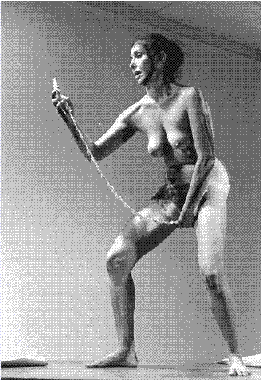
Schneemann produced performance events, films, assemblages and installations. Some of her best-known pieces include Meat Joy, an exuberant 1964 performance that mixed playful carnality and theatricality; and Interior Scroll, a 1975 work in which she read from a scroll extracted from her body as a provocative statement about voice, authorship, and censorship. Her filmic works combined experimental techniques with bodily presence, and she often invited audience interaction, destabilizing the passive viewer role.
- Meat Joy (1964) — a ritualistic, collaborative performance mixing food, fabric and movement.
- Interior Scroll (1975) — a controversial performance addressing language and the female body.
- Film and multimedia — series of shorts and projections that overlapped painting, drawing and live action.
Career, exhibitions and reception
Schneemann studied art at institutions including Bard College, where she earned a B.A., and later received an M.F.A. from the University of Illinois. Her work was exhibited in major museums and international venues, and it provoked strong critical debate about propriety, representation and artistic freedom. She showed at institutions such as the Los Angeles Museum of Contemporary Art and the Museum of Modern Art in New York, and her films were screened at film festivals and national institutions like the London National Film Theatre.
Life, death and legacy
Born in Philadelphia, Schneemann lived and worked for many years in New York State and became an influential teacher and writer as well as an artist. Her work opened pathways for subsequent generations of performance and feminist artists by insisting that the body be considered as a valid site of knowledge and artistic investigation. Schneemann died on March 6, 2019 at her home in New Paltz, New York, after a struggle with breast cancer. Scholars and curators continue to study her contributions to experimental art and to debates about representation and taboos.
Selected exhibitions and retrospectives, archival releases, and writings by Schneemann help preserve a complex legacy: one that merges provocation and craft, public spectacle and intimate inquiry. Her papers and recorded performances offer resources for those studying the intersections of gender, corporeality, and visual form. For further background on her ideas and texts, see institutional catalogues and artist monographs, including materials held at academic programs and museum archives referenced by peer institutions such as Bard College.
Related articles
Author
AlegsaOnline.com Carolee Schneemann: Experimental Artist of the Body and Performance Leandro Alegsa
URL: https://en.alegsaonline.com/art/17183
Sources
- anothermag.com : "Carolee Schneeman on Feminism, Activism and Ageing"
- washingtonpost.com : Carolee Schneemann, Artist Known for Taboo Breaking Performances, Dues at 79